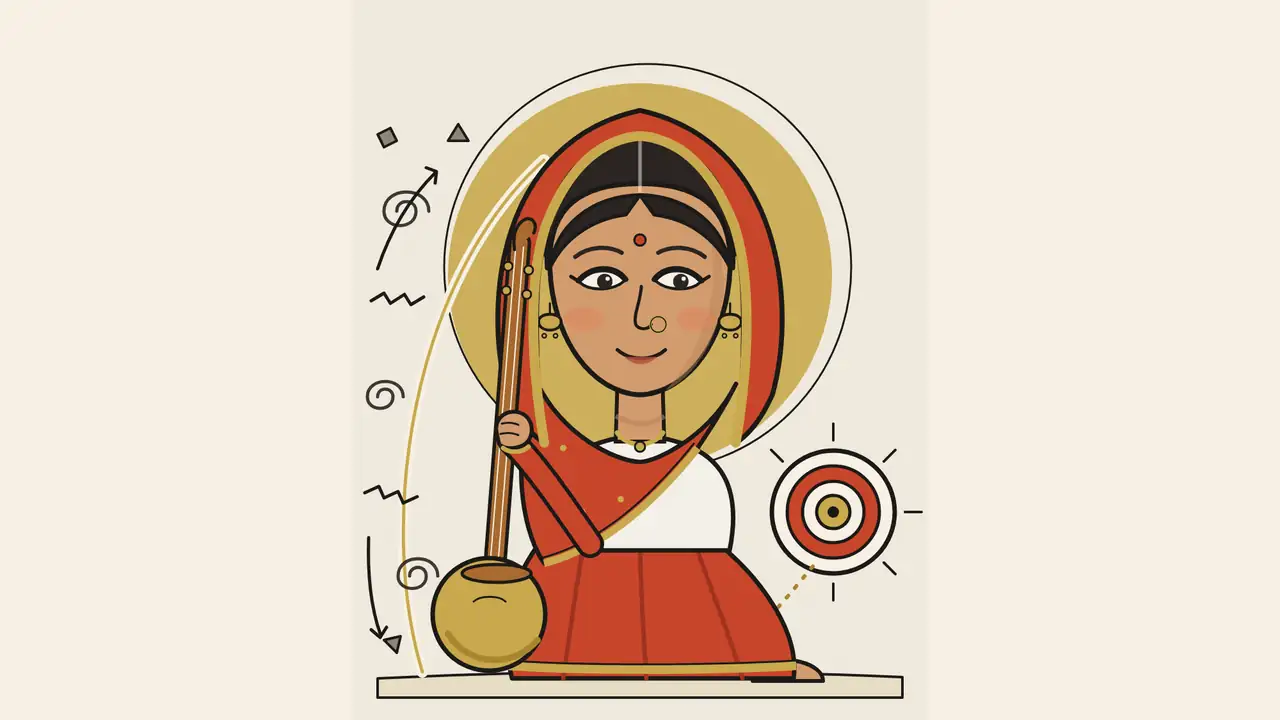
Original illustration drawn for WCRC. © Abhimanyu Ghosh & WCRC.
Spirituality · The Bhakti Saints · No. 09 of 27
Mirabai's one refuge, and the discipline of saying no without bitterness
A 16th-century Rajput princess sang that she had one beloved and no other, and kept to it through years of pressure. WCRC's Single-Refuge Focus Model asks leaders to name the one commitment their organisation will not divide.
WCRC Consulting · Strategy into execution
Implement these strategies inside your organisation
Deep analysis of where your organisation stands and a strategic implementation of The WCRC Single-Refuge Focus Model, built for your leadership team, culture and business.
Models created exclusively by Abhimanyu Ghosh; proprietary to Abhimanyu Ghosh and WCRC. WCRC's consulting service is not connected with, or endorsed by, any teacher, tradition or organisation discussed here.
Dates
c. 1498 – c. 1547
Region
Merta and Chittorgarh, Rajasthan; Dwarka, Gujarat
Tradition
Women Saints
WCRC model
WCRC-GLC-09
The model in one line
One refuge, held with courage and without hatred.
The WCRC Single-Refuge Focus Model™ · anchored in मेरे तो गिरधर गोपाल, दूसरो न कोई (Mine is Giridhar Gopal, and no one else)
A princess of Merta and the line she would not soften
Mirabai is remembered for a single line, the opening of a pada cited by Hinduism Today: mere to Giridhar Gopal, dusro na koi. Mine is Giridhar Gopal, and no one else. Almost everything else about her life is uncertain, and much of it comes from devotional biographies written after her death. The line, and the life arranged around it, are the reason she belongs in this series.
Tradition places her birth around 1498 at Merta or Kudaki in Rajasthan, the only child of Ratan Singh of the Merta Rathore house. As a child, tradition says, she adopted an image of Krishna as Giridhar Gopal as her beloved for life. In 1516 she married Bhoj Raj, crown prince of Mewar and son of Rana Sangram Singh, known as Rana Sanga. He died around 1521, probably of battle wounds, and later accounts say she declined to commit sati.
Tradition holds that the years that followed brought pressure and hostility at the Mewar court, and songs attributed to her allude to attempts on her life. She spent her days in her private temple, singing and receiving sadhus and pilgrims. In the later 1530s she left Mewar for Merta and then went on pilgrimage; tradition places her in Vrindavan for some years and then in Dwarka, where she settled. Around 1546, envoys came from Mewar to bring her back. Tradition holds that after a night at the Ranchhodji temple she was never seen again. Her death is dated 1546, 1547 or around 1557, depending on the source.
Her guru is disputed. Some traditions, and some padas, name Sant Ravidas; other tellings give her no human guru at all. She left no formal disciples. Her padas, in a Rajasthani-Braj idiom and also sung in Gujarati, were carried by singers in Vaishnava and Sant communities. Hundreds of songs, by some counts over a thousand, are attributed to her, and scholars think only a small portion are her own.
Dusro na koi: the undivided heart
Mine is Giridhar Gopal, and no one else.
Mirabai, pada "मेरे तो गिरधर गोपाल" (16th c.); English rendering prepared for this series
The teaching in that line is about division. Devotion, for Mirabai, meant refusing to split the heart. She did not argue that other loves were wicked. She declared one, and let everything else take its place relative to it.
Britannica describes love as the whole of her path. God is approached as the Beloved, and total, personal love is enough; no ritual credentials are needed. That conviction shapes the second part of her teaching. She held to her path against the pressure of family, caste and society, and, as Britannica notes, without hatred for those who persecuted her.
Her language matters as much as her conviction. She sang in homely images, the dancer's anklets, the jewel, the bazaar, so that ordinary people could feel God close at hand. A princess speaking in the images of the street was making a choice, and it brought God within reach of people who would never enter a court.
The last element is company. Mirabai's daily practice was singing God's name among sadhus, in satsang and kirtan. Her single refuge was never a solitary stubbornness. It was held in the company of others who shared it, and that company gave it daily form.
Years of song in a private temple
The defining period of Mirabai's life is a long one. After she was widowed, around 1521, tradition holds that she faced sustained pressure at the Mewar court to give up her devotion, and the songs attributed to her allude to attempts on her life. Devotees recount legends from these years: a cup of poison sent as a temple offering, which she drank with Krishna's name and which did her no harm; a basket of flowers that hid a cobra, which turned into an image of Krishna in her hands. These are devotional stories and should be read as such. Britannica notes that her poems allude to such attempts.
What the tradition records, more quietly, is how she spent those years. She kept to her private temple, singing, and received sadhus and pilgrims. The songs carry no hatred for the people who opposed her. Any judgement about the Mewar court belongs to historians; the leadership point lies in her conduct, which joined firmness and civility under strain.
When she left, in the later 1530s, she took the same single devotion to Merta, on pilgrimage and finally to Dwarka. Changing her circumstances did not change her centre. Devotees recount that when Mewar's envoys came to take her back, she asked for one night at the temple and was found gone, with only a piece of her sari left on the image.
Leaders under pressure from a powerful board member, a dominant customer or a vocal investor will recognise the shape of this test, though very few will face anything like its weight. The question Mirabai answered for herself is the one they must answer for their organisations: what is the one thing that will not be traded, and can it be held without turning the people who push against it into enemies?
A thousand pilots and one refuge
Artificial intelligence has handed leadership teams an abundance problem. McKinsey's State of AI survey, 2026 edition, found that nearly nine in ten respondents report regular use of AI in at least one business function, yet only 6 percent qualify as high performers. Microsoft's 2026 Work Trend Index found that only one in four AI users surveyed, 26%, say their leadership is clearly and consistently aligned on AI.
Read together, the figures describe organisations with more options than attention. Every function can now run a pilot, every vendor has an agent to sell, and every quarter brings a capability that did not exist the quarter before. When the options are effectively unlimited, the scarce resource is focus, and focus is a decision that only leadership can make.
Mirabai's line supplies the test. A company that has named its one refuge can ask of each AI proposal whether it serves that commitment, and decline the ones that do not, however attractive. A company that has not named one will fund whatever is loudest. Users who do not see their leadership aligned are, in effect, watching a leadership team with a divided heart.
Her conduct supplies the manner. Refusing an AI initiative, a vendor or a fashionable programme does not require disparaging it. The people who proposed it should hear the reason plainly and keep their standing. That is how refusals build trust instead of resentment.
The WCRC Single-Refuge Focus Model
Created by Abhimanyu Ghosh · A proprietary model of Abhimanyu Ghosh and WCRC
WCRC calls this the Single-Refuge Focus Model. Its anchor is Mirabai's line, Mine is Giridhar Gopal, and no one else, and the courage with which she held it. The model asks a leader to name the one commitment the organisation will not divide, and to protect it by saying no to whatever competes with it. The commitment is held with quiet courage under pressure, without turning opponents into enemies, and it is expressed in the everyday words people actually use. The concentric rings in the diagram place the refuge at the centre, with daily practice, trusted company, pressure and opinion, and distractions moving outward; everything outside the centre is tested against it.
The Single-Refuge Focus Model asks a leader to name the one commitment the organisation will not divide, and to protect it by saying no to what competes with it. The commitment is held with quiet courage under pressure, without turning opponents into enemies, and is expressed in the everyday words people actually use.
Fig. 1The WCRC Single-Refuge Focus Model™
© Abhimanyu Ghosh & WCRC
The building blocks
01Name the one refuge
Choose the single non-negotiable purpose that decides everything else, stated in one sentence anyone can repeat.
In practiceThe CEO writes the company's one non-negotiable commitment and tests every major decision against it.
02Say no to the restDusro na koi
An undivided focus needs visible refusals; what is declined shows what the refuge really is.
In practiceFor each new initiative approved, the leadership team retires or declines one that does not serve the refuge.
03Courage under pressure
Hold the commitment when powerful people push for a detour, quietly and without drama.
In practiceWhen a board member, major customer or investor presses for a detour, the CEO explains the refusal openly and in person.
04No hatred for opponents
Answer opposition without bitterness, so the door stays open and the commitment stays clean.
In practiceThe leader speaks of critics with respect in public and keeps working relationships with them.
05Everyday language
Say the purpose in homely words and images so people feel it close to their own work.
In practiceThe purpose is explained to frontline teams with no jargon, using images from their daily tasks.
What a chief executive must decline
The model's first demand on a CEO is a sentence. Write the company's single non-negotiable commitment so that anyone in the organisation could repeat it, then test the next major decision against it and note which way it pointed. Many leadership teams will discover at this point that they hold three or four commitments of roughly equal weight. That is the condition Mirabai's line rules out.
The second demand is visible refusal. The building block called dusro na koi, no one else, holds that what a company declines shows what its refuge really is. A practical discipline follows: for each new initiative approved, retire or decline one that does not serve the refuge, and announce the refusals as clearly as the approvals. A leadership team that only ever adds has not yet chosen.
The third demand is courage in person. When a board member, a major customer or an investor presses for a detour, the CEO explains the refusal openly and face to face, with respect. Mirabai received the sadhus and pilgrims who came to her and kept singing. She did not hide.
Two blind spots need watching. The first is defiance dressed as courage: a CEO who ignores legitimate governance or honest advice in the name of focus has misread the model. The second is subtler. The refuge can quietly become the CEO's personal preference presented as company purpose. The model's own safeguard is to test the refuge sentence with the board or co-founders before relying on it, and to revisit it every year.
Founders and the customer who wants something else
A young company's refuge is tested most often by its best customers. The large client who will sign if the product adds one feature, the investor who suggests a second market, the partner who wants a custom version: each request is reasonable, and each one divides the company a little further. A startup can be pulled apart by a series of sensible yeses.
If you are a founder, write the refuge in one line before the next such conversation, and let co-founders and early investors challenge it. Their question is whether this is the company's purpose or simply your taste. If it survives that challenge, use it openly when you decline. A customer told plainly that the company is built to do one thing well, and why, may respect the answer more than a reluctant yes.
The model's starts-and-stops rule is especially useful at this stage, because a small team's attention is its entire capital. Every new project begun is a project starved somewhere else. Pairing each start with a stop makes that trade visible instead of leaving it to accumulate silently.
Mirabai's everyday language applies too. A founder's refuge sentence should make sense to the newest engineer and the first sales hire without translation. If it needs a slide to explain it, it is still a draft.
Boards as keepers of the refuge
In a large company the refuge belongs to the board. Divisions, regions and functions will each have priorities of their own, and without a single commitment held at the top, capital drifts towards whichever unit argues best. The model asks the board to own the refuge, to attach the refuge test to capital requests and board papers, and to revisit the commitment once a year against evidence from outside the company.
Research supports the idea that clarity at the top pays. Gartenberg, Prat and Serafeim, writing in Organization Science in 2019, found from employee survey data that firms whose employees perceive both a strong sense of purpose and high clarity from management showed higher subsequent financial performance. The finding pairs purpose with clarity. People have to see the purpose clearly in what management does, which in practice means seeing where resources go and what is refused.
Boards also carry the burden of the model's first failure mode, rigidity. Mirabai's devotion did not change, but her circumstances did, and she moved from Mewar to Merta, to pilgrimage and to Dwarka. A company's refuge should be as stable as a commitment of the heart, and its strategy around that refuge should be free to move. The annual board review exists to tell the two apart.
Finally, large companies have critics: activists, regulators, rival firms, sceptical analysts. The model asks leaders to answer them without hostility, to speak of them with respect in public and to keep working relationships open. Firm conviction and civility can sit together, and a board that insists on both protects the company's reputation as much as its focus.
The business model
Inside a company, the Single-Refuge Focus Model runs as a discipline of concentration. Its inputs are one clearly named, non-negotiable purpose, leaders willing to refuse attractive options and a plain-language statement of that purpose. Four practices follow: every major decision is tested against the refuge, one initiative is retired for each new one, refusals are explained openly to stakeholders, and critics are answered without hostility. The operating model below shows how those practices produce a short, focused portfolio, consistent decisions across units and fewer abandoned initiatives, and how they lead over time to a distinctive market position and steadiness under outside pressure.
Fig. 2Operating model: running the WCRC Single-Refuge Focus Model
© Abhimanyu Ghosh & WCRC
Inputs
What the company commits
- One clearly named non-negotiable purpose
- Leaders willing to refuse attractive options
- A plain-language statement of purpose
Practices
What leaders do, repeatedly
- Test major decisions against the refuge
- Retire one initiative for each new one
- Explain refusals openly to stakeholders
- Answer critics without hostility
Outputs
What changes in the work
- A short, focused portfolio
- Consistent decisions across units
- Fewer abandoned initiatives
Outcomes
What the enterprise gains
- A distinctive market position
- Steadiness under outside pressure
- Respect even from those who disagree
The benefit model
Focus helps more people than the leader who chooses it. The leader gains a simple test for hard choices and the steadiness of knowing what will not be traded. Employees are no longer pulled between competing priorities and can see why some work stops while other work continues. Customers deal with a company that is clearly good at one thing, investors see capital placed in a focused set of bets with refusals explained in advance, and society sees that conviction and civility can coexist. The benefit model below sets this out group by group.
Fig. 3Benefit model: who gains what
© Abhimanyu Ghosh & WCRC
The leader
The leader gains a simple test for hard choices and the steadiness that comes from knowing what will not be traded.
Employees
Staff stop being pulled between competing priorities and can see why some work stops and other work continues.
Customers
Customers get a company that is clearly good at one thing and does not drift with each new trend.
Investors
Capital goes to a focused set of bets with a clear rationale, and refusals are explained in advance.
Society
Disagreement is handled without hostility, which shows that firm conviction and civility can sit together.
Fig. 4Where the model moves the needle
© Abhimanyu Ghosh & WCRC
- Vision Quotient
- ●●●●●
- Impact Index
- ●●●●●
- Innovation Score
- ●●●●●
- People Leadership
- ●●●●●
- Stakeholder Trust
- ●●●●●
- Resilience Factor
- ●●●●●
- Global Mindset
- ●●●●●
How to implement the WCRC Single-Refuge Focus Model
Your first move
On Monday, write the company's non-negotiable commitment in a single sentence and test this week's biggest decision against it.
If you are the founder or CEO
- 1
Write the refuge sentence
In the first week, write the company's single non-negotiable purpose in one sentence anyone can repeat. Test it with the board or co-founders to make sure it is the company's purpose and not your personal preference.
- 2
Test decisions against it
Test every major decision you make against the refuge statement and say which way it pointed. Keep a short written note of each test.
- 3
Retire one per new initiative
Each time you approve a new initiative, retire or decline one that does not serve the refuge. Announce the refusals as clearly as the approvals.
- 4
Explain refusals in person
When a board member, major customer or investor presses for a detour, explain your refusal openly and in person. Respect legitimate governance and honest advice, so courage does not become defiance.
- 5
Respect critics, revisit yearly
Speak of critics with respect in public and keep working relationships with them. Each year, review honestly whether the world has changed enough to revisit the refuge.
Rolling it out across the company
| Step | Owner | What the company puts in place |
|---|---|---|
| 01Map the current portfolio | CEO office with CFO | List every initiative with its capital and headcount and mark which directly serve the named refuge. This sets the baseline for resource concentration. |
| 02Pilot the starts-and-stops rule | Leadership team of one business | Apply the rule of retiring one initiative for each new one in a single business for a quarter, and test its major decisions against the refuge statement. Record every start and stop. |
| 03Embed the refuge test | CEO office and board | Make the refuge test a required section of every major investment paper and of the annual portfolio review. Put the plain-language purpose into induction and team briefings. |
| 04Train managers to say no | CHRO with business heads | Train all people managers to test proposals against the refuge, decline attractive options that do not serve it and explain the refusal without hostility. Use images from frontline work to explain the purpose. |
| 05Measure focus | CFO with CEO office | Track resource concentration, starts versus stops, decision consistency through an independent reviewer and leadership alignment, and report them every quarter. Read a rising number of starts without stops as drift. |
| 06Scale and revisit the refuge | Board | Apply the refuge test across all units, and review the refuge statement at board level each year against changes in the market. Guard against rigidity and against the refuge becoming one person's preference. |
The execution roadmap
Four phases, each closed by a gate. Do not move on until the gate is met.
Days 0–30
Phase 1 · Diagnose and commit
Name the one refuge and see how far current resources serve it.
- The CEO drafts the company's one non-negotiable commitment and tests last year's major decisions against it (Name the one refuge).
- The CEO office and CFO map the portfolio by fit with the refuge to set resource concentration.
- The board and senior team test whether the refuge is company purpose or the leader's personal preference.
- Record leadership alignment on the refuge across the top team.
Deliverable
A written refuge statement and a portfolio map showing resource concentration.
Gate to proceed
Baseline recorded for every KPI, the board has tested the refuge against the leader's personal preference, and the leadership team of one business has agreed to pilot the starts-and-stops rule.
Days 31–90
Phase 2 · Pilot and prove
Prove that the starts-and-stops rule concentrates resources without shutting out advice or governance.
- For each new initiative approved in the pilot business, retire or decline one that does not serve the refuge (Dusro na koi).
- Log each start and stop with its refuge test.
- The CEO explains each refused detour openly and in person to the board member, customer or investor pressing for it (Courage under pressure).
- The CEO speaks of critics with respect in public and keeps working relationships with them (No hatred for opponents).
Deliverable
A starts-and-stops log with the refuge test for each entry.
Gate to proceed
Every new initiative in the pilot business was matched by a stop or a decline, each is recorded with its refuge test, and the board has heard the reasoning for every detour refused.
Days 91–180
Phase 3 · Embed and scale
Embed the refuge test in planning and capital allocation.
- Attach a refuge test to every capital request and board paper.
- Train managers to decline requests by pointing to the refuge.
- Explain the refuge to frontline teams in everyday language, using images from their daily tasks (Everyday language).
- Publish the starts-and-stops rule across the company.
Deliverable
A refuge test in the planning and capital process, and frontline explanation materials.
Gate to proceed
Every capital request in the period carried a refuge test, and resource concentration has risen against baseline.
Month 7 onwards
Phase 4 · Sustain and renew
Hold the refuge with courage while revisiting it when the world changes.
- The board revisits the refuge each year against outside evidence.
- Check decision consistency across the year's major decisions.
- Review the dissent and honest advice heard, and what was done with it.
- Refresh the frontline language as teams and tasks change.
Deliverable
An annual refuge review by the board.
Gate to proceed
The board's annual review has tested the refuge against market changes and reaffirmed or revised it on the record.
Governance
- Sponsor
- The board chair with the CEO, because the refuge must belong to the company and not to one person's preference.
- Lead
- The CEO office with the CFO, owning the portfolio map and the starts-and-stops log.
- Review forum
- Monthly in the leadership meeting for starts and stops; quarterly at the board for concentration and consistency; annually at the board for the refuge itself.
- Decision rights
- The lead can decline any new initiative that fails the refuge test; stopping a live business line and any change to the refuge go to the CEO and the board.
Operating rhythm
- WeeklyThe leadership team checks new requests against the refuge before they reach the agenda.
- MonthlyA starts-and-stops review that pairs each approved start with a stop or decline.
- QuarterlyResource concentration and decision consistency are reported to the board, and the CEO meets leading critics.
- AnnuallyThe board revisits the refuge itself against outside evidence.
Implementation risks and how to handle them
| Risk | Early warning | Mitigation |
|---|---|---|
| Focus hardens into rigidity. | Clear market signals are dismissed as detours, and the refuge goes unchanged despite them. | Hold the annual board review with outside evidence and record what would justify changing the refuge. |
| Courage becomes defiance of governance or honest advice. | The CEO refuses board questions or brushes aside dissent in the name of the refuge. | Explain every refusal to the board, and keep the board chair as co-sponsor with authority to call a review. |
| The refuge is really the leader's preference. | Refuge decisions keep favouring the CEO's own projects, and leadership alignment stays low. | Have the senior team and board test the refuge, and seek an independent view at the annual review. |
| The starts-and-stops rule is gamed. | Stops are trivial or already-dead projects while resources stay spread thin. | Count the resources freed by each stop, not the number of stops. |
By stage of company
Startup
Founder-led, under ~50 people
The founder writes the refuge in one line and turns down customers or projects that pull away from it. Co-founders and early investors test whether it is the company's purpose or the founder's taste.
Scale-up
~50 to 1,000 people
Each new initiative is paired with a stop in the monthly leadership review, and the CFO tracks where resources go. Managers learn to decline requests by pointing to the refuge.
Enterprise
Large or listed company
The refuge test is attached to capital requests and board papers across divisions. The board owns the refuge, revisits it each year and backs the CEO in refusing detours that do not serve it.
Are you ready?
- Can our leadership team state the company's non-negotiable purpose in the same words?
- Are we prepared to stop good initiatives that do not serve it?
- Will we hold the line when a major customer or investor pushes for a detour?
What success looks like at 12 months
- Resources sit visibly in fewer initiatives that serve the refuge.
- Managers decline requests by pointing to the refuge, and colleagues accept the reason.
- The CEO refuses detours openly while keeping working relationships with those who pressed for them.
Habits to start this quarter
- 1
Write your own refuge as a leader
Separate from the company's purpose, write one sentence on what you personally will not trade as a leader. At the end of each month, read last month's diary against it and mark the hours that served something else.
- 2
Practise one graceful no a week
Each week this quarter, decline one attractive request that does not serve the refuge. Give the reason in two sentences, warmly, and offer to stay in touch with the person who asked.
- 3
Speak well of an opponent
Once this month, credit in public something a critic, a competitor or a sceptical analyst got right. Notice how the room responds, and how the critic does.
- 4
Explain the purpose with an object
The next time you speak to a frontline team, explain the company's purpose using an object or task from their working day instead of a strategy phrase. Ask one of them to explain it back.
- 5
Keep company with people who share it
Mirabai held her refuge among others who shared it. Set aside an hour a month with two or three colleagues who care most about the company's central commitment, with no agenda except what is pulling it apart.
What to measure
| Leading indicator | How to measure it |
|---|---|
| Resource concentration | Share of capital and headcount allocated to initiatives that directly serve the named refuge, from the annual portfolio review. |
| Starts versus stops | Number of initiatives retired or declined against the number approved each quarter. |
| Decision consistency | Sample major decisions each quarter and have an independent reviewer judge whether each was tested against the refuge statement. |
| Leadership alignment | Survey staff on whether leadership is clearly and consistently aligned on the company's main priority. |
Where the model goes wrong
- Focus becomes rigidity, and the refuge is never revisited even when the world has clearly changed.
- Courage turns into defiance of legitimate governance or of honest advice.
- The 'refuge' is the leader's personal preference presented as company purpose.
Anklets, a jewel and the bazaar
WCRC's view is that Mirabai offers leaders an unusually complete account of focus. She shows the choice, a single refuge named without hedging, and the cost, years of pressure borne in a private temple. She also shows the manner, conviction held without bitterness and sung in words anyone in the bazaar could follow. Most corporate talk of focus stops at the choice. In an era when AI multiplies every option, the cost and the manner are where focus is won or lost.
She was born into a royal court and kept, through everything, to one line of song. Choose your refuge, and hold it without hating anyone who asks you to leave it.
Powerfacts
- Who was Mirabai?
- Mirabai was a 16th-century Rajput princess and poet-saint of Krishna devotion, born around 1498 at Merta or Kudaki in Rajasthan. She married into the Mewar royal house in 1516, was widowed around 1521 and later left Mewar for Merta and, tradition holds, Vrindavan and Dwarka. Her padas in Rajasthani-Braj are still sung, though scholars think only a small portion of those attributed to her are her own.
- What is the WCRC Single-Refuge Focus Model?
- The Single-Refuge Focus Model is WCRC's leadership model drawn from Mirabai's line "Mine is Giridhar Gopal, and no one else." It asks leaders to name the one commitment their organisation will not divide and to protect it by refusing what competes with it. The commitment is held with quiet courage, without hostility to opponents, and explained in everyday words.
- Who was Mirabai's guru?
- Mirabai's guru is disputed. Some traditions and some padas name Sant Ravidas, while other tellings give her no human guru at all. Both views are held within the traditions that remember her.
Sources
- Mira Bai, Encyclopaedia Britannica
- Mirabai, Poetry Foundation
- Educational Insight: Mirabai's Soulful Love of God, Hinduism Today
- Mirabai, Cultures & Literatures of South Asia, University of Illinois
- The state of AI in 2026: On the road to ROI, McKinsey & Company / QuantumBlack
- Agents, human agency, and the opportunity for every organization: Work Trend Index Annual Report 2026, Microsoft WorkLab
- Corporate Purpose and Financial Performance (Gartenberg, Prat and Serafeim, 2019), Organization Science
Read Mirabai's life and teachings on Gurushakti.
The WCRC Single-Refuge Focus Model™ (WCRC-GLC-09) is part of The WCRC Guru Leadership Codex™. Created exclusively by Abhimanyu Ghosh; a proprietary model of Abhimanyu Ghosh and WCRC. © 2026 Abhimanyu Ghosh and World Centre for Research and Consulting. All rights reserved.