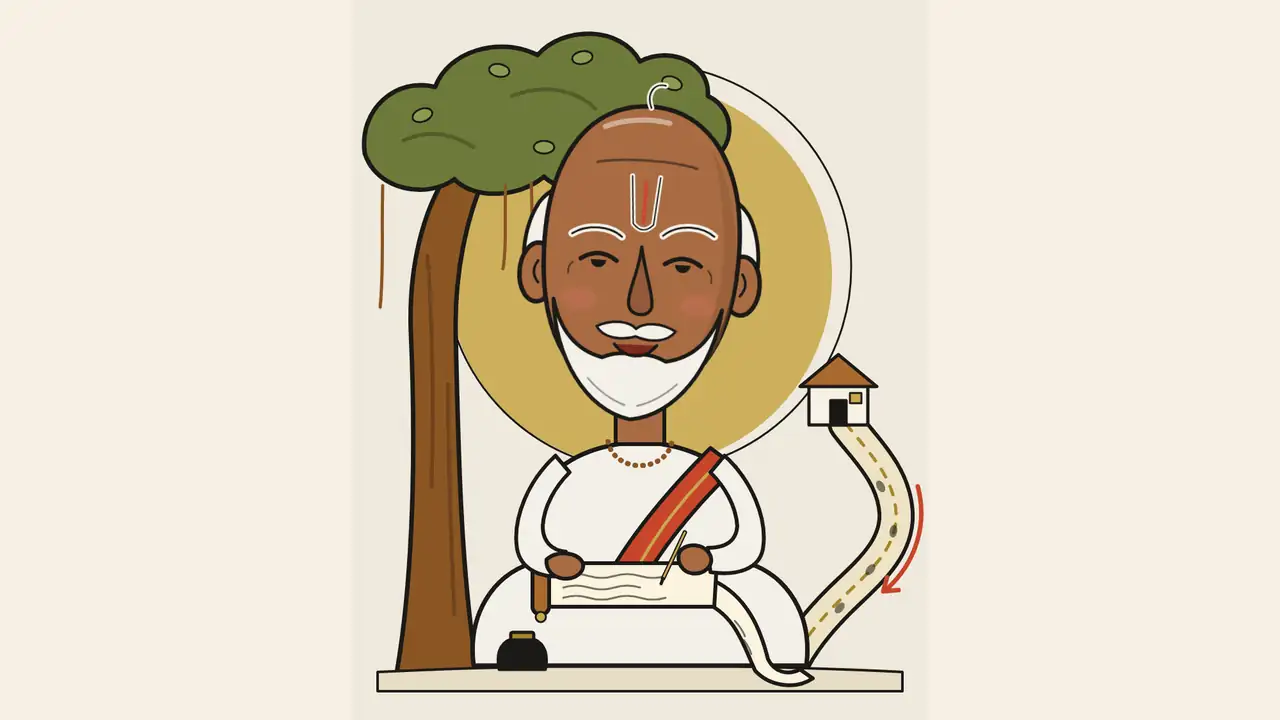
Original illustration drawn for WCRC. © Abhimanyu Ghosh & WCRC.
Spirituality · The Bhakti Saints · No. 10 of 27
Goswami Tulsidas kept the fire and changed its direction: a lesson for every pivot
One sentence from his wife, devotees recount, turned a young man's consuming attachment into the Ramcharitmanas, written in Awadhi for everyone. WCRC's PurposeTurn Model asks leaders to redirect their strongest passion into lasting service rather than put it out.
WCRC Consulting · Strategy into execution
Implement these strategies inside your organisation
Deep analysis of where your organisation stands and a strategic implementation of The WCRC PurposeTurn Model, built for your leadership team, culture and business.
Models created exclusively by Abhimanyu Ghosh; proprietary to Abhimanyu Ghosh and WCRC. WCRC's consulting service is not connected with, or endorsed by, any teacher, tradition or organisation discussed here.
Dates
early-to-mid 16th century – 1623
Region
Varanasi and Chitrakoot, Uttar Pradesh
Tradition
Bhakti
WCRC model
WCRC-GLC-10
The model in one line
Redirect your strongest passion into lasting service to others.
The WCRC PurposeTurn Model™ · anchored in परहित सरिस धरम नहिं भाई (No dharma equals doing good to others), Ramcharitmanas, Uttar Kand 41.1 (Gita Press)
From Rambola to the ghats of Varanasi
Across North India, village Ramlilas and the Ramlila of Ramnagar in Varanasi stage episodes from a single book. The book is the Ramcharitmanas of Goswami Tulsidas, and its presence on those stages since the late 16th century is the clearest evidence of what its author achieved. He took the story of Rama out of Sanskrit and gave it to everyone.
His beginnings are uncertain. He was born in the early-to-mid 16th century, traditionally in 1497, though many scholars, Britannica among them, prefer about 1543 and Hindupedia gives 1532. His birthplace was probably Rajapur, in today's Chitrakoot district of Uttar Pradesh, and his parents are named as Atmaram Dube and Hulsi. Tradition says he was born with teeth and named Rambola. Devotees recount that, left without family care as a child, he was taken in by a sadhu, Narharidas, who by the traditional account stood in the line of Swami Ramananda. Narharidas taught him the Ramayana and gave him the name Tulsidas. He studied Sanskrit and scripture, reportedly at Kashi.
Tradition names his wife as Ratnavali and says that their infant son, Tarak, died. Devotees recount that a rebuke from Ratnavali turned him to renunciation, and that he then lived for years as a wandering devotee. Tradition holds that Hanuman guided him, and devotees recount that Rama came to him at Chitrakoot while he was grinding sandalwood paste, and that he did not at first recognise him. These accounts come from later hagiography and are told here as devotees tell them.
By most accounts he began the Ramcharitmanas on Ram Navami in 1574, or 1575 by another reckoning, in Ayodhya, and completed it about two years, seven months and twenty-six days later, largely in Varanasi. He settled in Varanasi, wrote the Vinay Patrika, the Kavitavali, the Gitavali, the Dohavali and other works, and founded the Sankat Mochan Hanuman Temple. The Hanuman Chalisa is traditionally attributed to him. He died at Assi Ghat, Varanasi, in 1623.
Doing good as the measure of everything
Tulsidas's devotion has many strands, and one line from the Uttar Kand of the Ramcharitmanas gathers them into a test that any decision-maker can apply.
No dharma equals doing good to others; no sin equals causing them pain.
Goswami Tulsidas, Ramcharitmanas, Uttar Kand 41.1 (Gita Press numbering); English rendering prepared for this series
The couplet works in both directions, which is what makes it useful. It sets a ceiling and a floor. Doing good to others, parahit, is the highest duty, and causing harm is the lowest act. A leader who adopts it has a question to ask of every option: who does this serve, and whom could it hurt?
The line sits inside a wider vision. In the Bal Kand, Tulsidas writes that, knowing the whole world to be filled with Sita and Rama, he bows to all with folded hands. Every person, in that view, deserves respect as a dwelling of the divine. His long prayer, the Vinay Patrika, adds humility: the devotee comes to God as a servant. And at the centre of his practice is the Name of Rama, which he held to be the simplest and surest path for ordinary people.
The last strand is language. Tulsidas wrote the Ramcharitmanas in Awadhi, the speech of ordinary people, so that devotion would reach everyone and not stay with Sanskrit scholars. He says in the opening verses that he tells Raghunath's story for his own heart's joy. That private joy became a public one because it reached people in words they already spoke.
Ratnavali's sentence
Devotees recount that young Tulsidas could not bear to be apart from his wife Ratnavali, and when she went to her father's house he followed her there. She told him that if he loved Rama as he loved this body of bone and skin, he would be free. He left home that day.
Most retellings treat the story as a renunciation, and it is one. Read with a leader's eye, it is also a story about energy. Ratnavali did not tell her husband to love less. She told him to point the same love somewhere else. The force that had sent him chasing after her, unable to bear a separation of days, is the same force that later held him to a single book for more than two and a half years.
That is the turn at the heart of this chapter. Tulsidas kept the intensity and changed its object, and the work that resulted, written in Awadhi so ordinary people could hear it, has been staged in Ramlilas across North India since the late 16th century.
Two details matter for leaders. The wake-up came from someone close, in plain words. And it began a long redirection: years of wandering, then years of writing, then a life of work in Varanasi. A pivot that ends on the day of the decision has not yet begun.
Thirty-nine per cent of skills, and the question of direction
The World Economic Forum's Future of Jobs Report 2025 says that workers can expect two-fifths (39%) of their existing skill sets to be transformed or become outdated over the 2025–2030 period. The same report expects the creation of 170 million jobs and the displacement of 92 million by 2030, a net increase of 78 million. Careers and companies are being pushed to change direction whether they planned to or not.
The Tulsidas question is where the energy goes. Acemoglu and Restrepo, writing in the Journal of Economic Perspectives in 2019, argue that automation "always reduces the labor share in value added and may reduce labor demand even as it raises productivity", while the creation of new tasks "always raises the labor share and labor demand." Erik Brynjolfsson warns of a "Turing Trap": an excessive focus on AI that imitates and automates human work, at the expense of AI that augments what people can do.
Both arguments describe a choice of direction for the same force. A company can point its new capability at removing people, or at new work that serves customers and staff better. Ratnavali's sentence applies with uncomfortable precision. The passion that a team has for its old work need not be crushed when that work is automated. It can be turned towards something that does more good.
A leader who redirects talent towards new tasks that serve others, and tests each option for who it helps and whom it harms, is making the Tulsidas pivot. A leader who simply cuts has kept neither the fire nor the people who carried it.
The WCRC PurposeTurn Model
Created by Abhimanyu Ghosh · A proprietary model of Abhimanyu Ghosh and WCRC
WCRC calls this the PurposeTurn Model. Its anchor is the Uttar Kand line that no dharma equals doing good to others, and its story is the redirection that devotees say began with Ratnavali's words. The model treats a wake-up moment as the start of a turn: the leader keeps the full force of their passion and points it at serving others. Service becomes the test of every choice in the pivot, the redirected energy goes into one work built to last, and that work is made in the language of the people it serves. The flow in the diagram runs from raw passion through the wake-up moment to purpose, lasting work and reach to all, with one note beneath it: the same energy, in a new direction.
The PurposeTurn Model treats a wake-up moment as the start of a redirection: the leader keeps the full force of their passion and points it at serving others. Service to others becomes the test of every choice in the pivot, the energy goes into building one work that lasts, and that work is made in the language of the people it serves.
Fig. 1The WCRC PurposeTurn Model™
© Abhimanyu Ghosh & WCRC
The building blocks
01The wake-up moment
Recognise the moment that shows the old direction cannot hold, often in words someone close has the courage to say.
In practiceAfter a shock or a hard piece of honest feedback, the CEO writes down what it revealed before deciding anything.
02Redirect the passion
Keep the energy and change its object; suppressing it wastes the very force the pivot needs.
In practiceLeaders map what their teams care about most and point that energy at the new problem instead of shutting it down.
03Service of othersParahit
Doing good to others is the highest duty and the test of the new direction; causing harm is the lowest act.
In practiceEvery pivot option is assessed first on who it serves and who it could hurt.
04Build the lasting work
Pour the redirected energy into one durable work, as the Ramcharitmanas took more than two years of steady effort.
In practiceThe company commits multi-year resources to one flagship and protects it from quarterly cuts.
05Speak to everyone
Make the work in the language of the people it serves, as Tulsidas chose Awadhi over Sanskrit.
In practiceThe pivot is explained to customers and frontline staff in their own languages, including regional languages where relevant.
After the wake-up call: what a CEO decides first
The model's first discipline for a CEO is restraint. After a shock or a hard piece of honest feedback, write down what it revealed before deciding anything. The point is to separate a real signal from ordinary criticism. The model's first failure mode is pivoting on impulse, treating every complaint as a Ratnavali moment, and a CEO who changes direction every quarter teaches the organisation to wait each one out.
The second discipline is gratitude to the messenger. Ratnavali spoke plainly to someone she loved. In a company, the person who tells the CEO that the current direction cannot hold is usually taking a career risk. Thank them, ask what else you are missing and keep them close through the change. Few acts tell an organisation more clearly whether honesty is welcome.
The third discipline is the parahit test. Every option in a pivot should be assessed first on who it serves and whom it could harm, with the answer written beside the financial case. Options whose main effect is harm should be dropped however attractive the numbers. Tulsidas's couplet does not let a leader count only the upside.
The blind spot is the old passion itself. Leaders in the middle of a pivot often treat the people who loved the previous direction as obstacles. Those people hold the energy the new direction needs. Meet them, learn what they care about most and give them real parts in the new mission. Suppressing their passion wastes it, and the model's second failure mode describes what happens next: the people who carried it leave.
Founders who change direction and keep the team
Founders often pivot, and many pivot under pressure: the market was smaller than the deck said, the product solved the wrong problem, the money is running out. The moment usually arrives as a sentence from someone close, a co-founder, an early customer, a blunt investor. The PurposeTurn Model asks founders to treat that sentence as Tulsidas treated Ratnavali's, as information about where the energy should go.
A founder can test the wake-up signal with customers before acting on it. Then comes the harder work of carrying the team's existing enthusiasm into the new direction, person by person. An engineer who loved building the old product is likely to love building the new one if they can see why it matters and who it helps. The founder's job is to show them.
The flagship component matters more for startups than it first appears. Tulsidas spent more than two and a half years on one book. A pivoting startup is tempted to chase each quarter's trend, and the model asks it instead to commit to one product for several years and protect it. A company that pivots and then keeps pivoting has found a new habit, and not yet a new direction.
Flagships, budgets and the language of the people
In a large company, the PurposeTurn Model lives or dies in the budget process. Multi-year flagship work is the easiest line to cut when a quarter goes badly, and a pivot whose flagship is cut in its second year has not happened. The model asks boards to approve multi-year funding for one flagship and to confirm every quarter that it is still intact.
Boards should also insist that service is more than a slogan, the model's third failure mode. Gartenberg, Prat and Serafeim, writing in Organization Science in 2019, found from employee survey data that firms whose employees perceive both a strong sense of purpose and high clarity from management showed higher subsequent financial performance. Purpose in that finding is something employees perceive, and they perceive it in what management funds, protects and explains.
Language is where large companies most often fail the Tulsidas test. A pivot explained only in the language of the headquarters and the investor call reaches a fraction of the people who must carry it. Tulsidas chose Awadhi over Sanskrit so that his work would reach everyone. A company with plants, branches and customers across India's languages can explain its change of direction in each of them, and the model asks boards to review that reach every year.
Finally, the benefit-and-harm review belongs in board papers. When a company changes direction, investors and the public deserve to know whom the pivot serves and what it costs. A board that requires that statement in every major decision has written parahit into its governance.
The business model
Inside a company, the PurposeTurn Model runs as a disciplined redirection. The inputs are an honest signal that the old path is failing, the energy and skills already in the team, and a clear view of who is served. Four practices follow: options are assessed on benefit and harm, passionate teams are pointed at the new mission, one multi-year flagship is funded and protected, and the change is explained in stakeholders' own languages. The operating model below shows how those practices produce a pivot that keeps its talent, a flagship product or institution and messages understood across regions, and how they add up over time to growth on a durable purpose and lower attrition through change.
Fig. 2Operating model: running the WCRC PurposeTurn Model
© Abhimanyu Ghosh & WCRC
Inputs
What the company commits
- An honest signal that the old path fails
- Energy and skills already in the team
- A clear view of who is served
Practices
What leaders do, repeatedly
- Assess options on benefit and harm
- Point passionate teams at the new mission
- Fund one multi-year flagship work
- Communicate in stakeholders' own languages
Outputs
What changes in the work
- A pivot that keeps its talent
- A flagship product or institution
- Messages understood across regions
Outcomes
What the enterprise gains
- Growth on a durable purpose
- Lower attrition through change
- Reputation as a company that serves
The benefit model
A well-made turn benefits everyone it touches. The leader can change direction without losing the drive and identity that built the company. Employees keep their passion and skills and see them put to a purpose worth the effort, while customers are served by work built around their needs and explained in words they understand. Investors can judge the new direction against a lasting body of work. Society gains a company whose energy moves towards doing good and reaches people beyond elite audiences. The benefit model below sets out each group.
Fig. 3Benefit model: who gains what
© Abhimanyu Ghosh & WCRC
The leader
The leader gets a way to change direction without losing the drive and identity that built the company.
Employees
People keep their passion and skills and see them put to a purpose worth the effort.
Customers
Customers are served by work built around their needs and explained in words they understand.
Investors
The pivot is anchored in a lasting body of work, which makes the new direction easier to judge over time.
Society
The company's energy moves towards doing good and away from causing harm, and reaches people beyond elite audiences.
Fig. 4Where the model moves the needle
© Abhimanyu Ghosh & WCRC
- Vision Quotient
- ●●●●●
- Impact Index
- ●●●●●
- Innovation Score
- ●●●●●
- People Leadership
- ●●●●●
- Stakeholder Trust
- ●●●●●
- Resilience Factor
- ●●●●●
- Global Mindset
- ●●●●●
How to implement the WCRC PurposeTurn Model
Your first move
On Monday, write down what the latest shock or hard piece of honest feedback revealed about your current direction, before deciding anything.
If you are the founder or CEO
- 1
Write down the wake-up
In the first week after a shock or honest feedback, write down what it revealed before deciding anything. Separate a real signal from ordinary criticism so you do not pivot on impulse.
- 2
Thank the honest voice
Thank the person who had the courage to say it and ask them what else you are missing. Keep them close through the change.
- 3
Ask who it serves
Assess each pivot option first on who it serves and who it could harm, and write the answer down alongside the financial case. Drop options whose main effect is harm, however attractive.
- 4
Point passion at the mission
Meet the people who carried the old direction, learn what they care about most and give them a part in the new mission. Founders can do this person by person; CEOs of large firms should do it with business heads.
- 5
Protect the flagship work
Commit to one multi-year flagship and defend its funding yourself at every budget cycle. Explain the change to customers and frontline staff in their own languages.
Rolling it out across the company
| Step | Owner | What the company puts in place |
|---|---|---|
| 01Assess the wake-up signal | CEO office with strategy team | Gather the evidence that the old path is failing and map the energy and skills already in the team. Identify the key staff whose retention matters most through the change. |
| 02Pilot with one passionate team | One business head | Point one team's strongest interest at the new mission for a quarter and track who stays and how they engage. Run a benefit and harm review on the pilot. |
| 03Embed benefit and harm reviews | CEO office and board | Require a documented benefit and harm review for every major pivot decision, and ring-fence multi-year flagship funding in the budget process. Add contribution to the new mission to performance reviews. |
| 04Train managers to redirect energy | CHRO | Train all people managers to redirect their teams' passion toward the new mission without suppressing it, and to explain the change in staff's own languages. Include how to spot early signs of key staff leaving. |
| 05Track the pivot measures | CHRO with CFO | Track talent retained through the pivot, benefit and harm reviews, flagship continuity and language reach, and report them to the board every quarter. Compare retention with the period before the change. |
| 06Scale and review the purpose | Board | Extend the new direction across the company once the pilot keeps its talent, and review each year whether the flagship still serves people. Stop any service claim that has no lasting work behind it. |
The execution roadmap
Four phases, each closed by a gate. Do not move on until the gate is met.
Days 0–30
Phase 1 · Diagnose and commit
Test whether the wake-up signal is real before committing to a pivot.
- The CEO writes down what the shock or honest feedback revealed before deciding anything (The wake-up moment).
- The CEO office and strategy team test the signal against evidence and separate it from ordinary criticism.
- Map what teams care about most and who carries that passion (Redirect the passion).
- List pivot options and assess each first on who it serves and who it could hurt (Parahit).
Deliverable
A written wake-up assessment and a benefit-and-harm review of each pivot option.
Gate to proceed
Baseline recorded for every KPI, the wake-up signal tested against evidence and not a single criticism, and every pivot option has a written benefit-and-harm review.
Days 31–90
Phase 2 · Pilot and prove
Prove that a team's existing passion can be redirected to the new problem without losing its people.
- Pilot the pivot with one team that cares deeply about the old work.
- Point that team's energy at the new problem instead of shutting it down, with its leaders shaping how.
- Track who stays engaged, who drifts and who leaves.
- Explain the pivot to the pilot's customers and frontline staff in their own languages (Speak to everyone).
Deliverable
A pilot report on talent retained and early evidence of service to the people the pivot is meant for.
Gate to proceed
The pilot team's key people are still in the work, the pivot has been explained in every language its customers and staff use, and the harm review has been updated with what the pilot learned.
Days 91–180
Phase 3 · Embed and scale
Commit lasting resources to one flagship and make benefit-and-harm review standard.
- Commit multi-year resources to one flagship and protect it from quarterly cuts (Build the lasting work).
- Make a benefit-and-harm review a standing step for every major pivot decision.
- Train managers to redirect their teams' energy instead of suppressing it.
- Extend explanation of the pivot to every language group among customers and staff.
Deliverable
A board-approved multi-year flagship commitment and a standing benefit-and-harm review step.
Gate to proceed
The flagship has a multi-year commitment approved by the board, and every major pivot decision in the period went through a benefit-and-harm review.
Month 7 onwards
Phase 4 · Sustain and renew
Keep the flagship alive and the purpose honest over the years.
- Protect the flagship's funding in each budget round.
- Track retention of the people who carried the old passion.
- Gather evidence each year of service to the people the flagship was built for.
- Test any new wake-up signal with the same rigour before starting another pivot.
Deliverable
An annual purpose and flagship review to the board.
Gate to proceed
The flagship has kept its funding through every budget round, and its service to the people it was built for can be shown with evidence.
Governance
- Sponsor
- The CEO with the board, because only they can protect a multi-year flagship from quarterly pressure.
- Lead
- The head of strategy, with the CHRO responsible for talent retained through the pivot.
- Review forum
- Monthly in the leadership meeting while the pivot is under way; quarterly at the board for flagship continuity and harm findings.
- Decision rights
- The lead can redirect team resources within the flagship; starting a new pivot, cutting flagship funding or overruling a harm finding goes to the CEO and the board.
Operating rhythm
- WeeklyThe pivot lead and team leaders review who is engaged and who is drifting.
- MonthlyThe leadership meeting reviews talent retained and flagship progress.
- QuarterlyThe board confirms flagship funding is intact and reviews benefit-and-harm findings.
- AnnuallyThe board revisits the purpose behind the pivot and reviews language reach among customers and staff.
Implementation risks and how to handle them
| Risk | Early warning | Mitigation |
|---|---|---|
| The company pivots on impulse. | Strategy shifts after a single complaint, headline or board remark. | Require a written wake-up assessment tested against evidence before any pivot is approved. |
| The people who carried the old passion leave. | Long-serving experts resign or go quiet in the months after the announcement. | Map who carries the passion, give them leading roles in the new work and track their retention monthly. |
| Service becomes a slogan while the lasting work is starved. | Purpose language grows in communications while the flagship budget is trimmed. | Ring-fence the flagship budget and report its continuity to the board each quarter. |
| Regions and language groups are left out of the pivot. | Regional staff and customers hear about the pivot second-hand and repeat confused versions of it. | Explain the pivot in every working language through local managers before public announcement. |
By stage of company
Startup
Founder-led, under ~50 people
The founder tests a wake-up signal with customers before pivoting and carries the team's existing enthusiasm into the new direction. The flagship is the one product the company commits to for several years instead of chasing each quarter's trend.
Scale-up
~50 to 1,000 people
The strategy head runs benefit-and-harm reviews on pivot options, and the CHRO tracks retention of key people. The pivot is explained in each language the company's customers and staff use.
Enterprise
Large or listed company
The board approves multi-year flagship funding and protects it in budget rounds, with benefit-and-harm reviews attached to major pivots. Investor and public communication explains whom the pivot serves and what it costs, in the languages of every market served.
Are you ready?
- Can we tell a real wake-up signal from ordinary criticism?
- Have we identified the people who carry the old passion and how to keep them?
- Can we protect a flagship's funding over several years?
What success looks like at 12 months
- People who carried the old passion are leading parts of the new work.
- The flagship has survived budget rounds and serves the people it was built for.
- Customers and frontline staff in every language group can explain why the company changed direction.
Habits to start this quarter
- 1
Name your Ratnavali
Identify the one person in your working life who will tell you an uncomfortable truth to your face. Once this quarter, ask them a single question: what am I holding on to that no longer serves anyone? Write down the answer before you respond.
- 2
Keep a harm ledger
Each Friday, write one line about a decision you made that week that could cause pain to someone, and what you did to reduce it. Review the ledger at the end of the quarter for patterns.
- 3
Protect two hours for one long work
Set aside two hours a week for a piece of work that will take more than a year to finish, whether a capability, a mentoring relationship or a body of writing. Treat the hours as fixed, as Tulsidas treated his book.
- 4
Hear your company in another language
This quarter, sit in on a team meeting or customer conversation held in a language other than the one you use at the head office, with an interpreter if needed. Note what your last strategy message sounded like by the time it reached that room.
- 5
Greet the whole room
Tulsidas bowed to all as dwellings of the divine. In practical terms, for one month, greet every person in a meeting room by name, including the people serving tea and running the projector, before the agenda starts.
What to measure
| Leading indicator | How to measure it |
|---|---|
| Talent retained through the pivot | Retention of identified key staff over the 12 months after the change of direction, compared with the previous period. |
| Benefit and harm reviews | Share of major pivot decisions with a documented assessment of who is served and who could be harmed. |
| Flagship continuity | Whether the flagship's planned multi-year funding was kept intact at each budget cycle. |
| Language reach | Share of customer and staff communications about the change available in the languages those groups use. |
Where the model goes wrong
- Pivoting on impulse, treating every criticism as a wake-up moment.
- Suppressing the old passion instead of redirecting it, and losing the people who carried it.
- Service becomes a slogan with no lasting work behind it.
Same energy, a different object
WCRC's view is that Goswami Tulsidas offers leaders the most practical account of change in this series. He did not become a different person after Ratnavali spoke. He remained someone capable of overwhelming attachment, and he attached himself to work that served others. Companies facing the AI transition have the same choice about the energy of their people: crush it, waste it or turn it.
A book written for his own heart's joy, in the language of the street, is still staged in Ramlilas more than four hundred years later. Keep the fire. Change what it warms.
Powerfacts
- Who was Goswami Tulsidas?
- Goswami Tulsidas was a poet-saint of Rama devotion, born in the early-to-mid 16th century (traditionally 1497; many scholars c. 1543) and died at Assi Ghat, Varanasi, in 1623. He wrote the Ramcharitmanas in Awadhi, along with the Vinay Patrika, the Kavitavali and other works, and founded the Sankat Mochan Hanuman Temple in Varanasi. The Hanuman Chalisa is traditionally attributed to him.
- What is the WCRC PurposeTurn Model?
- The PurposeTurn Model is WCRC's leadership model drawn from Tulsidas's line that no dharma equals doing good to others, and from the redirection devotees say began with his wife Ratnavali's words. It treats a wake-up moment as the start of a pivot in which the leader keeps their passion and points it at serving others. The redirected energy goes into one lasting work, made in the language of the people it serves.
- When and where did Tulsidas write the Ramcharitmanas?
- By most accounts Tulsidas began the Ramcharitmanas on Ram Navami in 1574 (1575 by another reckoning) in Ayodhya. He completed it about two years, seven months and twenty-six days later, largely in Varanasi. He wrote it in Awadhi so that it would reach ordinary people as well as Sanskrit scholars.
Sources
- Tulsidas, Encyclopaedia Britannica
- Ramcharitmanas, Encyclopaedia Britannica
- Insight: Seven Bhakti Saints of North India, Hinduism Today
- Goswami Tulsidas, Hindupedia
- The Future of Jobs Report 2025, World Economic Forum
- Automation and New Tasks: How Technology Displaces and Reinstates Labor (Acemoglu and Restrepo, 2019), Journal of Economic Perspectives
- The Turing Trap: The Promise & Peril of Human-Like Artificial Intelligence (Erik Brynjolfsson, 2022), Daedalus
- Corporate Purpose and Financial Performance (Gartenberg, Prat and Serafeim, 2019), Organization Science
Read Goswami Tulsidas's life and teachings on Gurushakti.
The WCRC PurposeTurn Model™ (WCRC-GLC-10) is part of The WCRC Guru Leadership Codex™. Created exclusively by Abhimanyu Ghosh; a proprietary model of Abhimanyu Ghosh and WCRC. © 2026 Abhimanyu Ghosh and World Centre for Research and Consulting. All rights reserved.