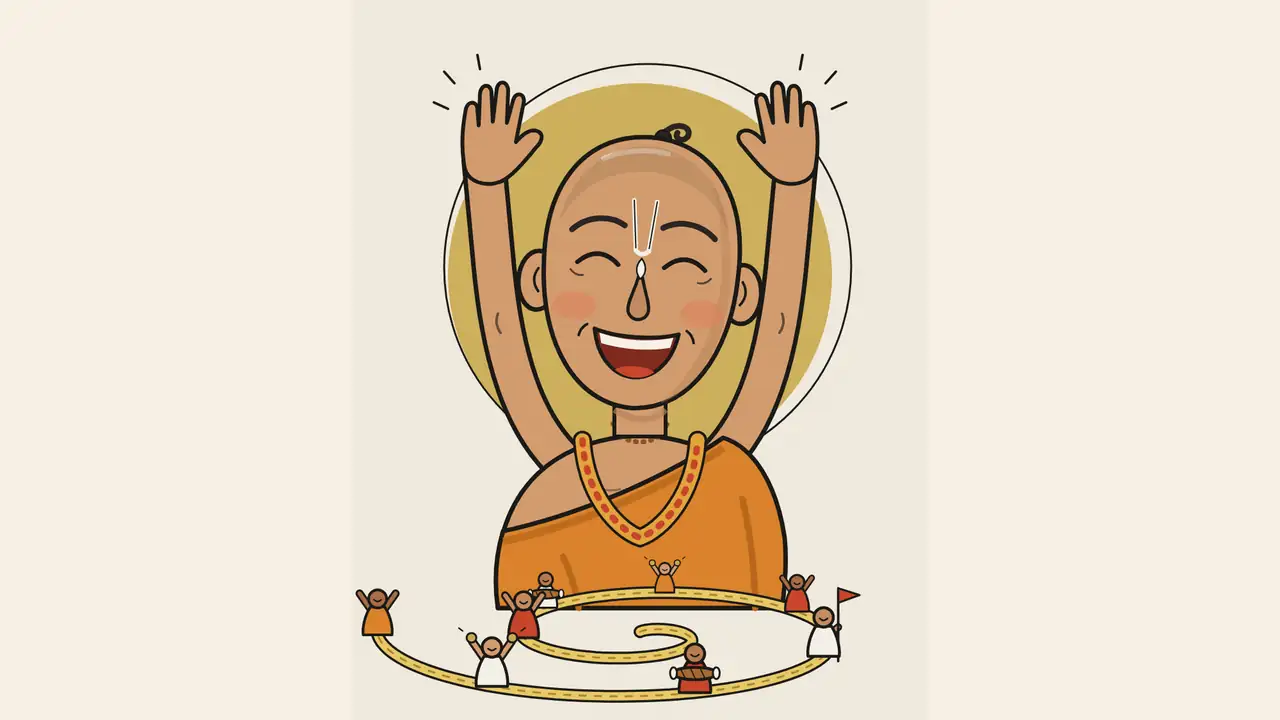
Original illustration drawn for WCRC. © Abhimanyu Ghosh & WCRC.
Spirituality · The Bhakti Saints · No. 08 of 27
Chaitanya Mahaprabhu and the leader who stands lower than the crowd
A celebrated young scholar of Navadvipa stopped teaching grammar and started singing in the streets with anyone who would join. WCRC's Chorus Movement Model asks leaders to build change as a shared practice, led from below.
WCRC Consulting · Strategy into execution
Implement these strategies inside your organisation
Deep analysis of where your organisation stands and a strategic implementation of The WCRC Chorus Movement Model, built for your leadership team, culture and business.
Models created exclusively by Abhimanyu Ghosh; proprietary to Abhimanyu Ghosh and WCRC. WCRC's consulting service is not connected with, or endorsed by, any teacher, tradition or organisation discussed here.
Dates
1486 – 1534 (some sources 1485 – 1533)
Region
Navadvipa, West Bengal; Puri, Odisha
Tradition
Bhakti
WCRC model
WCRC-GLC-08
The model in one line
Lead from below and let everyone join the song.
The WCRC Chorus Movement Model™ · anchored in तृणादपि सुनीचेन तरोरिव सहिष्णुना ... कीर्तनीयः सदा हरिः (Humbler than grass, patient as a tree ... always sing the name of Hari), Shikshashtakam v.3
The grammarian of Navadvipa
Chaitanya Mahaprabhu began as the kind of young man every institution wants to keep. Born Vishvambhara, and nicknamed Nimai, to Jagannatha Mishra and Shachi Devi in Navadvipa in Bengal, he became a celebrated Sanskrit scholar and opened his own school after his father's death. Gaudiya sources place his birth on Phalguna Purnima in February 1486, during a lunar eclipse; Britannica gives 1485. His life is usually dated 1486–1534, with some sources preferring 1485–1533.
Around 1508, aged about 22, he went to Gaya to perform his father's rites. There he met Ishvara Puri, took initiation and, in Britannica's account, was transformed. Devotees recount that the proud young scholar came home weeping the name of Krishna and could no longer teach grammar. For the next two years he led nightly kirtan in Navadvipa with a small circle that included Nityananda, Advaita and Srivasa.
In 1510, at 24, he took sannyasa from Keshava Bharati at Katwa and received the name Shri Krishna Chaitanya. At his mother's wish he settled at Puri, close to the Jagannath temple. Six years of travel followed: a pilgrimage through South India, then a journey to Vrindavan, where he identified sacred sites. At Prayag and Varanasi he instructed Rupa and Sanatana Goswami, who went on to write the theology of the school. His last eighteen years were spent in Puri, absorbed in ecstatic devotion to Radha and Krishna. He passed away there in 1533 or 1534, aged about 48. The circumstances are not historically documented, and the various legends about his end belong to devotion.
He wrote almost nothing. The eight verses of the Shikshashtakam are his; everything else comes from biographers writing decades later, in works such as the Chaitanya Charitamrita and the Chaitanya Bhagavata. His followers in the Gaudiya Vaishnava tradition revere him as Krishna himself, in the mood of Radha. Today his birthplace at Sri Mayapur holds Gaudiya Math temples and the world headquarters of ISKCON, a society founded in 1966, long after his time.
Lower than grass, steadier than a tree
Chaitanya's central practice was sankirtana: singing God's names together. He taught it as the simplest and most powerful practice for the age, and its defining feature is that it is open to all. No learning is required, no lineage, no seat. Anyone who can sing can join, and the practice is nothing more than that singing repeated together.
Humbler than grass, patient as a tree ... always sing the name of Hari.
Shikshashtakam v.3, Chaitanya Charitamrita Antya 20.21; common English rendering (not BBT wording)
The third verse of the Shikshashtakam sets the conditions for leading such a practice. The one who sings should be humbler than grass and as patient as a tree, and should give respect to others and demand none for himself. The first verse describes the Name as cleaning the mirror of the heart. The fourth asks God for no wealth, no followers and no fame, only for devotion itself.
That fourth verse deserves a second reading by anyone who leads a movement. Here is the central figure of a great devotional movement, praying not to be given followers. The tension is deliberate. A practice that depends on its leader's prestige stops when the prestige fades, and one that people join for its own sake does not.
His followers later formalised a philosophy of inconceivable oneness and difference, achintya bhedabheda, in which the soul is one with God in quality yet distinct. That system was the work of the Goswamis who came after him, and it should not be attributed to Chaitanya as a treatise. What he left in his own words is short and practical: sing together, stand low, bear patiently, ask for nothing.
A singing procession at the Kazi's door
Between about 1508 and 1510, the kirtan in Navadvipa was a small affair, held at night by a few companions. Devotees recount that the local Kazi banned public kirtan. Chaitanya's answer, as the tradition tells it, was neither to retreat into private worship nor to fight. He led a huge singing procession through the town to the Kazi's door, peacefully, and the Kazi lifted the ban.
The story comes from devotional biography, and it is best read as devotees tell it. Read that way, it holds the whole arc of the model in this chapter. A practice begun with a handful of people had become something an entire town would walk for. When authority blocked it, the response was to show, openly and without aggression, how many people stood behind it.
As the tradition tells it, the procession's force came entirely from visible, voluntary participation, with no aggression in it. The Kazi could see for himself that the practice was no longer one man's preference.
Most leaders will meet a smaller version of the Kazi: a regulator, a procurement rule, a sceptical head office, a policy written for another era. The Chaitanya approach is slow. It requires years of building a practice people genuinely join before the day the procession is needed. It is also unusually hard to refuse.
New ways of working spread the way kirtan did
Many companies roll out AI the way a head office issues a circular: licences, a training module, a memo from the top. Microsoft's 2026 Work Trend Index, which surveyed 20,000 workers using AI across 10 countries, suggests that is the wrong lever. It finds that organisational factors such as culture, manager support and talent practices account for more than twice the reported AI impact of individual factors, 67% against 32%. Only one in four AI users surveyed, 26%, say their leadership is clearly and consistently aligned on AI.
In Chaitanya's terms, the tool is the least of it. What matters is whether there is a shared practice people join, whether their managers make it safe to try and fail, and whether leadership is singing the same song. A new way of working spreads through a team that practises it together, much as kirtan spread through Navadvipa.
The research on humility explains why the leader's posture matters so much. Ou and colleagues, in a 2014 study in Administrative Science Quarterly conducted in private companies in China, found CEO humility positively associated with leadership behaviour that shares authority with others, which in turn correlated with top management team integration. The effect cascaded down the hierarchy: middle managers who perceived that climate of shared authority showed greater engagement and performance. Owens and Hekman's interviews with 55 leaders identified the behaviours involved, acknowledging personal limits and mistakes, spotlighting followers' strengths and modelling teachability.
A CEO who learns the new tools in public, as one participant among many, admits what they do not yet understand and credits the people who taught them is doing what the Shikshashtakam describes. That CEO is also building the conditions in which adoption carries itself, without waiting for the next memo.
The WCRC Chorus Movement Model
Created by Abhimanyu Ghosh · A proprietary model of Abhimanyu Ghosh and WCRC
WCRC calls this the Chorus Movement Model. It is drawn from the third verse of the Shikshashtakam, humbler than grass and patient as a tree, and from the practice of singing together that Chaitanya opened to everyone. The model sees lasting change as a shared practice anyone can join, led by someone who stands lower than the people he leads. The leader's humility and patience make participation safe, peaceful public action carries the practice outward, and a community that runs itself keeps it going after the leader steps back. The concentric rings in the diagram trace that ripple, from the leader's own practice to close companions, open participation, public procession and finally a lasting movement.
The Chorus Movement Model sees lasting change as a shared practice that anyone can join, led by someone who stands lower than the people he leads. The leader's humility and patience make participation safe, peaceful public action carries the practice outward, and a community that runs itself keeps it going after the leader steps back.
Fig. 1The WCRC Chorus Movement Model™
© Abhimanyu Ghosh & WCRC
The building blocks
01Shared practice anyone can joinSankirtana
Give people one simple practice they can join without credentials; the movement is that practice repeated together.
In practiceThe CEO defines one visible, repeatable team practice tied to the mission that any employee can lead.
02Humility of the leaderTrinad api sunichena
Stand lower than grass: give respect first, claim no special seat and ask nothing for yourself.
In practiceThe CEO joins the practice as one participant among many and credits others by name in public.
03Patient toleranceTaror iva sahishnuna
Bear criticism and slow progress as a tree bears weather, without retaliating.
In practiceInternal critics are invited into the work and their objections are answered in the open.
04Public, peaceful mobilisation
When a rule blocks the mission, show the scale of shared support openly and without aggression.
In practiceA policy or regulatory case is brought with the visible backing of employees, customers and partners, through constructive dialogue.
05Community that carries itself
Build leaders across the community so the movement runs without its founder; his companions and later the Six Goswamis carried and wrote down the teaching.
In practiceEach year the company names and trains new practice leaders and hands them real decisions.
A place in the circle, and the calls that stay yours
For a chief executive the model starts with a seating decision. In the shared practice, whatever it turns out to be, the CEO takes part as one participant and claims no special seat. Someone else leads. When it goes well, people are credited by name in public, and when it goes badly the CEO takes the blame. Jim Collins described the same pattern in Level 5 leaders, with their "tendency to give credit to others while assigning blame to themselves."
The habit that follows is patience with critics. Chaitanya's tree bears weather without striking back. Inside a company that means inviting the people who object to a change into the work itself, answering their objections openly and accepting that progress will be slower than a mandate would make it look. Mandated participation produces impressive numbers and very little belief; the model's own measures treat a jump in attendance after an order from the top as a false signal.
The blind spot is abdication. Humility can be used as cover for avoiding the hard decisions that belong to the CEO alone: closing a unit, removing a leader, saying no to a popular idea. The model lists this as its first failure mode. Standing lower than grass is a posture towards people. It does not transfer the CEO's responsibilities to anyone else.
A useful test sits in the success measures on this page. A year in, people should describe the CEO as one participant among many, and the practice should be running at sites the CEO rarely visits, led by peers the CEO did not appoint. If the practice stops when the CEO is travelling, it is still the CEO's practice.
Founders and the first companions
Chaitanya's nightly kirtan started with a few companions, Nityananda, Advaita and Srivasa among them. A founder's first practice usually begins the same way: a weekly customer call that the whole team joins, a Friday demo, an hour spent fixing whatever the support queue surfaced. Small and repeated beats ambitious and occasional.
The founder's temptation is to remain the lead singer forever. It feels efficient, and in the first year it often is. The by-stage guidance suggests the opposite: let someone else lead the practice from the start, invite the team's critics in and answer them in person. A founder who does this early builds a company that can sing without them, which is the only kind of company that can grow past them.
There is also a quieter lesson in the fourth verse of the Shikshashtakam, with its refusal of wealth, followers and fame. Startup culture often rewards founders for exactly those three things. A founder who builds a personality around the company risks the failure mode the model warns about, a following attached to one person. Practices outlast personalities, and the benefit model on this page counts that difference as lower key-person risk.
Founders can still be bold. Chaitanya gave up a successful school after Gaya. Boldness and humility sit together in the model. The boldness belongs to the mission, and the humility belongs to the person.
Succession, the Six Goswamis and the board
Chaitanya wrote eight verses. The theology, the biographies and much of the institutional life of his tradition were the work of others, his companions and later the Six Goswamis of Vrindavan, including Rupa and Sanatana, whom he instructed at Prayag and Varanasi. For a large company that is the most instructive fact in this chapter. The movement survived because he trained people who could carry and write it down.
Boards should look at culture change the same way they look at CEO succession. A practice that depends on one executive's energy is a key-person risk, however well it performs. The model asks boards to review the bench of practice leaders each year, alongside participation figures, and to ask how much of the practice would continue if the sponsoring executive left tomorrow.
Large companies also face the Kazi more often than small ones, in the form of regulators, governments and public opinion. The model allows for visible mobilisation of support from employees, customers and partners when a rule blocks the mission, and it sets strict limits. Any such effort should be approved by the board, conducted through constructive dialogue and kept peaceful in tone as well as in fact. The model's third failure mode, mobilisation sliding into pressure, can do lasting damage to a company's standing.
In a large organisation the CHRO usually carries the practical work: training practice leaders at each new site, keeping participation voluntary and tracking how much of the practice is peer-led. That work is unglamorous, and it is how a song started by a few people in Navadvipa came to outlive its singer.
The business model
Inside a company, the Chorus Movement Model runs as a practice that spreads by participation. It needs three inputs: one simple practice tied to the mission, a leader willing to stand among peers, and a few early companions who believe in it. The practice is opened to every level, resistance is met with patient and public dialogue, credit goes outward while blame comes inward, and new practice leaders are trained every year. The operating model below shows how those habits produce rising voluntary participation, peer-led practice across sites and visible support for the mission, and how they lead in time to culture change that sustains itself with less dependence on the founder.
Fig. 2Operating model: running the WCRC Chorus Movement Model
© Abhimanyu Ghosh & WCRC
Inputs
What the company commits
- One simple practice tied to the mission
- A leader willing to stand among peers
- Early companions who believe in it
Practices
What leaders do, repeatedly
- Open the practice to every level
- Answer resistance with patient, public dialogue
- Give credit outward, take blame inward
- Train new practice leaders every year
Outputs
What changes in the work
- Rising voluntary participation
- Peer-led practice across sites
- Visible, peaceful support for the mission
Outcomes
What the enterprise gains
- Culture change that sustains itself
- Influence on policy without conflict
- Less dependence on the founder
The benefit model
Everyone around the practice gains something different. The leader gains a following earned by example, which holds up under pressure better than authority alone. Employees at any level can take part and lead, so the mission feels like theirs. Customers meet staff who believe in what they do, and investors see a culture that keeps working when individual leaders leave. Society gains a model of disagreement settled through visible, peaceful participation. The benefit model below sets these out.
Fig. 3Benefit model: who gains what
© Abhimanyu Ghosh & WCRC
The leader
The leader gains a following that is earned through example, which holds up better under pressure than authority alone.
Employees
Anyone can take part and lead, whatever their level, so people feel the mission belongs to them.
Customers
Customers meet staff who believe in the practice themselves, and many are invited to join it.
Investors
The culture keeps working when individual leaders leave, which reduces key-person risk.
Society
Disagreements with authorities are settled through visible, peaceful participation, which keeps public life civil.
Fig. 4Where the model moves the needle
© Abhimanyu Ghosh & WCRC
- Vision Quotient
- ●●●●●
- Impact Index
- ●●●●●
- Innovation Score
- ●●●●●
- People Leadership
- ●●●●●
- Stakeholder Trust
- ●●●●●
- Resilience Factor
- ●●●●●
- Global Mindset
- ●●●●●
How to implement the WCRC Chorus Movement Model
Your first move
On Monday, name one simple, repeatable practice tied to the mission that any employee can lead, and join it yourself as a participant.
If you are the founder or CEO
- 1
Define the shared practice
In the first week, define one visible, repeatable practice tied to the mission that any employee can join without credentials. In a small company it can start with the whole team; in a large one, with a few early companions.
- 2
Join as one among many
Take part in the practice as an ordinary participant, claim no special seat and let others lead. Credit people by name in public and take the blame yourself when it goes wrong.
- 3
Answer critics in the open
Invite internal critics into the work and answer their objections openly and without retaliation. Accept that progress will be slower than you want.
- 4
Still make hard decisions
Keep making the hard calls that are yours to make, so humility does not turn into abdication. Explain them plainly to the people affected.
- 5
Hand decisions to practice leaders
Each year, name new practice leaders, hand them real decisions and step back. Watch for signs of a personality cult around you and correct them.
Rolling it out across the company
| Step | Owner | What the company puts in place |
|---|---|---|
| 01Find what people already join | CEO office with CHRO | Look for practices employees already take part in voluntarily and decide which simple practice best fits the mission. Record current voluntary participation as the baseline. |
| 02Pilot the practice at one site | Site head with early companions | Launch the shared practice at one site or function for a quarter, open to every level and led by non-managers wherever possible. Keep attendance voluntary. |
| 03Embed peer leadership | CHRO and business heads | Recognise practice leadership in reviews and promotion, and ask leaders to show in performance discussions how they credited others. When a rule blocks the mission, bring the case with visible support through constructive dialogue. |
| 04Train practice leaders and managers | CHRO | Train new practice leaders every year, and train all people managers in acknowledging limits and mistakes, spotlighting others' strengths and showing teachability. Include how to answer resistance with patient, public dialogue. |
| 05Measure the movement | CHRO | Track voluntary participation rate, peer-led share, leader humility pulse and the practice leader bench, and review them every quarter. Treat rising attendance after a mandate as a false signal. |
| 06Scale without the founder | CEO and board | Extend the practice across sites once it is peer-led at the pilot site, and review each year how much it still depends on the founder or CEO. Keep any public mobilisation peaceful and constructive. |
The execution roadmap
Four phases, each closed by a gate. Do not move on until the gate is met.
Days 0–30
Phase 1 · Diagnose and commit
Find what people already join willingly and choose one practice tied to the mission.
- Map the voluntary practices people already take part in without being asked.
- Define one visible, repeatable team practice tied to the mission that any employee can lead (Sankirtana).
- Identify early companions at one site who will lead the first sessions.
- The CEO commits to joining as one participant among many, not as the leader (Trinad api sunichena).
Deliverable
A practice charter: what the practice is, how it links to the mission and how anyone can lead it.
Gate to proceed
Baseline recorded for every KPI, the charter agreed with early companions at the pilot site, and the CEO has joined a session as a participant.
Days 31–90
Phase 2 · Pilot and prove
Prove that the practice spreads by choice and is led by peers.
- Run the practice at the pilot site with peers leading each session.
- The CEO credits contributors by name in public and does not lead.
- Invite internal critics into the practice and answer their objections in the open (Taror iva sahishnuna).
- Record voluntary participation and who led each session.
Deliverable
A pilot participation record and a log of objections with their answers.
Gate to proceed
Participation at the pilot site is voluntary and growing, most sessions are led by peers rather than managers, and every objection raised has an answer on record.
Days 91–180
Phase 3 · Embed and scale
Embed peer leadership and widen the practice beyond the pilot site.
- Train practice leaders and managers, keeping managers in a supporting role.
- Spread the practice to new sites through early companions, not by instruction.
- Where relevant, bring one policy or regulatory case with the visible backing of employees, customers and partners, through constructive dialogue (Public, peaceful mobilisation).
- Hand practice leaders real decisions about the practice and its link to the mission.
Deliverable
A trained practice leader bench and, where relevant, a stakeholder-backed policy case.
Gate to proceed
Practice leaders at each new site hold real decisions, and the leader humility pulse shows people see the CEO as a participant.
Month 7 onwards
Phase 4 · Sustain and renew
Make the movement carry itself without the founder or CEO at its centre.
- Name and train a new group of practice leaders each year (Community that carries itself).
- The CEO steps back from visible roles in the practice.
- Watch for signs of a personality cult and remove the leader's image from practice materials.
- Review any public mobilisation for its peaceful, constructive character.
Deliverable
An annual practice leader succession list.
Gate to proceed
The practice runs through a period when the CEO is absent, with voluntary participation and peer-led share holding steady.
Governance
- Sponsor
- The CEO, because the leader's humility is the model's test and has to be visible at the top.
- Lead
- The CHRO, supported by a council of practice leaders drawn from the front line.
- Review forum
- A monthly practice leader council; quarterly in the leadership meeting; annually at the board.
- Decision rights
- Practice leaders can change the practice's format and timing locally; any public or regulatory mobilisation, and any change to its link with the mission, goes to the CEO.
Operating rhythm
- WeeklyThe shared practice runs at each site, led by a rotating peer.
- MonthlyThe practice leader council meets, and objections raised are answered in the open.
- QuarterlyThe CEO credits named contributors in public, and the leader humility pulse is taken.
- AnnuallyNew practice leaders are named, trained and handed decisions, and any public mobilisation is reviewed.
Implementation risks and how to handle them
| Risk | Early warning | Mitigation |
|---|---|---|
| The movement becomes a personality cult around the leader. | Attendance rises when the CEO is present and falls when they are not, and practice materials feature the leader. | The CEO attends only as a participant, and materials credit peers by name. |
| Participation turns compulsory, and goodwill turns to cynicism. | Managers track attendance, and staff say they feel pressure to join. | Keep participation voluntary and out of performance reviews, and measure only the share who join by choice. |
| Humility becomes abdication. | Hard decisions are deferred to the community or wait for consensus that never comes. | The CEO decides promptly on matters outside the practice's remit and says so openly. |
| Public mobilisation slides into pressure, or does not suit every region's culture. | Campaign language turns adversarial, or staff in some regions are uneasy about public advocacy. | Keep mobilisation opt-in and limited to constructive dialogue, with legal review and local leaders' agreement before each step. |
By stage of company
Startup
Founder-led, under ~50 people
The founder starts one shared practice with the first companions and lets someone else lead it from the start. Critics in the team are invited in, and the founder answers them in person.
Scale-up
~50 to 1,000 people
The CHRO trains practice leaders at each new site and keeps participation voluntary. Peer-led share is tracked so the practice does not drift back to managers.
Enterprise
Large or listed company
Practice leader councils run in each region, and the board reviews the succession of practice leaders as well as participation. Any public or regulatory mobilisation is approved by the board and kept to constructive dialogue.
Are you ready?
- Is there a simple practice tied to our mission that anyone could join?
- Will our senior leaders take part without leading it or taking credit?
- Are we prepared for the practice to run without the CEO in the room?
What success looks like at 12 months
- The practice runs at sites the CEO rarely visits, led by peers the CEO did not appoint.
- Internal critics take part in the practice and see their objections answered.
- People describe the CEO as one participant among many.
Habits to start this quarter
- 1
Speak last
In every meeting you chair this month, hold your own view on any decision until everyone else has spoken. Note how often the discussion goes somewhere you would not have taken it.
- 2
Be taught by someone junior
Book a monthly hour in which a colleague well below you in the hierarchy teaches you something they know better, such as an AI tool they use every day. Ask questions as a learner and say publicly what you learned.
- 3
Wait a week before you retaliate
The next time another team's caution slows something you want, hold off escalation for a week. Use the week to understand their reason in their own words, then decide.
- 4
Notice what you ask for
For one week, write down each time you ask for recognition, a seat, a title or a mention. At the end of the week, decide which of those requests the work actually needed.
- 5
Answer your sharpest critic in writing
Choose the most pointed criticism you received this quarter and write a reply that begins with what is right in it. Send it, and keep the conversation going.
What to measure
| Leading indicator | How to measure it |
|---|---|
| Voluntary participation rate | Share of employees who take part in the shared practice in a given month without it being mandated, from attendance logs. |
| Peer-led share | Share of practice sessions led by people who are not managers, tracked from session records. |
| Leader humility pulse | Survey items on whether leaders acknowledge limits and mistakes, spotlight others' strengths and show teachability, following Owens and Hekman's three behaviours. |
| Practice leader bench | Number of trained practice leaders per site or function, reviewed annually. |
Where the model goes wrong
- Humility turns into abdication, and hard decisions are left unmade.
- The movement becomes a personality cult around the leader, the opposite of humility.
- Public mobilisation slides into pressure or confrontation and loses its peaceful character.
The song after the singer
WCRC's view is that Chaitanya Mahaprabhu offers leaders a working theory of change that most organisations have not tried. Mandates move behaviour for as long as someone is watching. A practice people choose to join, led by someone who stands lower than they do, keeps moving when no one is watching at all. In the age of AI, when the tools change faster than any memo can follow, that kind of movement is a serious strategic asset.
He prayed for no followers and left eight verses, and five centuries later people are still singing. Lead so that the singing goes on when you stop.
Powerfacts
- Who was Chaitanya Mahaprabhu?
- Chaitanya Mahaprabhu (1486–1534; some sources 1485–1533) was a Bengali saint and the central figure of Gaudiya Vaishnavism, born in Navadvipa and later settled at Puri. He taught sankirtana, singing God's names together, as a practice open to everyone. His own writing is limited to the eight verses of the Shikshashtakam.
- What is the WCRC Chorus Movement Model?
- The Chorus Movement Model is WCRC's leadership model drawn from Chaitanya's Shikshashtakam and his practice of shared kirtan. It treats lasting change as a simple practice anyone can join, led by a leader who stands humbler than grass and patient as a tree. Peaceful public support carries the practice outward, and trained peer leaders keep it going without the founder.
- What is the Shikshashtakam?
- The Shikshashtakam is a set of eight Sanskrit verses and the only text Chaitanya Mahaprabhu wrote himself. Its third verse asks the devotee to be humbler than grass and patient as a tree and to sing the name of Hari always. The rest of his teaching was recorded by biographers such as the authors of the Chaitanya Charitamrita and the Chaitanya Bhagavata.
Sources
- Chaitanya, Encyclopaedia Britannica
- Sri Chaitanya Charitamrita, Adi-lila 13, Vedabase (Bhaktivedanta Book Trust)
- Sri Chaitanya Charitamrita, Antya-lila 20.21 (Shikshashtakam v.3), Vedabase (Bhaktivedanta Book Trust)
- Agents, human agency, and the opportunity for every organization: Work Trend Index Annual Report 2026, Microsoft WorkLab
- Humble Chief Executive Officers' Connections to Top Management Team Integration and Middle Managers' Responses (Ou et al., 2014), Administrative Science Quarterly
- Modeling How to Grow: An Inductive Examination of Humble Leader Behaviors, Contingencies, and Outcomes (Owens and Hekman, 2012), Academy of Management Journal
- Level 5 Leadership: The Triumph of Humility and Fierce Resolve (Jim Collins), Harvard Business Review
Read Chaitanya Mahaprabhu's life and teachings on Gurushakti.
The WCRC Chorus Movement Model™ (WCRC-GLC-08) is part of The WCRC Guru Leadership Codex™. Created exclusively by Abhimanyu Ghosh; a proprietary model of Abhimanyu Ghosh and WCRC. © 2026 Abhimanyu Ghosh and World Centre for Research and Consulting. All rights reserved.