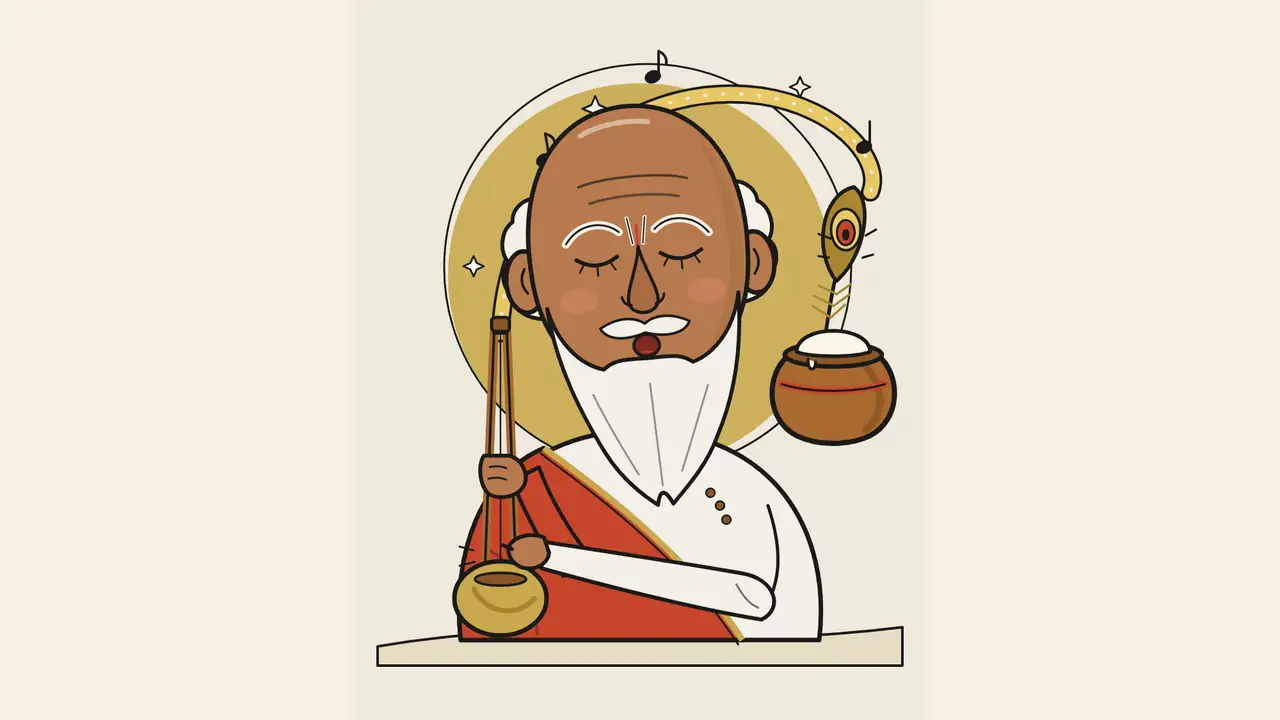
Original illustration drawn for WCRC. © Abhimanyu Ghosh & WCRC.
Spirituality · The Bhakti Saints · No. 07 of 27
Surdas sang what could not be told, and every strategy deck should take note
The Braj poet held that the Unmanifest is beyond words, so he sang of a child in a courtyard who swears he never touched the butter. WCRC's StoryLight Model asks leaders to see the future clearly, then tell it as a story other people will carry.
WCRC Consulting · Strategy into execution
Implement these strategies inside your organisation
Deep analysis of where your organisation stands and a strategic implementation of The WCRC StoryLight Model, built for your leadership team, culture and business.
Models created exclusively by Abhimanyu Ghosh; proprietary to Abhimanyu Ghosh and WCRC. WCRC's consulting service is not connected with, or endorsed by, any teacher, tradition or organisation discussed here.
Dates
16th century (traditionally c. 1478 – c. 1584)
Region
Braj (Govardhan and Parasoli), Uttar Pradesh
Tradition
Bhakti
WCRC model
WCRC-GLC-07
The model in one line
See it inwardly, then tell it as a human story.
The WCRC StoryLight Model™ · anchored in अबिगत गति कछु कहत न आवै (The way of the Unmanifest cannot be told), so Surdas sang the God with form
A poet the manuscripts keep multiplying
Surdas is easiest to meet through a set of numbers. The earliest dated manuscript of his poems, copied at Fatehpur in Rajasthan in 1582, holds 239 of them. By 1640, manuscripts titled Sursagar, "Sur's Ocean", held 795. By the 19th century nearly 10,000 poems carried his name. The scholar J. S. Hawley traces that growth. The songs passed into temple kirtan and to later singers, who also sang under the name "Sur".
The life behind the songs is mostly tradition, and the traditions disagree. His birth is placed around 1478 or 1483, his death in 1563 or around 1584, so the safest statement is that he belongs to the 16th century. Britannica says he flourished probably in Braj. The Pushtimarg account places his birth at Sihi village near Delhi and says he was blind from birth; Britannica and Hawley think his blindness more likely came later in life. Devotees give different accounts of it, and the early manuscripts allude to it only once.
Tradition says he left home young and settled at Gau Ghat on the Yamuna, between Agra and Mathura, singing devotional songs. According to Vallabha tradition, he met Vallabhacharya there around 1510, received initiation and went on to sing kirtan before Shrinathji at Govardhan, where he is believed to have been the temple's head kirtan singer. The Vallabha Sampradaya, or Pushtimarg, claims him as the foremost of the Ashtachhap, its "eight seals" of poets. These accounts come from the Chaurasi Vaishnavan ki Varta, traditionally ascribed to Vallabha's grandson Gokulnath, and Britannica calls the meeting historically doubtful. No 16th-century poem of Sur names Vallabha.
Later he lived in a simple hut at Parasoli, by Chandra Sarovar near Govardhan, composing. Stories tell of the emperor Akbar admiring his songs; Hawley notes a "Surdas" among Akbar's musicians but thinks it unlikely to have been the poet. Around 1600, Nabhadas's Bhaktamal singled him out for praise. Blind singers in North India still call themselves "Surdas", a measure of how far the name has travelled.
The taste of sweet fruit, and a child with butter on his hands
At the centre of Surdas's teaching is an admission that most strategists never make. Some things cannot be put into words.
The way of the Unmanifest cannot be told, like sweet fruit's taste to the mute.
Surdas, Sursagar pada "अबिगत गति कछु कहत न आवै" (Brajbhasha, 16th c.); English rendering prepared for this series
The formless God is real to him, and beyond description. A mute person who has tasted sweet fruit knows its sweetness completely and cannot tell you about it. So Surdas did something practical. He sang the God with form, Krishna in Braj, and he sang him in scenes. Vallabha tradition says this was exactly his guru's charge: sing the glory of Krishna's divine play, the lila, and devotion will grow in those who hear it.
Many of the best-loved padas attributed to him look at Krishna through his mother Yashoda's love. The child steals butter, teases and is teased, complains that Dau teases him, and grows up. In one of the most famous, the boy faces his mother and protests, "Mother, I did not eat the butter", pleading that she sent him off behind the cows at dawn. Scholars caution that such famous padas may be later additions to the Sursagar. Even so, the method is unmistakable. The infinite is approached through a child, a pot and an alibi.
Two other strands complete the picture. In the songs of viraha, love in separation, the gopis long for Krishna after he leaves for Mathura; in the bhramargit, the bee songs, they send away Udho and his dry philosophy and hold on to living love. In the vinaya poems, the poet speaks to Krishna directly about his own failings and need. The teaching, taken together, is that longing and honesty keep a story alive long after the argument has been forgotten.
Gau Ghat, and an ocean that outgrew its singer
Devotees recount that Vallabhacharya came to Gau Ghat, heard Surdas sing and told him to sing the glory of Krishna's divine play. According to Vallabha tradition, Surdas was initiated and went to Govardhan to sing before Shrinathji. Scholars doubt that the meeting happened as told. The leadership interest of the story does not depend on it.
What the story records is a change of brief. A gifted singer is given one subject, told in one way, and the rest of his life is spent on it. What followed is on record. A few hundred poems in 1582 became an ocean of nearly ten thousand by the 19th century, as later singers took up the songs and sang under his name.
Every leader who has watched a strategy travel through an organisation should feel both halves of that fact. The good half is reach: a story told well enough is retold without you, in rooms you will never enter. The harder half is drift. Hawley's caution that many famous padas may be later compositions is the scholarly version of a problem every large company knows, where the version of the strategy that people repeat is no longer quite the version the leadership meant.
Devotees also recount that, as he lay dying by Chandra Sarovar and was asked where his mind was, he answered with a final song about Krishna. The accounts differ on which song it was. They agree that his last act was the same as his first.
Seventy per cent of organisations can now write the deck
The 2026 AI Index from Stanford's Institute for Human-Centered Artificial Intelligence reports that generative AI is now used in at least one business function at 70% of organisations. Strategy papers, town-hall scripts, video explainers and customer letters can be produced in any volume at almost no cost. Volume used to signal effort. It no longer signals anything.
This is where Surdas's first teaching becomes a business problem. A strategy is, in an important sense, an Unmanifest: a picture of a future that does not yet exist. Generated language can describe it endlessly in abstractions, and abstractions are exactly what Surdas said cannot carry the taste of the fruit. People need the scene.
Paul Zak's research, reported in Harvard Business Review, points the same way. Zak writes that "character-driven stories do consistently cause oxytocin synthesis", a neurochemical associated with trust and cooperation, and that the amount released predicted how willing people were to help others. He argues that a story must first hold attention by developing tension. Surdas had a word for that tension. Viraha, the longing for what is absent, is what kept the gopis' songs alive.
A leader who has seen the future clearly and can tell it as a lived scene, with an honest gap between today and the goal, will be heard above any quantity of generated text. A leader who has seen nothing clearly will simply produce more of it.
The WCRC StoryLight Model
Created by Abhimanyu Ghosh · A proprietary model of Abhimanyu Ghosh and WCRC
WCRC calls this the StoryLight Model. It rests on the Sursagar line that the Unmanifest cannot be told, and on Surdas's answer: sing the God with form. The model holds that a leader must first see the future clearly within, then give it a concrete human story that others can feel and retell. Strategy statements on their own rarely move anyone. A lived story told with emotional truth, carried in many voices and kept alive by honest longing for what is not yet achieved, does. The arc in the diagram follows a story's hold on people over time through five stages, from inner vision to lasting longing, and the building blocks name the discipline each stage requires.
The StoryLight Model holds that a leader must first see the future clearly within, then give it a concrete human story that others can feel and retell. Abstractions such as strategy statements rarely move people; a lived story told with emotional truth, carried in many voices and kept alive by honest longing for what is not yet achieved, does.
Fig. 1The WCRC StoryLight Model™
© Abhimanyu Ghosh & WCRC
The building blocks
01Inner vision
See the destination clearly yourself before you describe it to anyone. Clarity comes from sustained attention, and more data rarely supplies it.
In practiceThe CEO writes one paragraph on what the company will feel like to a customer in five years before any slide is made.
02The human storyLila
Translate strategy into a concrete scene with people in it, because the abstract cannot be told. People remember who did what, and why it mattered.
In practiceEvery major strategy talk opens with one specific customer or employee scene drawn from the company's own work.
03Emotional truthBhava
Tell the feeling honestly, including doubt and failure, as Surdas's vinaya poems speak plainly of the poet's own failings.
In practiceIn the same talk as the plan, the leader names one thing that went wrong and what it taught.
04Repetition in many voices
A story lasts when others retell it in their own words; later singers carried Surdas's songs under the name 'Sur'.
In practiceTeam leaders retell the strategy story to their teams in their own words, and the versions are collected and compared.
05Longing that sustainsViraha
Keep the gap between today and the vision visible, so that what is still missing draws people forward.
In practiceEach quarter the CEO restates what has not yet been achieved and why it is still worth reaching.
The chief executive as first singer
The StoryLight Model starts with a decision most CEOs skip: to see before speaking. The first building block, inner vision, asks for one paragraph on what the company will feel like to a customer in five years, written before any slide exists. Some leaders will find they cannot write it. That discovery is the most useful thing the model will give them, because a story told without an inner vision behind it is spin, and staff can tell.
Once the vision is clear, the habit is the scene. Surdas did not sing about the nature of divine love in general; he sang a boy denying the butter theft to his mother. A CEO's equivalent is to open every major strategy talk with one real customer or employee drawn from the company's own work, named with their permission, in a situation people can picture. The rest of the plan then has somewhere to stand.
The vinaya poems supply the second habit. Surdas spoke to Krishna plainly about his own failings and need. A leader who names one thing that went wrong in the same talk as the plan, and what it taught, makes the rest of the talk more believable. Leaders who present only success are heard as selling.
The blind spot is control. A CEO who insists that every manager repeat the strategy word for word has misunderstood the Sursagar. The songs lasted because other singers made them their own. The task is to listen to the retellings, notice where meaning has drifted or hardened into slogan, and correct the drift, without demanding a single approved script.
Founders and the story the first twenty people retell
In a young company the founder's story is the strategy, the recruiting pitch and the brand at once. It is also told by fewer people than it will ever be told by again. That makes the first twenty employees the company's earliest singers, and how they retell it to the twenty-first matters more than any document.
If you are a founder, test your story by listening to it. Ask an early employee to explain to a new joiner why the company exists, and stay quiet. If the version you hear is accurate and in their own words, with a customer in it, the story is alive. If it is your own phrasing repeated back, or a slogan, it has started to harden.
Founders face a particular risk with viraha. The gap between what the company is and what it means to become is what draws early teams forward; it is also what exhausts them when it never narrows. Surdas's longing songs are full of feeling, and they are not songs of despair. Each quarter, say plainly what has not yet been achieved, and in the same breath mark what has. A team that only ever hears about the distance stops walking.
Investors are an audience for the same story. The benefit model on this page notes that one coherent story heard from founders, staff and the market lowers the risk of a hidden strategy gap. A founder who tells investors one version and the team another has two stories, and eventually neither will be believed.
Ten thousand singers under one name
A large company is a Sursagar. Its strategy is sung by thousands of managers in dozens of languages and regions, most of whom the CEO will never meet, and every year the body of retellings grows. Some of those versions are faithful and alive. Some have drifted. Some are slogans recited without meaning, which the model lists as one of its failure modes.
The practical answer is to treat retelling as a managed asset. Ask managers to tell the strategy story to their teams in their own words, with local scenes, and then collect and compare the versions. The point is to find where meaning has slipped, and accuracy matters more than uniformity: a Tamil Nadu plant and a London sales team should not sound the same, and both should be true.
Boards have a direct interest. Gartenberg, Prat and Serafeim, writing in Organization Science in 2019, found from employee survey data that firms whose employees perceive both a strong sense of purpose and high clarity from management showed higher subsequent financial performance. Clarity in that finding is something staff perceive, and a board can test for it. Directors can ask whether people below the senior team can state the strategy in their own words, and whether major decisions match the story told to staff and investors.
The scholarly caution about the Sursagar applies here too. When ten thousand songs carry one name, someone must keep asking which ones the singer meant. In a large company that duty belongs to the CEO, who should reaffirm or rewrite the inner vision every year, before the story goes stale and the retellings begin to describe a company that no longer exists.
The business model
Inside a company, the StoryLight Model runs as a loop between the leader's inner vision and the many voices that carry it. The inputs are the leader's clear picture of the future, real scenes from customers and staff, and an honest record of setbacks. Those feed four practices: strategy talks that open with a human scene, failures named alongside the plan, teams retelling the story themselves, and the unmet goal restated every quarter. The outputs are a strategy staff can explain accurately, a shared language across teams and messages that middle managers own. Over time, as the operating model below shows, they add up to faster alignment, more discretionary effort and a culture that can outlive its founder.
Fig. 2Operating model: running the WCRC StoryLight Model
© Abhimanyu Ghosh & WCRC
Inputs
What the company commits
- Leader's clear inner picture of the future
- Real scenes from customers and staff
- Honest record of setbacks
Practices
What leaders do, repeatedly
- Open strategy talks with a human scene
- Name failures alongside the plan
- Have teams retell the story themselves
- Restate the unmet goal each quarter
Outputs
What changes in the work
- Strategy staff can explain accurately
- Shared language across teams
- Messages owned by middle managers
Outcomes
What the enterprise gains
- Faster alignment on direction
- Higher discretionary effort
- A brand story customers repeat
- Culture that outlives the founder
The benefit model
The model benefits everyone who has to hear the strategy, and the leader who has to tell it. The leader's intent travels into rooms the leader will never enter. Employees understand in plain human terms why their work matters and can explain it with confidence. Customers meet a company whose message is consistent and recognisably human, which makes it easier to believe, and investors hear one coherent story from leadership, managers and the market. The benefit model below shows each of these in turn.
Fig. 3Benefit model: who gains what
© Abhimanyu Ghosh & WCRC
The leader
The leader's intent travels further without having to be in every room, because people carry the story for them.
Employees
Staff understand why their work matters in plain human terms and can explain it to others with confidence.
Customers
Customers meet a company whose message is consistent and recognisably human, which makes it easier to believe.
Investors
Investors hear one coherent story from leadership, managers and the market, which lowers the risk of a hidden strategy gap.
Society
Public communication rests on true stories told with care, which adds to trust in business rather than eroding it.
Fig. 4Where the model moves the needle
© Abhimanyu Ghosh & WCRC
- Vision Quotient
- ●●●●●
- Impact Index
- ●●●●●
- Innovation Score
- ●●●●●
- People Leadership
- ●●●●●
- Stakeholder Trust
- ●●●●●
- Resilience Factor
- ●●●●●
- Global Mindset
- ●●●●●
How to implement the WCRC StoryLight Model
Your first move
On Monday, write one paragraph on what the company will feel like to a customer in five years, before anyone makes a slide.
If you are the founder or CEO
- 1
Write the inner vision
In the first week, write one paragraph describing what the company will feel like to a customer in five years, without slides or data. Rework it until you can say it from memory.
- 2
Collect real human scenes
Gather specific scenes from the company's own customers and employees that show the vision at work. Founders can draw on their early customers; CEOs of large firms should ask business heads for them.
- 3
Open talks with a scene
Open every major strategy talk with one real customer or employee scene, and in the same talk name one thing that went wrong and what it taught. Keep the story true, because a story without an inner vision behind it is spin.
- 4
Listen to the retellings
Each quarter, read or hear how team leaders retell the strategy story in their own words. Note where the meaning has drifted or hardened into slogan.
- 5
Restate the unmet goal
Each quarter, restate what has not yet been achieved and why it is still worth reaching. Mark progress too, so longing draws people forward and does not exhaust them.
Rolling it out across the company
| Step | Owner | What the company puts in place |
|---|---|---|
| 01Test strategy recall | Internal communications with HR | Run a pulse survey asking staff to state the strategy in their own words, and review recent leadership communications for how many open with a real person or scene. This sets the baseline. |
| 02Pilot retelling in one unit | One business head | Have managers in one unit retell the strategy story to their teams in their own words for a quarter, then collect and compare the versions. Check them for accuracy against the leadership version. |
| 03Build the story into rituals | CEO office and internal communications | Make a human scene and an honest setback standard parts of every strategy talk, and schedule team-level retellings each quarter. Keep an honest record of setbacks for leaders to draw on. |
| 04Train managers to retell | CHRO | Train all people managers to tell the strategy story with a real scene, honest feeling and their own words, without reciting slogans. Include how to name a failure without blame. |
| 05Measure story reach | Internal communications | Track strategy recall in own words, team-level retellings, human-scene ratio and the purpose and clarity score, and report them every quarter. Look for answers that are accurate but copied word for word. |
| 06Scale the story outward | CEO and marketing head | Once staff can explain the strategy accurately, extend the story to customers and partners, and review each year whether the inner vision behind it still holds. Refresh the vision before the story goes stale. |
The execution roadmap
Four phases, each closed by a gate. Do not move on until the gate is met.
Days 0–30
Phase 1 · Diagnose and commit
Write the inner vision and find out how the current story lands.
- The CEO writes one paragraph on what the company will feel like to a customer in five years, before any slide is made (Inner vision).
- Test strategy recall in people's own words across levels.
- Count the human scenes against abstract statements in recent leadership talks to set the human-scene ratio.
- Collect true customer and employee scenes from the company's own work and check each with the people in it (Lila).
Deliverable
The inner-vision paragraph and a verified bank of human scenes.
Gate to proceed
Baseline recorded for every KPI, every scene in the bank verified with the people in it, and one business head agreed to pilot retelling.
Days 31–90
Phase 2 · Pilot and prove
Prove that a story told with emotional truth and retold by team leaders is remembered and understood.
- The CEO's strategy talk opens with a human scene and names one thing that went wrong and what it taught (Bhava).
- Team leaders in the pilot unit retell the strategy story to their teams in their own words (Repetition in many voices).
- Collect the retellings and compare them with the inner vision for meaning.
- Confirm that every scene used is true and that the people in it have agreed to its use.
Deliverable
A collected set of retellings compared against the inner vision.
Gate to proceed
Recall in own words has improved in the pilot unit, retellings differ in wording but keep the meaning, and no scene used has been found untrue.
Days 91–180
Phase 3 · Embed and scale
Build the story into company rituals and train managers to retell it.
- Open results talks, onboarding and town halls with the story and a fresh human scene.
- Train managers to retell the story and add true scenes from their own teams.
- Collect retellings from every team each quarter.
- Work with the marketing head so the external story matches the internal one.
Deliverable
A storytelling calendar across company rituals and a retelling library.
Gate to proceed
Every team leader has retold the story with their version collected, and the human-scene ratio in leadership talks has risen against baseline.
Month 7 onwards
Phase 4 · Sustain and renew
Keep the longing alive without slogans or exhaustion.
- Each quarter the CEO restates what has not yet been achieved and why it is still worth reaching (Viraha).
- Retire phrases that people now recite without meaning.
- Refresh the scene bank with new true scenes from every region.
- Mark what has been achieved alongside what remains, so longing draws people forward.
Deliverable
A quarterly restatement of the unfinished goal and a refreshed scene bank.
Gate to proceed
Purpose and clarity scores hold or rise, and retellings still show people's own words, not copied slogans.
Governance
- Sponsor
- The CEO, because the inner vision has to be the leader's own before anyone else can retell it.
- Lead
- The head of internal communications, with the marketing head for the external story.
- Review forum
- Quarterly in the leadership meeting to review retellings; annually at the board for purpose and clarity.
- Decision rights
- The lead can choose scenes and formats and pull any scene that cannot be verified; changes to the inner vision itself go to the CEO.
Operating rhythm
- WeeklyTeam leaders open one team meeting with a true customer or colleague scene from that week.
- MonthlyInternal communications gathers new scenes and checks each with the people involved.
- QuarterlyThe CEO restates the unfinished goal, and retellings are collected and compared.
- AnnuallyA purpose and clarity survey, and the CEO rewrites or reaffirms the inner-vision paragraph.
Implementation risks and how to handle them
| Risk | Early warning | Mitigation |
|---|---|---|
| The story turns into spin. | Staff say the stories do not match their experience, or a scene cannot be traced to real events. | Verify every scene, and always pair the story with an honest account of what went wrong. |
| Repetition hardens into slogans. | Retellings from different teams use identical phrases. | Ask for retellings in people's own words with their own scenes, and retire phrases that have gone stale. |
| Longing exhausts the team. | Purpose scores stay high while items on energy and workload fall, and people say the goal keeps moving. | Mark achievements alongside the unfinished goal, and keep the restated goal steady between annual reviews. |
| Leaders' decisions contradict the story, or it only reflects head office. | Recall is lower in distant regions, or staff point to decisions that clash with the story told. | Draw scenes from every region and check major decisions against the story before they are announced. |
By stage of company
Startup
Founder-led, under ~50 people
The founder writes the inner vision and tells it with real customer scenes at every pitch and all-hands. Early employees retell it to each new hire, and the founder listens for whether it keeps its meaning.
Scale-up
~50 to 1,000 people
Internal communications runs the scene bank and collects retellings from team leaders each quarter. The story is built into onboarding and town halls as the founding team becomes a minority.
Enterprise
Large or listed company
The inner vision is retold in many languages and regions with local scenes, and marketing keeps the external story in line with it. The board checks purpose and clarity scores and asks whether major decisions match the story told to staff and investors.
Are you ready?
- Can the CEO describe the company's future in a paragraph without slides?
- Are we willing to name our failures in the same talk as our plans?
- Will we accept managers' retellings of the strategy that differ in wording from ours?
What success looks like at 12 months
- Employees tell the company's story in their own words, with scenes from their own work.
- Leaders' talks name what went wrong as well as what went right, and staff find them credible.
- People can say what the company has not yet achieved and why it still matters to them.
Habits to start this quarter
- 1
Tell it to someone who owes you nothing
This month, explain your company's future to a friend or relative outside your industry in two minutes, without notes. Watch for the moment their attention drops, and ask afterwards what they remember. Repeat with a different listener until they remember a person instead of a phrase.
- 2
Cut one abstraction a week
In each document you sign this quarter, find one abstract phrase, such as "customer excellence" or "operational synergies", and replace it with the specific thing you mean, ideally a person doing something.
- 3
Keep a private page of honest failings
Once a month, write a few plain first-person sentences about where you fell short as a leader. No one else reads it. Over a quarter the page will show you which setbacks you are ready to name in public.
- 4
Spend an hour where the scenes happen
Once a month, spend an hour without an agenda where your customers meet your company: a service desk, a branch, a site visit, a support queue. Listen more than you speak, and write down one moment you saw.
- 5
Study one storyteller outside business
Give twenty minutes a week to a story told well in any form, a novel, a play, a song in a language you grew up with. Note one thing the teller did to hold you, and try it in your next talk.
What to measure
| Leading indicator | How to measure it |
|---|---|
| Strategy recall in own words | Pulse survey asking staff to state the strategy in one or two sentences; score each answer against the leadership version for accuracy. |
| Team-level retellings | Count the team sessions per quarter in which a manager retells the strategy story, logged by HR or internal communications. |
| Human-scene ratio | Review leadership communications each quarter and record the share that open with a specific person or scene rather than abstract claims. |
| Purpose and clarity score | Track employee agreement with items on sense of purpose and on clarity from management, following the Gartenberg, Prat and Serafeim survey approach. |
Where the model goes wrong
- Storytelling becomes spin when there is no real inner vision behind it or the story is not true.
- Repetition hardens into slogans that people recite without meaning, and retelling turns into copying.
- Longing becomes permanent dissatisfaction that exhausts the team instead of drawing it forward.
The fruit and the telling
WCRC's view is that Surdas solved, more than four centuries ago, the communication problem that generative AI has just made acute. When words become free, the scarce thing is a true picture seen clearly and told through people others can recognise. Surdas began from honesty about the limits of language and then did the patient work of finding scenes that could carry what language could not. Leaders who want their strategies to travel will have to do the same.
He could not describe the formless, so he sang a small boy with butter on his hands, and centuries later people are still singing it. Every leader has a sweet fruit they cannot quite describe. The job is to find the child in the courtyard who makes it real.
Powerfacts
- Who was Surdas?
- Surdas was a 16th-century poet-singer of Krishna devotion in Brajbhasha, traditionally dated to about 1478–1583/84, whose padas are collected in the Sursagar. The Vallabha Sampradaya (Pushtimarg) honours him as the foremost of its Ashtachhap poets. Tradition says he spent his later years at Parasoli, by Chandra Sarovar near Govardhan.
- What is the WCRC StoryLight Model?
- The StoryLight Model is WCRC's leadership model drawn from Surdas's teaching that the Unmanifest cannot be told, so he sang the God with form. It asks leaders to see the future clearly within, then tell it as a concrete human story with emotional truth that others can retell. Honest longing for what is not yet achieved keeps the story alive.
- What is the Sursagar?
- The Sursagar, or "Sur's Ocean", is the collection of padas (sung poems) attributed to Surdas, mostly on Krishna's life. The earliest dated manuscript, from 1582, holds 239 poems; manuscripts titled Sursagar held 795 by 1640, and nearly 10,000 poems carried his name by the 19th century. Scholars therefore read many famous padas as later additions.
Sources
- Sūrdās, Encyclopaedia Britannica
- Surdas, Sur's Ocean: introduction and sample (J. S. Hawley), Murty Classical Library of India / Harvard University Press
- Insight: Seven Bhakti Saints of North India, Hinduism Today
- Surdas ji: The Ashtachhap Poet, Vraj Dwar
- The 2026 AI Index Report, Chapter 4: Economy, Stanford Institute for Human-Centered Artificial Intelligence
- Why Your Brain Loves Good Storytelling (Paul J. Zak, 2014), Harvard Business Review
- Corporate Purpose and Financial Performance (Gartenberg, Prat and Serafeim, 2019), Organization Science
Read Sant Surdas's life and teachings on Gurushakti.
The WCRC StoryLight Model™ (WCRC-GLC-07) is part of The WCRC Guru Leadership Codex™. Created exclusively by Abhimanyu Ghosh; a proprietary model of Abhimanyu Ghosh and WCRC. © 2026 Abhimanyu Ghosh and World Centre for Research and Consulting. All rights reserved.