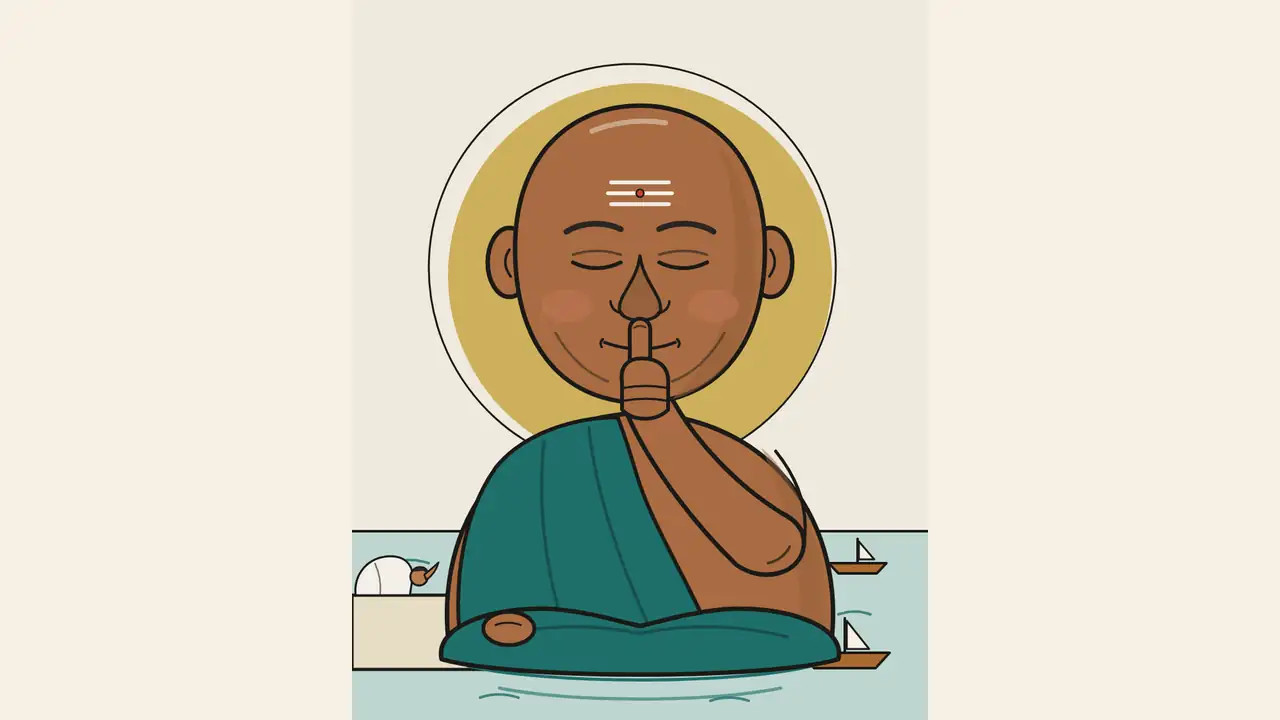
Original illustration drawn for WCRC. © Abhimanyu Ghosh & WCRC.
Spirituality · The Renaissance Masters · No. 13 of 27
Trailanga Swami barely spoke, and Varanasi still listens: authority without announcements
The most famous ascetic on the ghats of Kashi taught mostly through silence and example, and used his rare public praise on a householder clerk. In an age of endless messages, his way of leading is worth a second look.
WCRC Consulting · Strategy into execution
Implement these strategies inside your organisation
Deep analysis of where your organisation stands and a strategic implementation of The WCRC Silent Authority Model, built for your leadership team, culture and business.
Models created exclusively by Abhimanyu Ghosh; proprietary to Abhimanyu Ghosh and WCRC. WCRC's consulting service is not connected with, or endorsed by, any teacher, tradition or organisation discussed here.
Dates
Traditionally 1607 – 1887
Region
Varanasi, Uttar Pradesh
Tradition
Advaita
WCRC model
WCRC-GLC-13
The model in one line
Let your example speak first; honour merit wherever it sits.
The WCRC Silent Authority Model™ · anchored in Mauna (silence as teaching): he spoke rarely, and his presence and example were the teaching
Legend on one side of the ledger, 1887 on the other
Any honest account of Trailanga Swami has to begin by separating what devotees believe from what can be checked. Tradition gives his birth as 1607, at Kumbilapuram near Vizianagaram in present-day Andhra Pradesh, to parents remembered as Narasingha Rao and Vidyavati Devi, and his birth name as Shivarama. Other biographers give 1529. Paramahansa Yogananda, writing in Autobiography of a Yogi, reports that he lived over 300 years. A life of roughly 280 years is a matter of devotion, and this chapter says "according to tradition" whenever it is involved.
The traditional outline runs like this. After his mother's death he is said to have spent about twenty years meditating at a cremation ground. He met his guru, Swami Bhagirathananda Saraswati, traditionally in 1679, and took sannyasa in the Dashanami Saraswati order as Swami Ganapati Saraswati, traditionally in 1685. He then wandered on pilgrimage across India.
He settled in Varanasi, by tradition around 1737, and there people gave him the name by which he is known: Trailanga, the swami from the Telugu country. He lived at the Assi, Hanuman, Dashashwamedh and Panchganga ghats, kept long silences and ate almost nothing. Bengali seekers came to see him, among them Lahiri Mahasaya and, by tradition, Sri Ramakrishna. Mahendranath Gupta, known as "M", visited and fed him sweets.
The end of his life stands on firm ground. He died in Varanasi on 26 December 1887. At his wish the body was not cremated: it was placed in a box and given to the Ganga near Panchganga Ghat, a jal samadhi. The Shri Trailanga Swami Math near that ghat keeps his image and his meditation chamber. He is popularly called the walking Shiva of Kashi, a title often credited to Sri Ramakrishna, though it could not be found in The Gospel of Sri Ramakrishna.
What a silent monk taught without saying it
Trailanga Swami left no writings that can be confidently called his own. Most of what is known of his teaching comes through devotees, chiefly his Bengali biographer Umacharan Mukhopadhyay, and through Yogananda's account. That account presents a teacher whose method was mostly silence. He spoke rarely, and his presence and example were the instruction.
This is the hardest idea in the chapter for a modern executive to accept. Most leadership development assumes that a leader's job is to communicate, and that more communication is better. Trailanga Swami's life points the other way. When a person speaks seldom, each word is weighed. When a person's conduct is consistent for decades, people stop needing to be told what is expected of them.
His teaching on the oneness of all beings came, in the stories devotees tell, as a response to provocation. Yogananda recounts that a man once tried to poison him, and that the swami answered that God was present in his body as in every particle of creation. Devotees recount, too, that a sceptic handed him a pail of lime whitewash and called it curd. He drank it calmly, and it was the sceptic who fell into agony until the swami explained that all lives are one and released him. Harm done to another, in this teaching, returns to the one who does it.
Then there is endurance. Fasting and indifference to heat and cold were, in Yogananda's account, his way of showing that the Self is not the body. Leaders have no need to copy the austerity; the steadiness behind it is the useful part.
A renunciate praises a clerk
The moment that best explains Trailanga Swami's usefulness to leaders involves someone else. Lahiri Mahasaya was a householder who kept an office job and a family. Trailanga Swami was the best-known renunciate on the ghats. By outward measures, the two men were opposites.
Yogananda records that Trailanga Swami openly honoured Lahiri Mahasaya and spoke of him with great affection, comparing him to a divine kitten. A renunciate whose own standing rested on decades of austerity looked at a man with none of the usual credentials and recognised the real thing. Then he said so where people could hear.
Two things make the episode instructive. The first is judgement: he saw merit where his own path gave him no reason to look for it. The second is economy. A man who spoke rarely chose to spend his words on praise for someone else. In a culture that hoards credit, that combination is unusual.
His tradition is sometimes summarised as teaching that realisation does not depend on outer renunciation. That lesson came from him, about a man very different from him, and it has outlived both.
Cheap words, costly deeds
Generated text now costs almost nothing. A leader can produce a polished all-staff note, a thoughtful-sounding post and a personalised thank-you in the time it once took to draft one memo. The result is predictable: words carry less information than they used to, and people look elsewhere for signals they can believe.
Microsoft's 2025 Work Trend Index, a survey of 31,000 workers across 31 markets, reports that employees are interrupted every 2 minutes during core work hours, 275 times a day. Every additional leadership broadcast adds to that count. Trailanga Swami's silence looks less like an eccentricity in that light and more like respect for other people's attention.
Trust, as Mayer, Davis and Schoorman set it out, rests on three characteristics of the trusted party: ability, benevolence and integrity. People judge all three mainly by watching what a leader does over time. No language model can generate them on a leader's behalf. In a period when anyone can sound wise, credibility moves back to the one thing that cannot be automated, which is a consistent record of conduct.
The teaching on oneness has an AI-age reading as well. Automation makes it easy to move cost quietly onto someone else: a customer routed through an endless chatbot, a supplier whose payment terms are set by an algorithm, an employee whose work is monitored more closely than it is supported. Each shift looks efficient on its own. Trailanga Swami's lesson, in the lime and poison stories devotees tell, is that the harm finds its way back to the one who caused it, and a company that forgets this may learn it from its customers.
The WCRC Silent Authority Model
Created by Abhimanyu Ghosh · A proprietary model of Abhimanyu Ghosh and WCRC
WCRC calls this the Silent Authority Model. Its diagram, above, is a simple matrix with words spoken on one axis and example lived on the other. Leaders who talk a great deal and live little of it fall into hollow rhetoric; those who do neither are absent; those who live the example and also talk constantly are credible but noisy. The target quadrant is silent authority: high example, few words. Five building blocks sit beneath it: speak less and signal more, treat example as instruction, endure, recognise merit beyond credentials, and remember that harm to others returns to the organisation. The model scores highest on people leadership and stakeholder trust.
Silent Authority is leadership whose credibility rests on visible conduct rather than volume of words. The leader says less, makes every signal count, holds steady under strain, and has the judgement to recognise real merit even when it carries no title or credential.
Fig. 1The WCRC Silent Authority Model™
© Abhimanyu Ghosh & WCRC
The building blocks
01Speak less, signal moreMauna
Words from the top are scarce and therefore weighty; each one is chosen because people will read meaning into it.
In practiceCut routine leadership broadcasts and keep the few that announce a real decision or a real change.
02Example as instruction
People copy what the leader does far more than what the leader says, so conduct is the primary channel.
In practiceBefore issuing a new rule, the CEO adopts it personally and lets people see that first.
03Endurance
Steadiness under pressure and discomfort is itself a message that the organisation is safe in the leader's hands.
In practiceIn a hard quarter the leader keeps routines, visits and commitments unchanged rather than retreating from view.
04Recognise merit beyond credentials
Judgement means seeing real capability in people whose path, title or background does not fit the usual pattern.
In practiceThe CEO publicly credits one contributor each quarter whose impact outran their rank or résumé.
05Oneness
Harm done to a colleague, customer or partner eventually returns to the organisation that did it.
In practiceTest major decisions by asking who bears the cost and whether that cost will come back to the firm.
Fewer messages, heavier ones
The first decision the model asks of a CEO is subtraction. Look at your recurring leadership communications and ask which of them announce a real decision or a real change. Keep those. The rest are habit, and they train people to skim.
The second is order. When a new rule arrives, whether a travel freeze, a return-to-office policy or a new approval limit, the CEO adopts it first and visibly, before asking anyone else to. Collins describes Level 5 leaders as those in whom "extreme personal humility blends paradoxically with intense professional will." Doing the rule yourself before you announce it is a small, daily form of that humility.
The third concerns hard quarters. The temptation when results turn is to retreat: fewer visits, cancelled reviews, more time behind closed doors. Trailanga Swami's endurance points the other way. Keep the routines, keep the visits and keep the commitments, because the steadiness itself tells people the organisation is in safe hands.
The blind spot is the obvious one, and it is serious. Silence can turn into absence. In a crisis, people need to hear from the leader, and withholding words then reads as hiding. Silent authority means few words in ordinary times so that the leader's voice carries when it is needed. It never means vanishing when the building is on fire.
The founder who does the rule first
Start-ups produce more founder words than almost any other kind of organisation. There is the weekly update, the all-hands, the investor letter, the social posts, the podcast. Much of it is useful. Some of it is a founder filling silence because silence feels like failure.
The Silent Authority approach suggests a test: if there is no decision to share this week, skip the update. Your team will learn that when you do speak, something has changed.
Small companies are also where merit beyond credentials is easiest to see and easiest to miss. The founder knows everyone, and so can notice the operations hire who quietly fixed the billing system, or the self-taught engineer who carries the hardest module. Trailanga Swami's praise of Lahiri Mahasaya is the pattern. Say publicly, and specifically, what that person did. And when someone without the usual background gets a role, explain why, so the decision reads as judgement.
A caution for founders who like the austerity in this story: restraint performed for effect is still performance. If your frugality has become part of your personal brand, it has stopped being restraint.
Counting words against deeds
Large organisations can measure this model more precisely than most. A say-do ratio is straightforward: list the public commitments leadership made in a quarter and record how many were delivered on time and as stated. A message count is easier still. Most communications teams already know how many all-staff emails, posts and town halls left the leadership office last month.
Edelman's 2026 Trust Barometer, which surveyed 33,938 respondents in 28 countries, finds that employers are best positioned to broker trust across divides. A company whose leaders say less and deliver what they say is better placed to take up that role than one that floods every channel.
Boards should add a question about talent. The model's fourth building block asks leaders to recognise merit beyond credentials, and the KPI below tracks the share of promotions and key roles going to people without the conventional degree, pedigree or path. A board that reviews that number each year is asking whether the company can see a Lahiri Mahasaya when one walks in.
Finally, the oneness test. Before a major decision, ask who bears the cost and whether that cost will return to the firm. Layoffs handled carelessly, suppliers squeezed past endurance, customers misled by fine print: in Trailanga Swami's teaching, the harm comes back.
The business model
Inside a company, the model takes the leader's own conduct and routines as its main input, along with a small set of clear commitments, visibility on the floor and a habit of noticing talent that does not show up on lists. The practices are disciplined: fewer and weightier leadership messages, the leader adopting every rule first, public credit for overlooked contributors and a cost-to-others test on big decisions. The outputs are a close match between words and deeds and signals people read correctly. Over time the company gains steady stakeholder trust, a culture that copies good conduct, a wider talent pipeline and less noise.
Fig. 2Operating model: running the WCRC Silent Authority Model
© Abhimanyu Ghosh & WCRC
Inputs
What the company commits
- Leader's personal conduct and routines
- A small set of clear commitments
- Visibility on the floor and in the field
- A habit of noticing unlisted talent
Practices
What leaders do, repeatedly
- Fewer, weightier leadership messages
- Leader adopts every rule first
- Public credit for overlooked contributors
- Cost-to-others test on big decisions
Outputs
What changes in the work
- High match between words and deeds
- Signals people read correctly
- Talent spotted beyond credentials
- Calm, consistent presence in difficulty
Outcomes
What the enterprise gains
- Durable stakeholder trust
- Culture that copies good conduct
- Wider, fairer talent pipeline
- Lower noise in the organisation
The benefit model
The leader gains most directly: authority that no longer depends on constant communication frees energy for deciding and doing. Employees get clear signals and a model they can copy, and people without the usual credentials see that real contribution is noticed. Customers deal with a company whose promises are few and kept, and investors receive guidance they can rely on. The wider community gains from a business that tests decisions against harm to others before it acts.
Fig. 3Benefit model: who gains what
© Abhimanyu Ghosh & WCRC
The leader
Authority stops depending on constant communication, so the leader spends less energy persuading and more on deciding and doing.
Employees
They get clear signals and a model they can copy, and those without the usual credentials see that real contribution is noticed.
Customers
They deal with a company whose public promises are few and kept, which makes its word worth more.
Investors
Guidance becomes more reliable because the leader says less and delivers what was said.
Society
A business that tests decisions against harm to others carries fewer hidden costs into the community around it.
Fig. 4Where the model moves the needle
© Abhimanyu Ghosh & WCRC
- Vision Quotient
- ●●●●●
- Impact Index
- ●●●●●
- Innovation Score
- ●●●●●
- People Leadership
- ●●●●●
- Stakeholder Trust
- ●●●●●
- Resilience Factor
- ●●●●●
- Global Mindset
- ●●●●●
How to implement the WCRC Silent Authority Model
Your first move
Cancel the routine leadership broadcasts on this week's calendar and keep only the ones that announce a real decision or change.
If you are the founder or CEO
- 1
Cut your own message load
In the first week, stop routine all-staff emails and posts from your office and keep only messages that carry a real decision. Tell people why, once, and then let the silence work.
- 2
Adopt every rule first
Before any new rule goes out, follow it yourself where people can see it, for at least a few weeks. If you will not live by it, do not issue it.
- 3
Keep routines in hard times
In a bad quarter, keep your visits, reviews and commitments unchanged instead of retreating. Where people need to hear from you in a crisis, speak briefly and plainly; silence must never become absence.
- 4
Credit one overlooked contributor
Every quarter, publicly credit someone whose impact outran their title, degree or background. A founder can find them directly; a large-company CEO should ask managers for names and check the work personally.
- 5
Test decisions for cost to others
Before each major decision, ask who bears the cost and whether it will come back to the firm, and say the answer aloud in the meeting. Make this a habit every time.
Rolling it out across the company
| Step | Owner | What the company puts in place |
|---|---|---|
| 01Count words against deeds | CEO office | List last quarter's public leadership commitments and all-staff messages, and record which were delivered and how clear people found them. This gives the baseline say-do ratio and message load. |
| 02Pilot in one leadership team | One business head and their team | Have one leadership team cut routine broadcasts, adopt each new rule first and credit one overlooked contributor in a quarter. Compare clarity and modelling scores with other teams. |
| 03Embed merit beyond credentials | CHRO | Change promotion and key-role criteria so observed work counts above degree, pedigree or conventional path. Add the cost-to-others test to the template for major decision papers. |
| 04Train managers to lead by example | CHRO and all people managers | Coach managers to model a change before asking for it and to spot capable people outside the usual pattern. Warn them against performing restraint for show. |
| 05Track say-do and signal quality | CEO office with HR analytics | Report the say-do ratio, leadership message load against clarity ratings, the modelling score and non-traditional promotions every quarter. Discuss gaps openly at the leadership meeting. |
| 06Scale and review for absence | CEO and board | Extend the practice to all leadership teams once say-do and modelling scores improve, and review each year whether quiet leadership has slipped into absence during difficulty. Fix any team where people say they no longer hear from leaders when it matters. |
The execution roadmap
Four phases, each closed by a gate. Do not move on until the gate is met.
Days 0–30
Phase 1 · Diagnose and commit
Count how much leadership says against how much it delivers, and commit to fewer, weightier words.
- Count every all-staff email, post and town hall from the leadership office over the past few months, as the baseline for 'Speak less, signal more'.
- List last quarter's public leadership commitments and record which were delivered on time and as stated.
- Add the item 'senior leaders do what they ask of us' to the next employee survey.
- Record the share of recent promotions and key roles that went to people without the conventional degree, pedigree or path.
Deliverable
A words-against-deeds audit and a list of the routine broadcasts the leadership team agrees to stop.
Gate to proceed
Baseline recorded for all four KPIs, and the leadership team has agreed in writing which routine broadcasts end.
Days 31–90
Phase 2 · Pilot and prove
Prove in one leadership team that fewer words and visible example raise trust and clarity.
- The pilot business head stops routine broadcasts and keeps only those that announce a real decision or change.
- Before issuing any new rule, the head adopts it personally and lets the team see that first, as example as instruction.
- Through the next hard month, the head keeps routines, visits and commitments unchanged rather than retreating from view.
- The head publicly credits one contributor whose impact outran their rank or résumé, and applies the oneness test to one major decision by asking who bears its cost.
Deliverable
A pilot note comparing message count, clarity ratings and the say-do ratio before and after.
Gate to proceed
The pilot team's message count is down against baseline with clarity ratings holding or rising, and every commitment made in the pilot is tracked to delivered or openly explained.
Days 91–180
Phase 3 · Embed and scale
Turn the pilot habits into leadership rules and promotion practice.
- Adopt a rule across the leadership office: no broadcast unless it carries a decision or a change.
- Require promotion panels to consider at least one candidate whose path does not fit the usual pattern, and record why they were or were not chosen.
- Train managers to introduce new expectations by doing them first, using real cases from the pilot.
- Add the oneness question, who bears the cost and will it return to us, to every major investment paper.
Deliverable
A leadership communication rule, revised promotion criteria and an updated investment paper template.
Gate to proceed
The say-do ratio is reported for every leadership team, and promotion panels are documenting non-traditional candidates.
Month 7 onwards
Phase 4 · Sustain and renew
Keep restraint meaningful and stop it sliding into absence or performance.
- Write a crisis exception: in a crisis leaders speak more often, at fixed times, and the restraint rule is paused.
- Review once a year whether any leader's restraint has become a display rather than a practice.
- Re-run the modelling survey item and compare say-do ratios year on year.
- Check that the endurance shown at the top is not hiding real strain on the leader or the team.
Deliverable
An annual signal-quality review covering say-do, message load, modelling score and non-traditional promotions.
Gate to proceed
The modelling score holds or rises year on year, and staff say they heard enough from leaders during the last crisis.
Governance
- Sponsor
- The CEO, because silence only carries weight if the most senior voice changes first.
- Lead
- The head of the CEO office, who keeps the commitment register and the count of leadership messages.
- Review forum
- Quarterly in the leadership meeting, with the say-do ratio reported to the board once a year.
- Decision rights
- The lead can stop routine broadcasts and log commitments without approval; invoking the crisis exception and changing promotion criteria go to the sponsor.
Operating rhythm
- WeeklyThe CEO office reviews draft leadership broadcasts and stops any that carry no decision or change.
- MonthlyThe commitment register is updated with each public promise marked delivered, late or dropped, with the reason.
- QuarterlyThe CEO publicly credits one contributor whose impact outran their rank or credentials, and says why.
- AnnuallyThe modelling survey item and the absence review: are leaders doing what they ask, and were they heard when it mattered?
Implementation risks and how to handle them
| Risk | Early warning | Mitigation |
|---|---|---|
| Silence is read as absence when the organisation is under strain. | Rumours rise and managers report more questions about what leadership thinks. | Trigger the crisis exception early, with fixed update times and the leader seen in person. |
| Leaders protect the say-do ratio by making fewer or vaguer commitments. | Commitments per quarter fall and more of them lack a date or a measurable outcome. | Require every logged commitment to carry a date and a stated outcome, and report the count alongside the ratio. |
| Managers copy the cut in words but not the example, and teams become under-informed. | Team-level clarity scores fall below leadership-level scores. | Make clear the rule covers broadcasts only; regular one-to-ones and team conversations continue as before. |
| Recognition of merit beyond credentials is seen as favouritism by credentialed staff. | The same kind of person is credited each quarter, and complaints of patronage appear in pulse comments. | Publish the reasons for each credit and rotate who nominates. |
By stage of company
Startup
Founder-led, under ~50 people
The founder drops the weekly all-hands update unless there is a decision to share, and does every new rule personally before asking others to. Promotions are discussed openly, with the founder saying why someone without the usual background got the role.
Scale-up
~50 to 1,000 people
The CEO office keeps a commitment register and a monthly count of leadership messages, and promotion panels must consider at least one non-traditional candidate. Managers are trained to lead new expectations by doing them first.
Enterprise
Large or listed company
Every leadership team reports its say-do ratio, and the communications function enforces the no-decision, no-broadcast rule. The board reviews the say-do ratio and non-traditional promotions each year and checks that restraint has not become absence.
Are you ready?
- Do our senior leaders follow a new rule themselves before they ask others to?
- Could we cut most routine leadership messages without people losing information they need?
- Do our promotion criteria let real capability count above title or credentials?
What success looks like at 12 months
- Staff say leadership messages are fewer and that they read every one.
- Leaders are seen doing what they ask of others before they ask it.
- People without the usual degree or path hold key roles, and colleagues can say why they earned them.
Habits to start this quarter
- 1
Read your own sent folder
Spend thirty minutes this month reading every message you sent to more than ten people. Mark the ones that announced a decision. Count the rest.
- 2
Hold one silent meeting
In one regular meeting this quarter, say nothing for the first half. Listen, take notes and speak only when you have a decision or a question. Ask a colleague afterwards what changed in the room.
- 3
Keep a promise register
Write down every commitment you make in public this quarter, however small, in one list. Review it each Friday and close what you can.
- 4
Write the one-line version first
Before you send any message to a large group this quarter, write the decision it carries in a single line at the top. If you cannot, do not send it yet.
- 5
Credit someone you would have overlooked
Once this quarter, find a contributor whose impact outran their title or background and name what they did, specifically, in a forum where their peers will hear it.
What to measure
| Leading indicator | How to measure it |
|---|---|
| Say-do ratio | List public leadership commitments each quarter and record the share delivered on time and as stated. |
| Leadership message load | Count all-staff emails, posts and town halls from the leadership office per month and track the trend against employee survey ratings of clarity. |
| Modelling score | Add a survey item such as "senior leaders do what they ask of us" and track the agreement rate over time. |
| Non-traditional promotions | Track the share of promotions and key roles going to people without the conventional degree, pedigree or path for that role. |
Where the model goes wrong
- Silence turns into absence: in a crisis people need to hear from the leader, and withholding words reads as hiding.
- Endurance becomes a display of toughness that ignores real strain on the leader and the team.
- Austerity becomes a status symbol, so the leader's restraint is performed for effect rather than practised.
What the ghats remember
WCRC's view is that the Silent Authority Model will matter more each year that machines make words cheaper. Leaders who keep talking will be heard less. Leaders whose conduct is consistent, whose promises are few and kept, and who notice merit in unexpected places will find that people believe them without needing to be persuaded.
What Varanasi remembers of Trailanga Swami is how he lived, and the clerk he chose to honour. Of speeches there were almost none. Say less, and make sure what you do can be read from across the river.
Powerfacts
- Who was Trailanga Swami of Varanasi?
- Trailanga Swami was a yogi and Dashanami monk who lived on the ghats of Varanasi and died there on 26 December 1887. Tradition holds that he was born in 1607 near Vizianagaram in present-day Andhra Pradesh, a lifespan devotees accept as faith. He spoke rarely and taught mainly through silence and example.
- What is the WCRC Silent Authority Model?
- It is WCRC's model of leadership whose credibility rests on visible conduct more than on volume of words. The leader speaks less, adopts every rule first, holds steady under strain and recognises merit beyond credentials. Its diagram places 'silent authority' where example is high and words are few.
- Why does silent authority matter in the AI age?
- Generated text has made words cheap, so people rely more on conduct to judge leaders. Microsoft's 2025 Work Trend Index reports employees are interrupted every 2 minutes during core work hours, 275 times a day. Fewer, weightier messages and kept commitments cut through that noise.
Sources
- Autobiography of a Yogi, ch. 31 (1946 text), Paramahansa Yogananda; Crystal Clarity
- Autobiography of a Yogi, Project Gutenberg
- The Gospel of Sri Ramakrishna, M., Internet Archive
- 2025: The Year the Frontier Firm Is Born, Work Trend Index, Microsoft WorkLab
- An integrative model of organizational trust (Mayer, Davis and Schoorman, 1995), Academy of Management Review
- Level 5 leadership: The triumph of humility and fierce resolve (Collins), Harvard Business Review
- 2026 Edelman Trust Barometer, Edelman
Read Trailanga Swami's life and teachings on Gurushakti.
The WCRC Silent Authority Model™ (WCRC-GLC-13) is part of The WCRC Guru Leadership Codex™. Created exclusively by Abhimanyu Ghosh; a proprietary model of Abhimanyu Ghosh and WCRC. © 2026 Abhimanyu Ghosh and World Centre for Research and Consulting. All rights reserved.