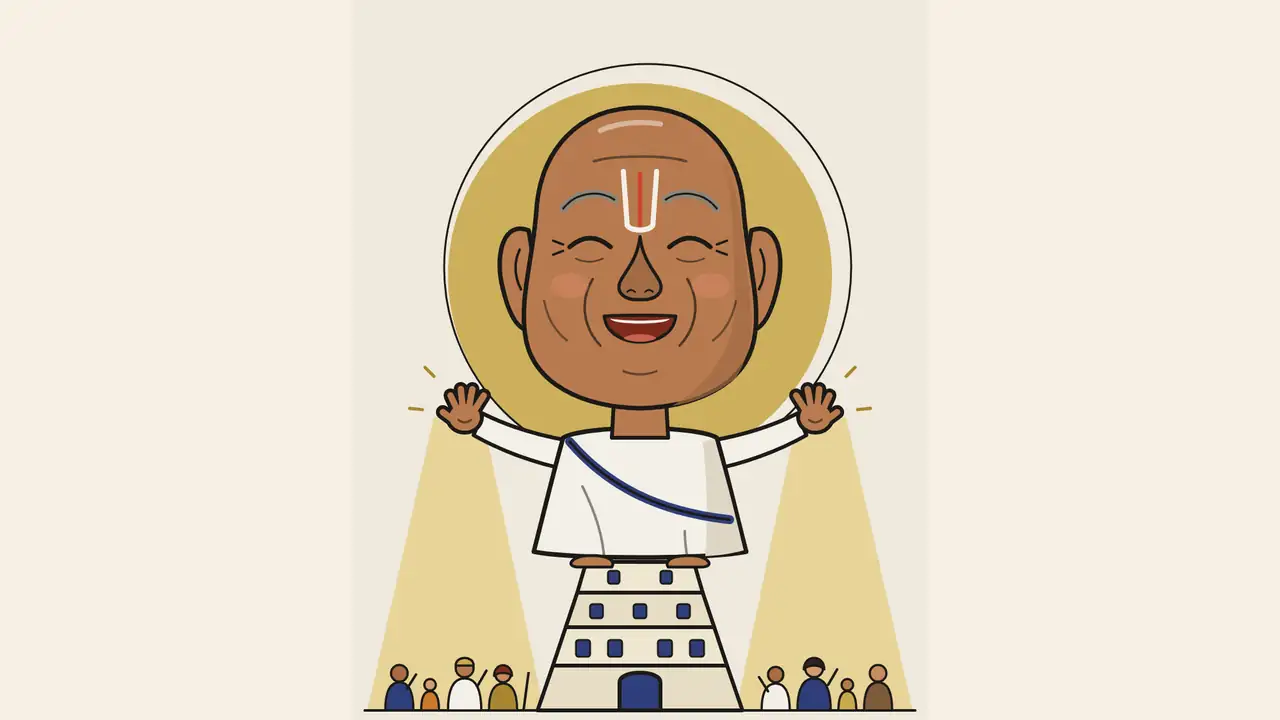
Original illustration drawn for WCRC. © Abhimanyu Ghosh & WCRC.
Spirituality · The Classical Acharyas · No. 02 of 27
Ramanujacharya climbed the temple tower: what a leader risks, and gains, by giving away the secret
A teacher told to keep a mantra to himself shouted it to the crowd instead. Nine centuries later, the question he answered is the one every company faces as it decides who gets the tools, the data and the reasons.
WCRC Consulting · Strategy into execution
Implement these strategies inside your organisation
Deep analysis of where your organisation stands and a strategic implementation of The WCRC Open Gopuram Model, built for your leadership team, culture and business.
Models created exclusively by Abhimanyu Ghosh; proprietary to Abhimanyu Ghosh and WCRC. WCRC's consulting service is not connected with, or endorsed by, any teacher, tradition or organisation discussed here.
Dates
Traditionally 1017 – 1137
Region
Srirangam, Tamil Nadu
Tradition
Vedanta
WCRC model
WCRC-GLC-02
The model in one line
Open the tower: share what you know with all.
The WCRC Open Gopuram Model™ · anchored in The sacred mantra shared from the temple tower at Thirukoshtiyur
A life told through the people around him
Ramanujacharya is easiest to understand through the people who shaped him and the people he shaped. Born at Sriperumbudur, near today's Chennai, into a Brahmin family, he is traditionally dated from 1017 to 1137 CE, a lifespan of 120 years that the Sri Vaishnava tradition and Britannica both record. Some recent scholarship, cited by the Internet Encyclopedia of Philosophy, proposes 1077 to 1157 instead. Most of what follows comes from later hagiographies, the Guruparampara texts, and is told here as tradition holds it.
His first teacher was Yadavaprakasha at Kanchipuram. They disagreed over the meaning of the Upanishads, and tradition goes so far as to say the teacher plotted against the student's life. In the same years the young man befriended and learnt from Kanchipurna, a temple servant of a lower caste, which the custom of the day did not allow. One teacher of high standing turned against him; one man of low standing became his mentor. The pattern repeats through the rest of his life.
The most important teacher was one he never met alive. Yamunacharya, head of the Sri Vaishnavas at Srirangam, died before Ramanuja could reach him. Devotees recount that three of the dead teacher's fingers were folded, and that they opened only when Ramanuja vowed to fulfil three unfinished wishes, one of them a commentary on the Brahma Sutras. He was initiated by Periya Nambi, later took sannyasa at Kanchipuram and became known as Yatiraja, king of ascetics.
At Srirangam he led the community and reorganised temple worship. He wrote the Sri Bhashya, the Vedartha Sangraha and the Gita Bhashya, the three works whose authorship is secure, and travelled across India in debate. Tradition then tells of persecution by a Chola king, whose identity is disputed. Ramanuja fled to Karnataka and lived about twelve years at Melukote under Hoysala patronage, where he opened the temple to people of all castes. His disciple Kuresha, who went to the king's court in his place, is said to have been blinded.
He returned to Srirangam and, by the traditional reckoning, died there in 1137. Tradition speaks of 74 lineage-holders who carried his teaching on, and his preserved form is still venerated in a shrine at the Srirangam temple. In 2022, for his thousandth birth anniversary, a 216-foot statue in Hyderabad was dedicated to him under the name Statue of Equality. The name chosen for it says what his followers most want remembered.
A real world, so real people
Ramanuja taught Vishishtadvaita, usually rendered as qualified non-dualism. God is one. Souls and the world are real and distinct, and they relate to God as a body relates to its soul. The world is God's real body and creation, which is why Ramanuja would not treat it as illusion to be escaped.
That doctrinal position has a very practical consequence. If the world is real and sacred, then the welfare of the people in it matters now, in this life, and not only as a step towards something beyond it. A teacher who holds that view cannot be relaxed about who is let into the temple and who is kept outside.
His account of devotion joins love and work. Bhakti, for him, is constant loving remembrance of God combined with selfless duty. Beside it sits prapatti, or sharanagati: taking refuge in God and admitting no other refuge. In the Vedartha Sangraha he writes, in substance, that surrender to the supreme Lord is the way to emancipation and that no other way is needed. The Internet Encyclopedia of Philosophy stresses that this path is open to all.
Put those ideas together and the social teaching follows almost by logic. Caste does not decide who may approach God. Mantras and temple access are to be shared widely, not rationed. The Press Information Bureau's account of the 2022 dedication and the Statue of Equality's own material both describe him chiefly in those terms.
Leaders should notice the shape of the argument. Ramanuja opened the gates because his view of what people are made rationing indefensible. Openness in a company lasts only when it rests on a view of that kind about the people inside it.
Thirukoshtiyur: the mantra and the tower
The story his tradition tells most often takes place at the temple of Thirukoshtiyur, in present-day Sivaganga district. Devotees recount that the teacher Thirukoshtiyur Nambi taught Ramanuja the sacred eight-syllable mantra and told him to keep it secret.
Ramanuja climbed the temple tower and gave the mantra to the crowd below.
Warned that breaking the instruction would send him to hell, he is said to have answered that he would go gladly if so many people were saved. His guru embraced him and called him Emperumanar. In the tradition's memory, this is the moment when knowledge kept for a few became open to all.
A gopuram is the gateway tower of a South Indian temple, the structure that defines the boundary between outside and inside. Ramanuja used the boundary itself as a platform. That inversion gives this chapter's model its name and its central question for any leader: what are you guarding from the top of your tower that would do more good if you called it out to everyone below?
Who gets the tools when the tools think
In earlier technology cycles, access to a new system was largely a question of licences and budget. With AI it is a question of who rises. The person who gets the tool, the data behind it and the training to use it well accumulates judgement that colleagues without access do not. Within a few years, the rollout plan becomes a promotion list.
Microsoft's 2026 Work Trend Index, which surveyed 20,000 workers using AI across ten countries, found that organisational factors such as culture, manager support and talent practices account for more than twice the reported AI impact of individual factors (67% versus 32%). The same report found that only one in four AI users surveyed (26%) say their leadership is clearly and consistently aligned on AI. Read in Ramanuja's terms, the gate matters more than the worshipper, and the people keeping the gate have not agreed who should pass.
There is a quieter problem underneath. Connelly and colleagues, writing in the Journal of Organizational Behavior in 2012, define knowledge hiding as an intentional attempt to withhold or conceal knowledge that another person has asked for, and they separate it from simply failing to share. In an AI rollout this looks like the team that keeps its prompts, datasets or workflows to itself because they confer status. Each instance is small. Together they rebuild the inner sanctum that Ramanuja climbed out of.
The model's question for the AI age is therefore narrow and testable. Look at who has access to AI tools and training today, by level, function and background. Then ask whether your rollout is opening the gate or narrowing it.
The WCRC Open Gopuram Model
Created by Abhimanyu Ghosh · A proprietary model of Abhimanyu Ghosh and WCRC
WCRC calls this the Open Gopuram Model. Its premise is that knowledge hoarded at the top protects a few people, while knowledge shared widely lifts the whole institution. The diagram above draws it as concentric rings, widening from the leadership circle to the second line, the whole workforce, customers and partners, and finally the wider ecosystem. Four moves carry it: open the knowledge, lower the gate, surrender the ego of position, and build a loyal second line able to carry the work when the leader cannot. The first two come from the tower and from Melukote; the last two come from Ramanuja's surrender and from Kuresha.
The Open Gopuram Model holds that knowledge hoarded at the top protects a few, while knowledge shared widely lifts the whole institution. It asks leaders to open access ring by ring, from the inner circle to the wider ecosystem, to let go of the ego of position, and to build a second line trusted enough to carry the work when the leader cannot.
Fig. 1The WCRC Open Gopuram Model™
© Abhimanyu Ghosh & WCRC
The building blocks
01Open the knowledge
Strategy, data, skills and context that sit with the top team are shared as widely as safety and law allow.
In practiceThe CEO publishes the reasoning behind major decisions to the whole organisation, not only the decision.
02Lower the gate
Remove the barriers of rank, background and credentials that decide who gets access to opportunity, tools and leaders.
In practiceThe CEO reviews who gets training, stretch roles and new tools, and opens them to groups that have been left out.
03Surrender ego of positionPrapatti (surrender)
Like taking refuge with no other refuge, the leader stops treating the title as the source of authority and accepts personal risk for the wider good.
In practiceThe CEO accepts visible criticism for opening a gate, as Ramanuja accepted the warning on the tower.
04Build a loyal second line
Tradition holds that Kuresha went to the Chola court in Ramanuja's place. Loyalty of that kind is earned by sharing, and an institution needs successors who carry the work in the leader's absence.
In practiceThe CEO names and develops successors for every critical role and gives them real authority before it is needed.
Giving up the title as the source of authority
The hardest component for a chief executive is the third: surrendering the ego of position. In Ramanuja's teaching, prapatti means taking refuge with no other refuge. Applied to leadership, it asks the CEO to stop treating the title as the reason people should follow, and to accept personal risk for the wider good, as Ramanuja accepted the warning on the tower.
In practice, this shows up in a few decisions. Publishing the reasoning behind a major decision, including the options rejected, invites argument that a bare announcement avoids. Opening stretch roles and new tools to people outside the usual pipeline draws objections from senior colleagues who benefited from the old gate. The model expects the CEO to answer those objections personally and in the open.
Amy Edmondson's research gives a useful frame. In a 1999 study in Administrative Science Quarterly, she defined team psychological safety as a shared belief held by members of a team that the team is safe for interpersonal risk taking, and found it associated with team learning behaviour across 51 work teams. A leader who shares reasons, and tolerates being questioned on them, makes that belief easier to hold.
The blind spot runs the other way too. Surrender of positional ego can slide into abdication, where the leader shares everything and decides nothing. Ramanuja's guru remained the guru after the tower; the embrace was an act of authority. A CEO who opens the knowledge must still make the call when the call is theirs.
The founder who is the only key to the temple
Founders often begin as the whole of the inner sanctum. They hold the customer relationships, the product logic, the investor history and the reasons behind every early choice. For the first year this is efficient. By the third it is the company's largest single risk, and usually its most invisible one.
If you founded a sixty-person company, try a simple exercise. List the things that only you know and that the company needs to function. Then mark which of them you keep to yourself by necessity and which by habit, comfort or a quiet sense that knowing them is what makes you the founder. The second group is your temple secret.
Ramanuja's early life offers founders a second lesson about whom to learn from. His most valuable mentor in youth was a temple servant whom custom said he should not befriend. Founders who take advice only from people with recognisable credentials cut themselves off from the person in the support queue or the warehouse who sees the problem first.
The model's founder guidance is plain: share reasoning at the weekly all-hands, give every hire the same tools and data access from day one, and name the small group who can run an area while you are away. That last step is where Kuresha comes in, and where boards should pay attention.
Kuresha and the board's succession question
Devotees recount that when the Chola king summoned Ramanuja, his disciple Kuresha went to the court in his master's robes so that Ramanuja could escape, and lost his eyesight for it. The account comes from later hagiography, and it should be read with that care. Its point for an institution is still clear. The teaching survived because there was someone ready, trusted and willing to stand in the leader's place.
Boards of large companies often treat succession as an emergency file. The Open Gopuram Model treats it as the natural result of sharing. A second line can carry the work only if it has been given real authority, real context and access to the same knowledge as the top team, well before it is needed.
There is a trust question here that boards should ask directly. Mayer, Davis and Schoorman, in a 1995 paper in the Academy of Management Review, identified three characteristics of a trustworthy party: ability, benevolence and integrity. A succession bench is a bet on all three, and a board can test each one. Has the successor run something real? Do they act for the institution when no one is watching? Do their words and actions match over time?
The failure mode the model names is loyalty that becomes personal allegiance. The loyalty worth building is loyalty to the institution and its purpose. A second line that exists to protect one executive, rather than the institution, is a liability dressed as a bench. Directors should be able to tell the difference, and the governance arrangements in the playbook below give the nominations committee the means to ask.
The business model
The operating model below starts with what senior leaders already hold: knowledge, data, tools and training budgets, plus a leader willing to take criticism. It turns these into a handful of habits, such as opening decision rationale to all staff, spreading access to AI tools and training fairly, keeping succession benches for critical roles and sharing knowledge with partners and customers. The visible outputs are fewer silos, wider participation in problem-solving and ready successors. Over time those produce higher trust across ranks and continuity when leaders change.
Fig. 2Operating model: running the WCRC Open Gopuram Model
© Abhimanyu Ghosh & WCRC
Inputs
What the company commits
- Knowledge held by senior leaders
- Data, tools and training budgets
- A leader willing to take criticism
Practices
What leaders do, repeatedly
- Open decision rationale to all staff
- Fair access to AI tools and training
- Succession benches for critical roles
- Partner and customer knowledge sharing
Outputs
What changes in the work
- Less knowledge hidden in silos
- Wider participation in problem-solving
- Ready successors for key roles
Outcomes
What the enterprise gains
- Higher trust across ranks
- Continuity through leadership change
- Broader capability across the ecosystem
The benefit model
The leader gains most quietly: no longer the single gate for knowledge, they have more time and the company has less key-person risk. Employees gain access to context, tools and growth once kept for a few, with the dignity that comes with being trusted. Customers meet front-line staff who understand why decisions were made and can use judgement instead of escalating. Investors see a stronger bench and a business that is easier to value over the long term, and society gains when companies narrow skill gaps internally that would otherwise widen outside. The benefit model below sets out each group.
Fig. 3Benefit model: who gains what
© Abhimanyu Ghosh & WCRC
The leader
The leader is no longer the single gate for knowledge, which frees time and lowers the risk of the organisation depending on one person.
Employees
People at every level gain access to context, tools and growth that were once reserved for a few, and are treated with equal dignity.
Customers
Front-line staff who understand the reasoning behind decisions can serve customers with more judgement and less escalation.
Investors
A trusted second line and spread capability reduce key-person risk and make the company easier to value over the long term.
Society
Wider access to knowledge and skills inside companies narrows gaps that would otherwise widen outside them.
Fig. 4Where the model moves the needle
© Abhimanyu Ghosh & WCRC
- Vision Quotient
- ●●●●●
- Impact Index
- ●●●●●
- Innovation Score
- ●●●●●
- People Leadership
- ●●●●●
- Stakeholder Trust
- ●●●●●
- Resilience Factor
- ●●●●●
- Global Mindset
- ●●●●●
How to implement the WCRC Open Gopuram Model
Your first move
On Monday, write to every employee explaining the reasoning behind your most recent major decision.
If you are the founder or CEO
- 1
Share one decision's reasoning
In the first week, explain to all staff the reasoning behind one recent major decision, including the options you rejected. In a small company this can be a team meeting; in a large one, a written note from you.
- 2
Review who gets access
Within the first month, sit with HR and IT and look at who receives training, stretch roles and AI tools, by level and background. Decide personally which gates to open first.
- 3
Take criticism in the open
When opening a gate draws objections from senior colleagues, answer them yourself and in public. Accept the personal risk that prapatti asks for, and do not pass the objection down to a manager.
- 4
Name successors for critical roles
Each quarter, name a ready or developing successor for every critical role, including your own, and give them real authority in a defined area now. Founders should start with the roles only they can currently do.
- 5
Decide after you share
Make it a standing habit to share context widely and still make the call yourself when it is yours to make. Sharing everything and deciding nothing is abdication.
Rolling it out across the company
| Step | Owner | What the company puts in place |
|---|---|---|
| 01Map where knowledge sits | CEO office with CHRO | Identify which strategy, data and skills are held only by the top team and who is currently shut out of training and tools. Use IT and HR records as the baseline for AI and training access spread. |
| 02Open one gate first | One business head | Pilot open decision rationale and fair access to AI tools and training in one unit for a quarter, with clear rules on confidential data. Check whether people get the information they ask for. |
| 03Write openness into policy | CEO office, CHRO and legal | Set a policy that the rationale for major decisions is shared with all staff within an agreed period, with a defined list of what stays confidential by law or safety. Open training and stretch roles to application from every level. |
| 04Train managers to share context | CHRO | Train all people managers to explain decisions and data in terms their teams can use, and to develop a named successor. Include what must not be shared and why. |
| 05Report the open-gopuram KPIs | Internal communications and HR | Track AI and training access spread, knowledge-sharing climate, succession bench strength and decision rationale reach, and report them to the leadership team every quarter. Break results down by level so closed gates show up. |
| 06Extend to partners and review | Board nominations committee | Once internal sharing works, extend knowledge sharing to key partners and customers, and review succession bench strength at board level every year. Watch for second-line loyalty turning into personal allegiance. |
The execution roadmap
Four phases, each closed by a gate. Do not move on until the gate is met.
Days 0–30
Phase 1 · Diagnose and commit
Map who holds knowledge, tools and opportunity today, and choose the first gate to open.
- Map where strategy context, data and skills sit by level and function, ring by ring from the leadership circle outwards.
- Review who receives AI tools, training and stretch roles by level and background (Lower the gate).
- Agree with legal and IT a classification of information as open, open with context, or restricted, so opening stays safe.
- The CEO publishes the reasoning behind one recent major decision, including the options rejected (Open the knowledge).
Deliverable
A knowledge and access map, with a signed-off classification of what can be shared at each ring.
Gate to proceed
Baseline recorded for every KPI, the information classification signed off by legal, and one business head agreed to open the first gate.
Days 31–90
Phase 2 · Pilot and prove
Prove in one unit that opening a gate widens capability without exposing confidential data.
- Open AI tools and training in the pilot unit to the levels and groups previously left out.
- Share the reasoning for every major unit decision with all its staff within an agreed period.
- Name a developing successor for each critical role in the unit and hand them authority over a defined area (Build a loyal second line).
- The CEO answers in public the objections senior colleagues raise to the opening (Prapatti).
Deliverable
A pilot report comparing access spread and knowledge-sharing climate before and after, with any data incidents logged.
Gate to proceed
Access spread in the pilot unit has widened at the levels previously left out, no confidential data incident is traced to the opening, and every critical role in the unit has a named successor holding real authority.
Days 91–180
Phase 3 · Embed and scale
Write openness into policy and widen the gopuram from the workforce ring to customers and partners.
- Publish an openness policy that makes sharing decision rationale the default and sets fair access rules for AI tools and training.
- Train managers to share context and reasoning with their teams, not only instructions.
- Take the succession bench for every critical role, the CEO's included, to the board nominations committee.
- Begin sharing relevant know-how with key partners and customers, within the agreed classification.
Deliverable
An approved openness policy and a succession bench reviewed by the board.
Gate to proceed
Decision rationale reach is logged company-wide, and the nominations committee has reviewed a named successor for every critical role, including the CEO's.
Month 7 onwards
Phase 4 · Sustain and renew
Keep the gate open as people, tools and partners change, and keep the second line loyal to the institution.
- Run an access review before every new AI tool or training programme is rolled out.
- Rotate second-line leaders across bosses and units so their loyalty attaches to the institution, not to a person.
- Extend knowledge sharing to the wider ecosystem, such as suppliers and industry bodies.
- The CEO checks where sharing has slid into abdication and keeps ownership of the decisions that are theirs.
Deliverable
An annual open-gopuram review to the board covering access, climate, bench strength and reach.
Gate to proceed
Every new AI tool or training programme has passed the access review before rollout, and second-line leaders have run their areas through a full cycle without escalating routine decisions.
Governance
- Sponsor
- The CEO, because only the person at the top can absorb visible criticism for opening a gate the senior team would prefer to keep closed.
- Lead
- The CHRO working with the CIO, since access to training, roles and AI tools runs through HR and IT records.
- Review forum
- Monthly in the leadership meeting for access spread and rationale reach; quarterly at the board nominations committee for the succession bench.
- Decision rights
- The lead can open access to training and tools within the agreed information classification; any change to what counts as restricted, and every successor named for a top-team role, goes to the CEO.
Operating rhythm
- WeeklyBusiness heads publish the reasoning for that week's major decisions to the people they affect.
- MonthlyThe leadership meeting reviews access spread by level and background and chooses the next gate to open.
- QuarterlyA pulse survey on the knowledge-sharing climate, and the nominations committee's review of the succession bench.
- AnnuallyAn access review of all AI tools and training, and a session where key partners and customers hear the reasoning behind decisions that affect them.
Implementation risks and how to handle them
| Risk | Early warning | Mitigation |
|---|---|---|
| Information is opened without context or safeguards and leaks or confuses. | Staff forward sensitive figures outside the company, or managers field a rising number of 'can I share this?' questions. | Apply the open, open-with-context and restricted classification, attach context to every release, and train managers on it before each new gate opens. |
| Senior and middle managers quietly keep the gate shut. | Teams receive summaries without reasoning, and access requests for tools and training wait in approval queues. | Track approval times, have the CEO answer objections in public, and include sharing of context in managers' performance reviews. |
| The second line becomes a circle of personal loyalists who echo the leader. | Named successors never disagree in meetings, and selection follows closeness to the leader rather than results. | Rotate successors across bosses, assess them on institutional outcomes, and have the nominations committee interview them directly. |
| Access is opened on paper but not used by the groups it was meant for, especially where hierarchy discourages asking. | Access spread rises in the records while usage logs at newly included levels stay flat. | Pair access with protected time and manager permission to use it, and provide materials in the languages teams work in. |
By stage of company
Startup
Founder-led, under ~50 people
The founder shares reasoning at the weekly all-hands and gives every hire the same tools and data access from the first day. The second line is the small group of early people trusted to run an area while the founder is away.
Scale-up
~50 to 1,000 people
HR and IT write access rules as headcount grows, so tools and training do not stay with the early team. Business heads publish decision rationale for their units and name successors for each critical role.
Enterprise
Large or listed company
An openness policy and information classification govern sharing across business units and regions, with legal sign-off. The board nominations committee reviews succession bench strength, the CEO's included, and the board asks how AI access is spread by level.
Are you ready?
- Can we say clearly what must stay confidential, so everything else can be shared?
- Is the CEO willing to be criticised for opening access that senior people have controlled?
- Does every critical role, including the CEO's, have a named successor?
What success looks like at 12 months
- Front-line staff can explain why a recent major decision was made without asking their manager.
- People from levels and backgrounds once left out use AI tools and training as a matter of course.
- When a senior leader is away, a named successor runs the area and decisions keep moving.
Habits to start this quarter
- 1
Find your temple secret
This month, write down three things you know that the people who report to you do not, and that would help them do their work. Share one of them in full within a week, and note what changed in the conversations that followed.
- 2
Learn from someone custom says you should not
Choose one person far outside your usual circle of advisers, in a front-line, support or junior role, and meet them every fortnight this quarter. Ask what they see that leadership misses. Ramanuja's early mentor was a temple servant.
- 3
Say the cost out loud
The next time you open something up and expect pushback, tell the people affected what you are risking and why you think it is worth it. Ramanuja answered the warning on the tower plainly, cost included.
- 4
Use your own tools in public
Spend an hour each week working openly with the same AI tools your least senior colleagues have access to, and share what you learn in a short note. If you cannot use the standard kit, neither can much of your company.
- 5
Rehearse your absence
Once this quarter, take a full week away from one area you normally control, and let the person you trust most run it without checking in. Afterwards, ask them what they lacked. That list is your own succession plan.
What to measure
| Leading indicator | How to measure it |
|---|---|
| AI and training access spread | Share of employees, by level and function, with access to AI tools and related training, from IT and HR records. |
| Knowledge-sharing climate | Pulse survey items on whether people get the information they ask for from senior colleagues, tracked by level. |
| Succession bench strength | Share of critical roles with at least one ready successor, reviewed by the board nominations committee. |
| Decision rationale reach | Share of major decisions whose reasoning was shared with all staff within an agreed period, logged by internal communications. |
Where the model goes wrong
- Opening the gate without context or safeguards exposes confidential data or confuses people with information they cannot use.
- Loyalty in the second line turns into personal allegiance and sycophancy instead of commitment to the institution.
- Surrender of positional ego becomes abdication: the leader shares everything and decides nothing.
The view from the gopuram
WCRC's view is that most companies are richer in knowledge than they behave. The strategy, the data, the reasons and the tools exist; they are simply kept inside a small inner circle, often by people who would describe themselves as generous. Ramanuja's teaching asks a harder test than generosity. It asks what you believe about the people outside the gate, and whether your rules for access match that belief.
A tower is built to mark who is inside. Ramanuja climbed it to reach everyone outside, and that is what the best leaders will do with what they know.
Powerfacts
- Why is Ramanujacharya associated with equality?
- Ramanujacharya taught that caste does not decide who may approach God, and tradition holds that he shared a secret mantra publicly from a temple tower and opened the Melukote temple to all castes. A 216-foot statue in Hyderabad dedicated to him in 2022 is called the Statue of Equality.
- What is the WCRC Open Gopuram Model?
- The WCRC Open Gopuram Model is a leadership framework drawn from Ramanuja's teaching and life. It asks leaders to open knowledge, lower the gates of rank and background, give up the ego of position and build a trusted second line. Access widens ring by ring from the leadership circle to the wider ecosystem.
- What is Vishishtadvaita in simple terms?
- Vishishtadvaita, or qualified non-dualism, is the Vedanta school Ramanuja taught. It holds that God is one while souls and the world are real and distinct, related to God as a body to its soul. The world is treated as God's real creation, not as illusion.
Sources
- Rāmānuja (Shyam Ranganathan), Internet Encyclopedia of Philosophy
- Ramanuja, Encyclopaedia Britannica
- PM dedicates the 216-feet Statue of Equality, Press Information Bureau
- Bhagawad Sri Ramanujacharya, Statue of Equality
- Sri Ramanuja & Sri Vedanta Desika, a sketch (community source; hagiographic detail), TRS Iyengar
- Agents, human agency, and the opportunity for every organization: Work Trend Index Annual Report 2026, Microsoft WorkLab
- Knowledge hiding in organizations (2012), Connelly, Zweig, Webster and Trougakos, Journal of Organizational Behavior
- Psychological safety and learning behavior in work teams (1999), Edmondson, Administrative Science Quarterly
- An integrative model of organizational trust (1995), Mayer, Davis and Schoorman, Academy of Management Review
Read Ramanujacharya's life and teachings on Gurushakti.
The WCRC Open Gopuram Model™ (WCRC-GLC-02) is part of The WCRC Guru Leadership Codex™. Created exclusively by Abhimanyu Ghosh; a proprietary model of Abhimanyu Ghosh and WCRC. © 2026 Abhimanyu Ghosh and World Centre for Research and Consulting. All rights reserved.