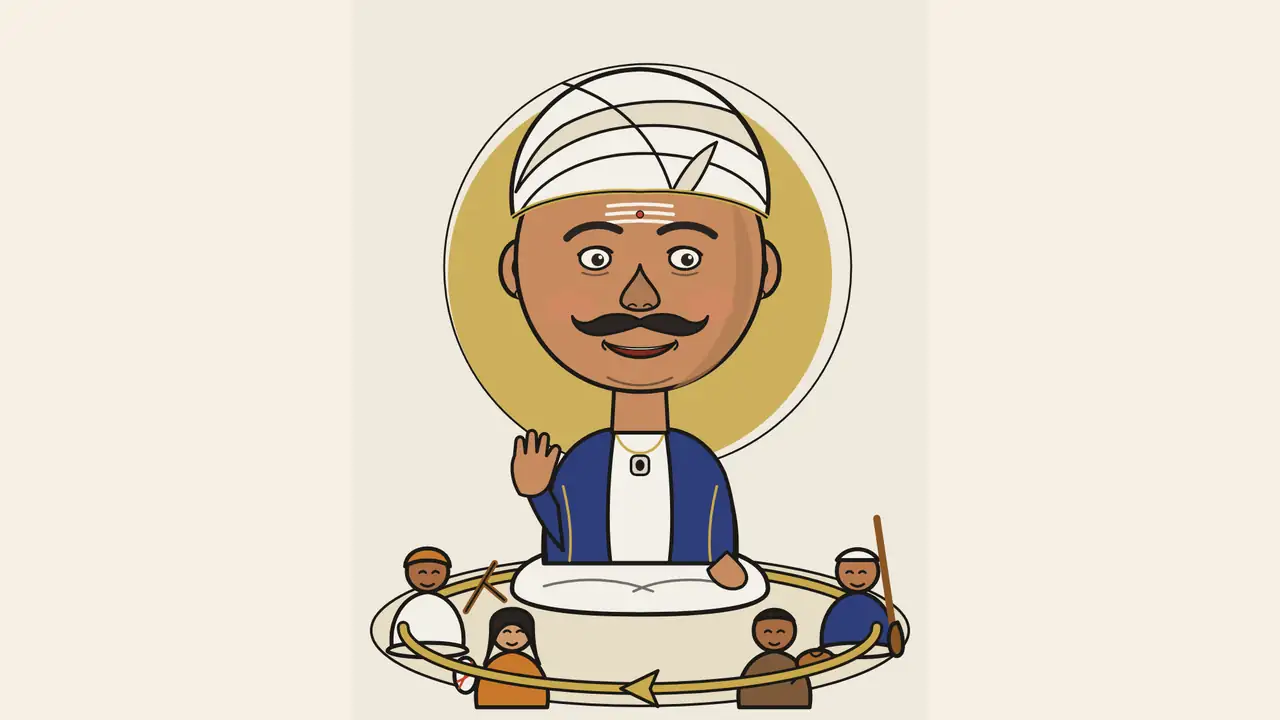
Original illustration drawn for WCRC. © Abhimanyu Ghosh & WCRC.
Spirituality · The Classical Acharyas · No. 04 of 27
Basavanna kept the king's treasury and opened a hall for cobblers: a 12th-century answer to the dignity of work
A finance minister in medieval Kalyana taught that every honest job is sacred and every earning is to be shared. As automation reshapes work, his vachanas ask leaders a question that spreadsheets cannot settle on their own.
WCRC Consulting · Strategy into execution
Implement these strategies inside your organisation
Deep analysis of where your organisation stands and a strategic implementation of The WCRC Kayaka–Dasoha Value Loop, built for your leadership team, culture and business.
Models created exclusively by Abhimanyu Ghosh; proprietary to Abhimanyu Ghosh and WCRC. WCRC's consulting service is not connected with, or endorsed by, any teacher, tradition or organisation discussed here.
Dates
12th century (passed c. 1167–68)
Region
Kalyana and Kudalasangama, Karnataka
Tradition
Shaiva
WCRC model
WCRC-GLC-04
The model in one line
Honour every role, share what is earned, open the hall.
The WCRC Kayaka–Dasoha Value Loop™ · anchored in Kayaka (work as worship) and Dasoha (sharing what is earned)
From Bagewadi to the treasury at Kalyana
Basavanna, also known as Basaveshwara, held one of the highest financial offices of a kingdom, an unusual seat from which to teach that humble work is sacred. Britannica says simply that he flourished in the 12th century. His birth is given variously as around 1105 or around 1131 to 1134, at Bagewadi, today's Basavana Bagewadi in Vijayapura district, Karnataka. Tradition names his parents as Madarasa and Madalambike, and the family was Shaiva and Brahmin.
The first decisive act tradition records is a refusal. As a young man, it is said, he set aside the sacred thread rather than accept rites that excluded others, and went to Kudalasangama, where the Krishna and Malaprabha rivers meet. There he studied and worshipped at the Sangameshwara temple. Shiva as Kudalasangama Deva, the Lord of the Meeting Rivers, became the name that signs every one of his vachanas, the short free-verse sayings he composed in Kannada.
Around the 1150s he moved to Kalyana, today's Basavakalyan in Bidar district, the capital of the Kalachuri king Bijjala. During Bijjala's reign (1156–67), Britannica records, he became chief of the treasury and later a chief minister. In the same city he gathered the Anubhava Mantapa, the hall of experience, where sharanas (devotees) of every caste, men and women, met to talk about spiritual life in their own language.
Tradition calls him the founder of the Lingayats. Britannica notes that inscriptions suggest he revived an existing Shaiva community, so it is more accurate to call him the great leader of the Lingayat, or Virashaiva, movement. Its fellowship included Allama Prabhu, Akka Mahadevi, his nephew Channabasavanna, Siddharama and many working-class saints.
The end came quickly. Around 1167, tradition recounts, a marriage was arranged among the sharanas between a family of former 'untouchable' background and a Brahmin family. Orthodox anger and court intrigue followed, and Kalyana was thrown into turmoil. Basavanna left the city and died soon afterwards at Kudalasangama, around 1167–68, though some sources give a later date. His samadhi there, the Aikya Mantapa, stands at the meeting of the rivers, and Basava Jayanti is observed each year in the month of Vaishakha.
A body for a temple, a job for a prayer
Basavanna's ethics begin with conduct, before belief. In one well-known vachana he lists what true religion forbids in plain terms: do not steal, do not kill, do not lie, do not rage, do not look down on others. Religion, for him, began with honest everyday behaviour.
He then moved the sacred into the place where most people actually spend their lives. In another vachana, devotees recount, he observes that the rich build temples for Shiva while the poor devotee has only himself to offer. So the poor man's legs become the pillars, his body the shrine, his head the golden dome. Worth lies in the devoted life, not in what one can afford to build.
Two practical ideas follow. The first is kayaka: honest work of any kind, done with devotion, is sacred, and no labour is lowly. The phrase 'kayakave Kailasa', work itself is heaven, is widely linked to him, though it is often traced to other sharanas, so it belongs to the vachana tradition as a whole. The second is dasoha: what is earned is to be shared, including with those in need. Basavanna roots this in a line that needs no commentary.
Compassion is the root of dharma.
Basavanna, vachana 'Dayavillada dharmavavudayya' (Kannada, 12th c.); English rendering prepared for this series
Put kayaka and dasoha side by side and they form a loop. Work done with dignity creates value; value shared renews the dignity of the people who created it. That loop, with a hall in the middle where everyone can speak, is the structure of the model in this chapter.
A cobbler, a ferryman and a queen in the same hall
The defining fact about Basavanna is a pairing. He held the treasury of a kingdom, and he built a room where the people who never saw a treasury could speak as equals.
Devotees recount that at the Anubhava Mantapa a cobbler, a washerman, a ferryman and Akka Mahadevi, a queen who had become an ascetic, sat together to speak of God. Karnataka Tourism and the Bagalkot district administration both describe the hall as an open forum, rare in its time. The conversation was in Kannada, the language of the people in the room, and the authority in it came from experience, which is what the name means.
One vachana captures the spirit of the hall. Basavanna prays that he should never ask of anyone 'whose man is he?', and should instead say:
He is one of us, he is one of us.
Basavanna, vachana 'Ivanarava' (Kannada, 12th c.); English rendering prepared for this series
Leaders who chair meetings will recognise how unusual this is. Most rooms in most organisations are arranged so that the person with the largest budget speaks first and longest. Basavanna kept the kingdom's treasury and arranged a room in which the ferryman's experience counted. The model takes its open forum directly from that choice.
When machines take the task, who keeps the dignity
Basavanna's argument about work was a moral one: honest labour is sacred whatever its kind. Automation turns it into a design question. When a company decides which tasks software will take over, it is also deciding which roles keep their dignity, which disappear and which new ones are created.
The World Economic Forum's Future of Jobs Report 2025 says workers can expect that two-fifths (39%) of their existing skill sets will be transformed or become outdated over the 2025–2030 period. The economists Daron Acemoglu and Pascual Restrepo, writing in the Journal of Economic Perspectives in 2019, argue that automation always reduces the labour share in value added and may reduce labour demand even as it raises productivity, while the creation of new tasks always raises the labour share and labour demand.
Read through Basavanna, that research points to a choice. A company can use AI only to remove kayaka, or it can use it to create new, dignified roles and share the gains with the people whose work made them possible. The first path may look cheaper this year. The second is the one his loop describes.
The open hall matters here as well. Gallup's State of the Global Workplace 2026 report finds that global employee engagement fell to 20% in 2025, down from a peak of 23% in 2022. People who are told about automation after the decisions are made have little reason to bring care to what remains of their work. People who are heard first, in a forum where their experience counts, have more.
The WCRC Kayaka–Dasoha Value Loop
Created by Abhimanyu Ghosh · A proprietary model of Abhimanyu Ghosh and WCRC
WCRC calls this the Kayaka–Dasoha Value Loop. It holds that all honest work has dignity, that value created should be shared, and that everyone, from the cobbler to the queen, deserves a seat in the open hall. The diagram above draws it as a cycle with five stations: dignity of role, value created, value shared, the open forum and renewed trust, with kayaka and dasoha at the centre. Each turn of the loop renews dignity and trust, and that renewed trust is what powers the next round of value creation. Break any station, by belittling a role, hoarding a gain or ignoring the hall, and the loop slows.
The Kayaka–Dasoha Value Loop holds that all honest work has dignity, that value created should be shared, and that everyone, from cobbler to queen, deserves a seat in the open hall. Each turn of the loop renews dignity and trust, which drives the next round of value creation.
Fig. 1The WCRC Kayaka–Dasoha Value Loop™
© Abhimanyu Ghosh & WCRC
The building blocks
01Dignity of every roleKayaka
Every honest role, from the shop floor to the boardroom, is treated as worthy work, and people are not ranked as persons by their job.
In practiceThe CEO spends regular time doing or shadowing front-line work and speaks of it with respect in public.
02Value created
Work done with care produces value for customers and the enterprise; dignity is the condition for that care.
In practiceThe CEO links each team's work to the customer value it creates, in plain terms.
03Value sharedDasoha
What is earned is shared with those who created it and with those in need, not held only at the top.
In practiceThe CEO sets fair, visible rules for how gains are shared with employees and the community.
04Open forumAnubhava Mantapa
A standing hall where people of every level speak as equals about the work and its purpose.
In practiceThe CEO holds a regular open forum where front-line voices are heard first and decisions follow from what is said.
05Renewed dignity and trust
When people are respected, share in gains and are heard, trust grows and the loop turns again with more energy.
In practiceThe CEO reports back on what changed because of the forum, closing the loop.
The treasurer's test for a chief executive
Basavanna's position gives the model its edge for CEOs. He was the person who controlled the money, and the person who insisted that all work was sacred and all gain was to be shared. Most organisations split those roles between a finance function that counts and a culture function that speaks. The loop asks the chief executive to hold both.
The decisions it touches are concrete. How gains are shared across levels, and whether the same rules apply to the top team. Whether the CEO spends real time doing or shadowing front-line work, and speaks about it with respect. Whether the open forum is a standing part of how the company decides, with front-line voices heard first and the chief executive speaking last.
Psychology supports the intuition. Self-determination theory, set out by Richard Ryan and Edward Deci in American Psychologist in 2000, posits three innate psychological needs: competence, autonomy and relatedness. When they are satisfied, people show enhanced self-motivation and mental health; when they are thwarted, motivation and well-being fall. Kayaka speaks to competence, the open hall to autonomy and relatedness, and dasoha to the fairness without which none of the three can be trusted.
The blind spot is the gap between words and rewards. A CEO who praises the dignity of front-line work while gain-sharing stops at the senior grades is running the loop backwards. The model names this failure directly, and it is the one employees notice first.
Founders, devotion and the overtime trap
Founders are especially exposed to the most serious misreading of kayaka. 'Work is worship' can be bent into a demand for unpaid evenings, impossible hours and low pay justified by devotion to the mission. The model lists this as its first failure mode, and Basavanna's own teaching rules it out: the same tradition that sanctifies work insists that what is earned be shared.
If you run a fifteen-person company, the loop is small enough to see whole. You can work alongside every role in the early months. You can publish a simple bonus or equity rule that covers the entire team, including the most junior hire. You can hold a monthly meeting in which the newest and most junior people speak first. None of this needs a policy department.
The harder discipline is attitude. Founders tend to celebrate the roles that resemble their own, usually product, sales or engineering, and to treat support, operations and logistics as costs. Basavanna's vachana on the poor man's temple is a correction. The person whose only offering is their own labour has made the most complete offering of all.
Early decisions on sharing also tend to harden. The equity table, the bonus rule and the unspoken hierarchy of whose work matters, once set, are expensive to unwind. Founders who set them in the spirit of dasoha avoid a reckoning later.
Keeping the hall honest at ten thousand people
Large companies have no shortage of forums. Town halls, listening sessions, pulse surveys and suggestion schemes are everywhere. The question Basavanna's hall raises is whether any of them work the way the Anubhava Mantapa did: experience given authority, every level heard, decisions shaped by what was said.
The model's most important failure mode for big organisations is the forum as theatre. People speak, nothing changes, and trust falls faster than if there had been no forum at all. The protection is simple and demanding. After every forum, someone with authority reports back on what changed because of it and what did not, with reasons. The playbook below assigns that to the CHRO and site heads, with a logged action record reviewed monthly.
Language matters at scale, as it did in Kalyana. The Anubhava Mantapa spoke Kannada, the language of the people in the room. A multinational that runs every forum in the head-office language has quietly chosen who will speak. The enterprise guidance in the playbook asks for forums in local languages at every site.
Boards have a specific role. Gain-sharing rules, redeployment commitments for roles affected by automation and forum outcomes all go to the remuneration committee. Directors should compare how respected people feel in their roles across levels, and resist the comfort of a single overall engagement number. A loop that turns well at headquarters and stalls on the shop floor is a broken loop.
The business model
The operating model below runs on three inputs: a shared view that every role is worthy work, fair rules for sharing gains, and a standing open forum. Leaders turn those into habits, by doing front-line work regularly, sharing gains transparently, hearing front-line voices first and reporting back on what each forum changed. The outputs are greater care in everyday work, front-line ideas acted on and fairness people can see in their rewards. Over time those produce stronger engagement and retention, customer value created by willing people and a company known in its community as a fair employer.
Fig. 2Operating model: running the WCRC Kayaka–Dasoha Value Loop
© Abhimanyu Ghosh & WCRC
Inputs
What the company commits
- Every role treated as worthy work
- Fair gain-sharing rules
- A standing open forum
Practices
What leaders do, repeatedly
- Leaders doing front-line work regularly
- Transparent sharing of gains
- Front-line voices heard first
- Reporting back on forum outcomes
Outputs
What changes in the work
- Higher care in everyday work
- Ideas from the front line acted on
- Visible fairness in rewards
Outcomes
What the enterprise gains
- Stronger engagement and retention
- Customer value created by willing people
- Community standing as a fair employer
The benefit model
The leader gains a workforce that brings care and ideas to its work, and a clear moral footing for hard decisions about pay and roles. Employees in every role are respected, heard and paid a fair share of what they help create. Customers are served by people who take pride in the job, which shows in quality and attention. Investors see lower attrition and fewer hidden costs of disengagement, and society gains from companies that treat all honest work as dignified and strengthen the communities around them. The benefit model below sets this out group by group.
Fig. 3Benefit model: who gains what
© Abhimanyu Ghosh & WCRC
The leader
The leader gains a workforce that brings care and ideas to the work, and a clear moral basis for decisions about pay and roles.
Employees
People in every role are respected, heard and share fairly in what they help to create.
Customers
Customers are served by people who take pride in their work, which shows in quality and attention.
Investors
A fair, engaged workforce lowers attrition and the hidden costs of disengagement over time.
Society
Companies that treat all honest work as dignified and share their gains strengthen the communities around them.
Fig. 4Where the model moves the needle
© Abhimanyu Ghosh & WCRC
- Vision Quotient
- ●●●●●
- Impact Index
- ●●●●●
- Innovation Score
- ●●●●●
- People Leadership
- ●●●●●
- Stakeholder Trust
- ●●●●●
- Resilience Factor
- ●●●●●
- Global Mindset
- ●●●●●
How to implement the WCRC Kayaka–Dasoha Value Loop
Your first move
On Monday, book your first shift doing or shadowing front-line work and set a regular date for the next ones.
If you are the founder or CEO
- 1
Work a front-line shift
In the first month, spend time doing or shadowing front-line work and speak about it with respect in your next public message. Founders of small firms can do this weekly; CEOs of large ones should rotate across sites each quarter.
- 2
Link work to customer value
In your communications, connect each team's work to the customer value it creates, in plain terms. Name roles that are rarely mentioned at leadership level.
- 3
Set fair gain-sharing rules
Set and publish clear rules for how gains are shared with employees across levels and with the community. Apply the same rules to the top team.
- 4
Chair the open forum
Chair a regular open forum where front-line voices speak first and you speak last. Commit in the room to what you will decide from what is said.
- 5
Report back every time
After each forum, report back on what changed because of it and what did not, with reasons. This closes the loop and keeps the forum from becoming theatre.
Rolling it out across the company
| Step | Owner | What the company puts in place |
|---|---|---|
| 01Check dignity and sharing gaps | CHRO with CFO | Survey whether people at every level feel their role is respected and map which employees are covered by gain-sharing. Compare results across levels and functions to see where dignity and sharing break down. |
| 02Pilot a forum in one site | Site or unit head | Run an open forum in one site or unit for a quarter, with front-line voices heard first and a named owner logging each suggestion and its outcome. Have leaders in the same unit do regular front-line shifts. |
| 03Embed kayaka and dasoha | CEO office, CHRO and CFO | Write gain-sharing rules into reward policy so coverage reaches every level, and make respect for every role a criterion in hiring and promoting managers. Set working-hours limits so 'work is worship' cannot be used to justify overwork. |
| 04Train managers to run forums | CHRO | Train all people managers to run open forums where they speak last, act on front-line suggestions and report back. Include how to plan redeployment for roles affected by automation. |
| 05Measure the value loop | Forum owners and HR | Track front-line voice to action, gain-sharing reach, role dignity score and redeployment after automation, and publish them internally every quarter. Show the gaps between levels openly. |
| 06Scale forums and review sharing | CEO and board | Extend forums to every site once the pilot shows suggestions being acted on, and review gain-sharing rules every year for fairness. Stop any forum that has become theatre and restart it with a new owner. |
The execution roadmap
Four phases, each closed by a gate. Do not move on until the gate is met.
Days 0–30
Phase 1 · Diagnose and commit
Find where dignity and sharing fall short across roles before promising anything.
- The CHRO and CFO compare gain-sharing coverage, pay structure and role dignity survey results by level and function.
- The CEO works or shadows front-line shifts at more than one site (Kayaka).
- Map each team's work to the customer value it creates, naming roles rarely mentioned at leadership level (Value created).
- Choose a pilot site for the first Anubhava Mantapa forum.
Deliverable
A dignity and sharing gap report by level and function.
Gate to proceed
Baseline recorded for every KPI, the gap report shared with the leadership team, and a site head agreed to host the first forum.
Days 31–90
Phase 2 · Pilot and prove
Prove that an open forum where the front line speaks first leads to decisions people can see.
- Run the open forum at the pilot site with front-line voices first and the CEO speaking last.
- Log every suggestion with an owner and a decision date.
- Report back after each forum on what changed and what did not, with reasons (Renewed dignity and trust).
- Draft gain-sharing rules that apply equally to the top team (Dasoha) and put them to employee representatives.
Deliverable
A forum action log and a draft gain-sharing rulebook.
Gate to proceed
Every suggestion from the pilot forum has a recorded decision and a report-back, and employee representatives have reviewed the draft gain-sharing rules.
Days 91–180
Phase 3 · Embed and scale
Make the loop standard: forums at every site, published sharing rules and redeployment for automated roles.
- Publish the gain-sharing rules across levels, including the share set aside for the community.
- Train managers to run forums and report back, with chairs rotating among front-line staff.
- Commit to redeployment for roles affected by automation and AI, with a plan for each role before it changes.
- Extend forums to all sites on a published calendar.
Deliverable
Published gain-sharing rules and a forum calendar for every site.
Gate to proceed
Gain-sharing coverage is published by level, forums run at every site with report-backs logged, and a redeployment plan exists for every role scheduled for automation.
Month 7 onwards
Phase 4 · Sustain and renew
Keep the loop honest, so devotion to work never becomes cover for overwork or low pay.
- Review each year whether gains actually shared match the published rules.
- Check hours and pay in roles that leaders praise publicly as kayaka.
- Track where people whose tasks were automated now work.
- The CEO continues front-line shifts on a rotating basis.
Deliverable
An annual value-loop report covering voice to action, gain-sharing reach, role dignity and redeployment.
Gate to proceed
Role dignity scores at front-line levels are closing the gap with management levels, and the gains actually shared match the published rules.
Governance
- Sponsor
- The CEO with the board, because gain-sharing rules touch pay at every level, the top team's included.
- Lead
- The CHRO, working with the CFO on sharing and with site heads on forums.
- Review forum
- Monthly in the leadership meeting for the forum action log; quarterly at the board remuneration committee for gain-sharing and redeployment.
- Decision rights
- The lead can act on forum suggestions within site budgets and set forum formats; changes to gain-sharing rules, and any automation that removes a role without redeployment, go to the CEO and the board.
Operating rhythm
- WeeklySite heads update the status of forum suggestions where staff can see it.
- MonthlyAn open forum at each site, front line first, opening with a report-back on last month's suggestions.
- QuarterlyThe CEO works a front-line shift at a rotating site, and the remuneration committee reviews gain-sharing reach.
- AnnuallyThe value-loop review of sharing outcomes, redeployment and role dignity scores, shared with all staff.
Implementation risks and how to handle them
| Risk | Early warning | Mitigation |
|---|---|---|
| 'Work is worship' becomes a cover for overwork or low pay. | Overtime rises in roles praised publicly while pay gaps stay the same. | Pair any public praise of a role with a CHRO check on its hours and pay, and act on what the check finds. |
| The forum becomes theatre and cynicism grows. | Attendance falls, the same few people speak, and suggestions pass their decision dates without an answer. | Publish the decision log, report back every time and rotate the chair among front-line staff. |
| Leaders apply the sharing rules to others but not to themselves. | Top-team bonuses rise while the front-line share stays flat. | Apply the same rules to the top team and publish outcomes by level. |
| Front-line staff will not speak openly in front of senior people or in head-office language. | Forums at some sites produce no critical suggestions at all. | Collect anonymous inputs before each forum, run forums in the local working language and let a front-line chair lead. |
By stage of company
Startup
Founder-led, under ~50 people
The founder works alongside every role in the early months and shares gains through a simple published bonus or equity rule that covers the whole team. A monthly open meeting where the newest and most junior people speak first serves as the hall.
Scale-up
~50 to 1,000 people
The CHRO writes gain-sharing rules by level, and site heads run forums with logged report-backs. Leaders rotate front-line shifts across locations as the company spreads.
Enterprise
Large or listed company
Gain-sharing rules, redeployment commitments for automated roles and forum outcomes are reported to the board remuneration committee. Forums run in local languages at every site, and the board compares role dignity scores across levels, not only overall engagement.
Are you ready?
- Would our senior leaders do front-line work without turning it into a photo opportunity?
- Can we explain to every employee how gains are shared and why?
- Are we ready to act on what the front line says, and to report back when we do not?
What success looks like at 12 months
- Front-line staff can name a change that came from something they said in a forum.
- Gain-sharing rules are known across levels and the top team is seen to follow them.
- People whose tasks were automated are working in new roles inside the company.
Habits to start this quarter
- 1
Learn the names behind the work you never see
Each week this quarter, learn the name and the job of three people whose work keeps the company running but never reaches your desk: cleaning, security, dispatch, maintenance. Use their names the next time you meet. Basavanna's hall began with knowing who was in the room.
- 2
Catch the question 'whose man is he?'
Notice when you size someone up by title, background or department before you hear what they say. When you catch it, deliberately take their point seriously first. The 'Ivanarava' vachana asks for exactly this shift.
- 3
Keep a personal dasoha
Set aside a fixed share of your own time or income this quarter for people in need, decided in advance and kept private. A leader who practises sharing personally speaks about gain-sharing with more authority.
- 4
Test your words for contempt
Before sending any message about a team or role, check three things: is it true, is it kind, and is it free of contempt for anyone's work? Rewrite anything that fails. Basavanna's list of what religion forbids ends with looking down on others.
- 5
Hold one conversation in their language
Once a fortnight, hold a conversation with a team in the language they speak most comfortably, with an interpreter if you need one. The Anubhava Mantapa spoke Kannada, and its forum worked because people could say what they meant.
What to measure
| Leading indicator | How to measure it |
|---|---|
| Front-line voice to action | Number of front-line suggestions from open forums that were implemented, with the time taken, logged by the forum owner. |
| Gain-sharing reach | Share of employees, by level, covered by profit-sharing, bonus or other gain-sharing schemes, from HR records. |
| Role dignity score | Survey items on whether people feel their role is respected by leadership, compared across levels and functions. |
| Redeployment after automation | Share of roles affected by automation whose holders moved into new roles inside the company, from workforce planning data. |
Where the model goes wrong
- "Work is worship" is used to justify overwork or low pay in the name of devotion to the company.
- The open forum becomes theatre: people speak, nothing changes, and trust falls faster than if there had been no forum.
- Sharing is announced but uneven, so the gap between words and rewards damages the loop.
Legs for pillars, a hall for everyone
WCRC's view is that the dignity of work is about to become the central leadership question of the decade. As AI takes over tasks, companies will reveal what they really believe about the people who did them: whether those people are costs to remove or contributors whose next role is worth building. Basavanna gave his answer nine centuries ago, from the most powerful financial chair in his kingdom.
His loop is simple enough to remember and hard enough to live. Honour every honest job, share what it earns, and keep a hall where the ferryman speaks before the treasurer.
Powerfacts
- Who was Basavanna and what did he teach?
- Basavanna, also called Basaveshwara, was a 12th-century leader of the Lingayat or Virashaiva movement in Karnataka who served as chief of the treasury and later a chief minister at the Kalachuri court in Kalyana. His Kannada vachanas teach that honest work is sacred (kayaka), that earnings should be shared (dasoha) and that caste does not decide holiness.
- What is the WCRC Kayaka–Dasoha Value Loop?
- The WCRC Kayaka–Dasoha Value Loop is a leadership framework drawn from Basavanna's teaching. It links the dignity of every role, value created, value shared and an open forum where all levels are heard. Each turn renews trust, which drives the next round of value creation.
- What was the Anubhava Mantapa?
- The Anubhava Mantapa, or hall of experience, was the gathering Basavanna formed in Kalyana in the 12th century. Devotees of every caste, men and women, including a cobbler, a ferryman and Akka Mahadevi, met there to discuss spiritual life in Kannada. A memorial at Basavakalyan in Bidar district is linked to it today.
Sources
- Basava, Encyclopaedia Britannica
- Kudalasangama, Bagalkot district administration, Government of Karnataka
- Kudala Sangama, Karnataka Tourism
- Vachana Sanchaya (open corpus of vachanas)
- The Future of Jobs Report 2025, World Economic Forum
- Automation and new tasks: how technology displaces and reinstates labor (2019), Acemoglu and Restrepo, Journal of Economic Perspectives
- State of the Global Workplace: 2026 Report, Gallup
- Self-determination theory and the facilitation of intrinsic motivation, social development, and well-being (2000), Ryan and Deci, American Psychologist
Read Basavanna's life and teachings on Gurushakti.
The WCRC Kayaka–Dasoha Value Loop™ (WCRC-GLC-04) is part of The WCRC Guru Leadership Codex™. Created exclusively by Abhimanyu Ghosh; a proprietary model of Abhimanyu Ghosh and WCRC. © 2026 Abhimanyu Ghosh and World Centre for Research and Consulting. All rights reserved.