
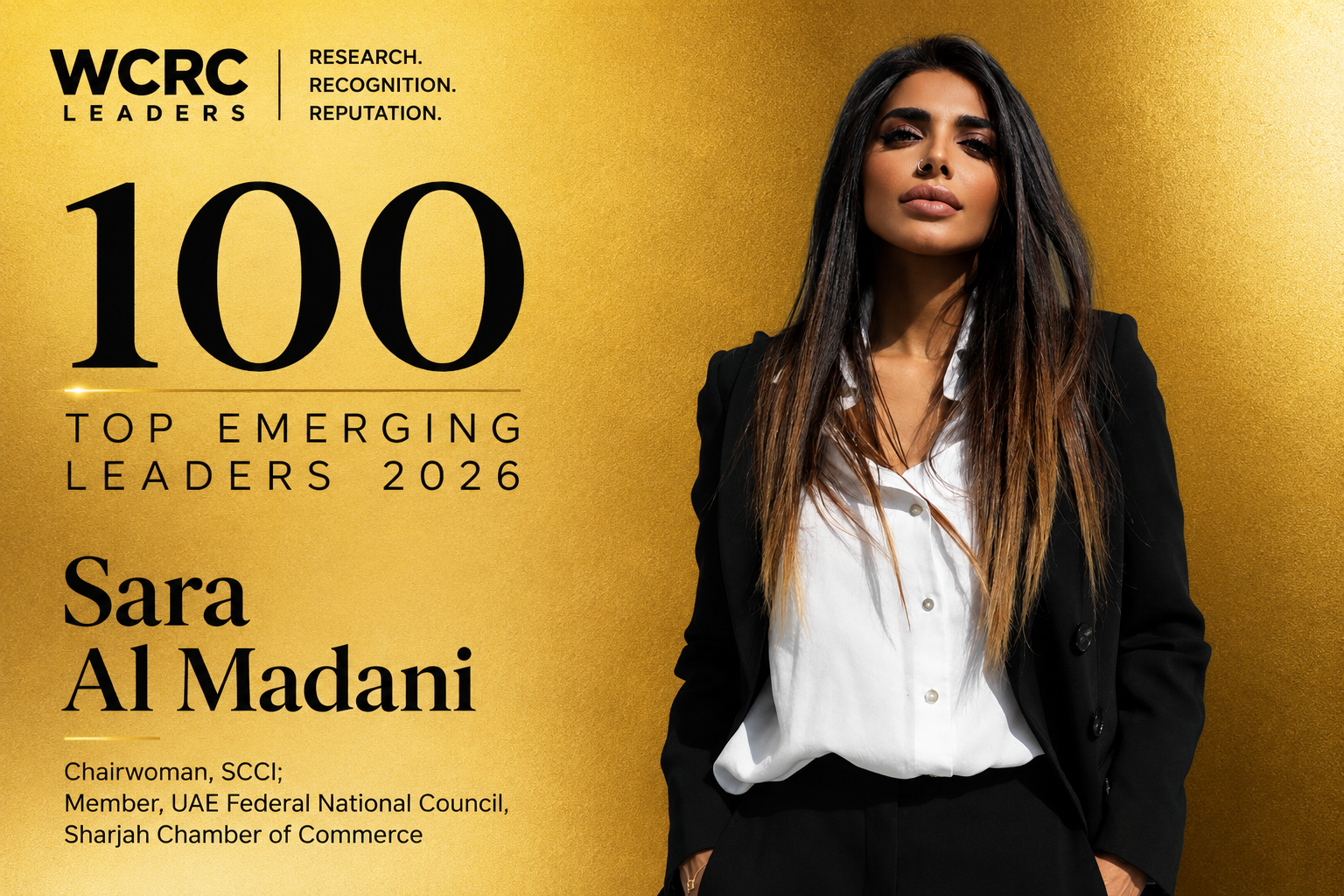
Leadership · Asia Top 100 Emerging Leaders 2026
Sara Al Madani: The Teenage Abaya Designer Who Became the Gulf's Loudest Voice for Women in Business — and Why WCRC Ranks Her No. 6 in Asia
A Dh25,000 teenage fashion venture, the youngest-ever seat on the Sharjah Chamber board, and a decade of ecosystem-building — behind a People Leadership score of 95.
654/700
Composite score
95
People Leadership
No. 6
Asia rank 2026
15
Age at first venture
Most people's entrepreneurial origin story starts with a business plan. Sara Al Madani's started with a dyslexia diagnosis and a Dh25,000 stake saved from odd jobs and modeling gigs at fifteen. WCRC's Asia Top 100 Emerging Leaders 2026 research has scored her 654 out of 700 — sixth overall in a field of 847 qualified candidates across 18 nations, with a People Leadership score of 95, one of the highest in the entire cohort.
Starting at Fifteen, With a Design Problem to Solve
Al Madani was born in Dubai on January 20, 1986, to a Bahraini father and an Emirati mother, and grew up between Ajman and Sharjah. She was diagnosed with dyslexia as a child — a detail she's returned to often in interviews as formative to how she learned to work around conventional paths rather than through them. She began working odd jobs and modeling in her early teens to fund what would become her first venture, launching Rouge Couture — later renamed Sara Al Madani Fashion Design — at fifteen, with roughly Dh25,000 she'd saved herself.
Her specific design contribution was to the abaya, a garment she felt had gone underserved by contemporary fashion design. “I wanted to have more definition to it, more edge to it,” she told Emirates Woman, describing an approach aimed at showing “the woman is strong in her traditional wear, without her having to take it off.” That instinct — modernizing a traditional form rather than rejecting it — became a recurring thread across her later ventures as well.
Youngest-Ever Board Member of the Sharjah Chamber of Commerce
In 2014, Al Madani was selected by His Highness Sheikh Dr Sultan bin Muhammad Al Qasimi, Ruler of Sharjah, to join the board of the Sharjah Chamber of Commerce and Industry — the youngest person ever appointed to the board. In that role, she led the shjSEEN initiative, launched in February 2016, aimed at strengthening a culture of quality, organizational excellence and innovation across Sharjah's business community. In 2017, she was also selected for the UAE SME and Enterprise Council, under the Ministry of Economy — extending her policy involvement from the emirate level to the federal one.
WCRC's own citation lists her current title as Chairwoman of the Sharjah Chamber of Commerce and Industry and a member of the UAE Federal National Council — a step up from board membership that would mark a significant expansion of her institutional role. That specific elevation isn't independently confirmed in publicly available biographical sources at the time of writing, which continue to describe her primary institutional role as SCCI board membership; whatever her current formal title, the trajectory WCRC's citation describes — from youngest board member in 2014 toward broader legislative and policy influence — tracks consistently with the decade of work that preceded it.
Building Past Fashion, One Venture at a Time
Al Madani's career after the SCCI appointment moved outward from fashion into an unusually wide spread of sectors, each new venture launched roughly on the strength of credibility from the last. In 2016, she partnered with fellow Sharjah entrepreneur Haleema Al Owaisi to open Shabarbush, a café in Dubai's Mamzar district. In 2017, she co-founded Social Fish, a digital marketing agency, moving into content creation for other businesses. In 2020, she co-founded HalaHi, an app connecting fans with celebrities for personalized video messages, taking the CEO role herself. She has also invested in the financial firm Cahero Holding.
That range — fashion, hospitality, marketing, consumer tech, finance — doesn't read as a founder chasing trends so much as one repeatedly testing whether her instinct for underserved niches, first proven with the abaya redesign, would hold up across categories she had no formal training in. She's largely self-taught outside of a few early internships, a detail she's cited often when speaking to audiences about entrepreneurship without a conventional credential path.
A More Public Public Life
Al Madani's visibility expanded considerably in 2022, when she joined the main cast of “The Real Housewives of Dubai,” Bravo's first UAE-set entry in the franchise — a platform she's used, per her own and outlet framing, to offer international audiences a picture of modern Arab womanhood and entrepreneurship that departs from more familiar stereotypes. The same year, she became a UAE Global Goodwill Ambassador for Smile Train, adding a philanthropic dimension to a public profile that already included more than 200 keynote addresses delivered worldwide on entrepreneurship, resilience, and leadership. Her recognitions over the years include an Entrepreneur of the Year award, a GCC Inspiring Women Leaders honor, and the 2017 Ecosystem Influencer of the Year award, alongside an honorary doctorate in Business Administration and Women's Empowerment from Eton University, awarded in 2018. She is a single mother to her son, Maktoum.
What WCRC's Data Adds
WCRC's Asia Top 100 Emerging Leaders framework scores candidates across seven parameters — Vision Quotient, Impact Index, Innovation Score, People Leadership, Stakeholder Trust, Resilience Factor and Global Mindset — applied through a five-stage process of nomination, eligibility screening, independent evaluator scoring, editorial panel review and final verification.
Al Madani's standout figure is a People Leadership score of 95. WCRC's own citation describes her as among the most visible advocates for female entrepreneurship and SME development in the Arab world, combining legislative influence with startup mentorship at scale, and credits the score to what it calls an extraordinary ability to cultivate ecosystems rather than simply run organizations. That framing fits a career built less around any single flagship company than around a sustained pattern of institution-adjacent work — chamber governance, SME policy councils, mentorship, and a media platform used deliberately to widen the field for other Emirati women entrepreneurs behind her.
The Company She's Keeping
Al Madani sits within WCRC's Gulf Region cohort — 28 of the 100 ranked leaders this year, a group the research frames as bringing sovereign scale and global ambition to whatever domain its members enter. Her nearest company includes Omar Sultan Al Olama, the UAE's Minister of State for Artificial Intelligence (rank 2, 651/700), and Sheikha Bodour Al Qasimi, President of the International Publishers Association (rank 3, 657/700) — both leaders whose influence, like hers, runs through institutions rather than a single company balance sheet.
What separates her within that group is scale of starting point. Al Olama and Al Qasimi each built from a defined institutional base — a ministry, a family publishing tradition. Al Madani's path ran from a self-funded teenage fashion venture through a decade of small, self-started businesses across unrelated sectors, arriving at chamber governance and SME policy work from the ground up rather than from an existing platform. It's a different route to the same tier of the ranking.
The Throughline
Strip away the reality-TV visibility and what's left is a fairly consistent method, in place since she was fifteen: identify something conventional that's underserving people — the abaya, café culture in her neighborhood, digital marketing for small brands, celebrity access, SME policy representation — and build toward fixing it with whatever resources are available, then use the credibility earned to reach the next room. WCRC's 654-point score and its 95 in People Leadership are, per the research's own framing, measuring the ecosystem-building version of that instinct: not one company scaled large, but a career spent making room for the entrepreneurs who came after her.