Leadership · Asia Top 100 Emerging Leaders 2026
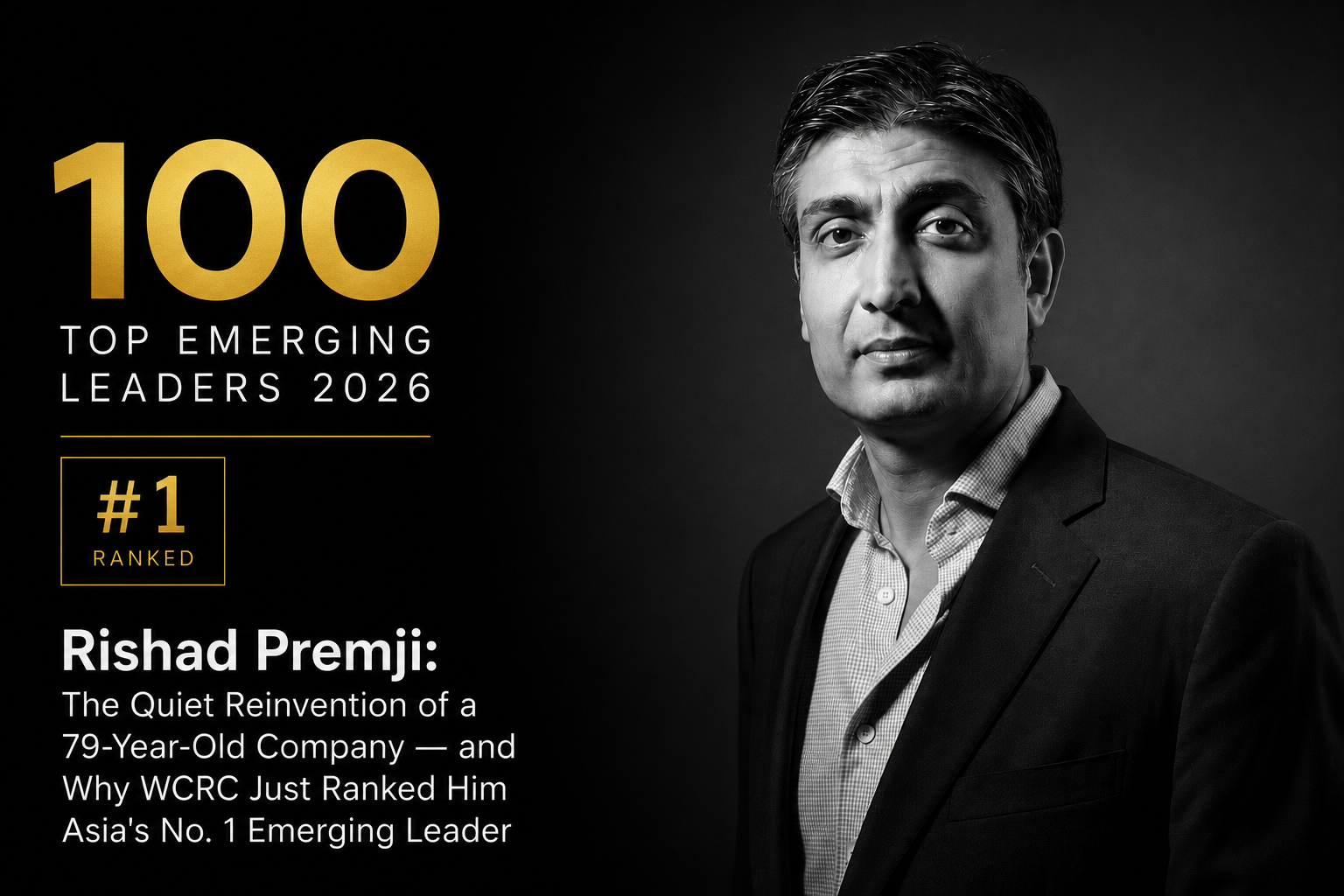
Rishad Premji: The Quiet Reinvention of a 79-Year-Old Company — and Why WCRC Just Ranked Him Asia's No. 1 Emerging Leader
How a decade of quiet institution-building put Wipro's Executive Chairman at No. 1 on WCRC's Asia Top 100 Emerging Leaders 2026.
665/700
Composite score
97
Stakeholder Trust
847
Qualified candidates
18
Nations assessed
There's a version of this story that writes itself: son inherits father's company, keeps the lights on, gets a headline once a year at the AGM. That is not what happened at Wipro. What happened instead is a decade-long, largely unglamorous rebuild — of strategy, of technology bet-placing, of institutional culture — that WCRC's Asia Top 100 Emerging Leaders 2026 research has now quantified with a composite score of 665 out of 700, the highest of 847 qualified candidates across 18 nations. The ranking isn't the story. It's the receipt.
Before Wipro: Building the Resume Elsewhere
Rishad Premji did not arrive at his father's company as an heir apparent groomed from adolescence. He was schooled at Cathedral and John Connon School in Mumbai, then left India entirely for his undergraduate years, earning an economics degree from Wesleyan University in Connecticut before going to Harvard Business School for his MBA. That's a standard elite-credential path for a certain kind of global executive — but what he did after it is more instructive than the degrees themselves.
Instead of walking straight into Wipro, Premji spent two years at Bain & Company in London, working consulting assignments across consumer products, automobiles, telecom and insurance — a deliberate immersion in how outside firms diagnose and fix other people's businesses. He followed that with four years at GE Capital in the United States, inside the insurance and consumer lending businesses, going through GE's well-regarded Financial Management Program along the way. By the time he joined Wipro in 2007, he had spent six years building judgment in rooms where the Premji name meant nothing.
He started as a business manager — not an executive title, a working one. Over the next twelve years he moved through roles that read like a self-designed leadership curriculum rather than a dynastic fast-track: General Manager in Banking and Financial Services, Head of Investor and Government Relations, Head of Strategy and M&A, and eventually Chief Strategy Officer, where he ran acquisitions and strategic partnerships across the company. He also led Wipro Ventures, the firm's investment arm, which put him inside the startup and emerging-technology ecosystem years before “innovation” became a mandatory line item on every legacy company's strategy deck. Along the way, he chaired NASSCOM — India's technology industry association — for 2018–19, a role that forced him to think about the sector's collective interests, not just Wipro's. In 2014, the World Economic Forum named him a Young Global Leader, five years before he'd take the chair he's known for today.
None of this made news the way a funding round or an IPO does. But it's the reason the transition, when it came, didn't look like a handoff — it looked like a promotion earned in the ordinary sense.
Taking the Chair, 2019
Azim Premji stepped down as Executive Chairman in July 2019 after 53 years leading Wipro, transitioning to Non-Executive Director and Founder Chairman. Rishad Premji took over the Executive Chairman role at a company with a well-earned reputation for integrity and a less enviable reputation for being slow — a large, respected, somewhat sleepy IT services player in a sector being reshaped by cloud, then by AI, faster than most incumbents could keep pace with.
The job he inherited wasn't to preserve a legacy. It was to reorient a 260,000-person global organization without breaking the thing that made it trustworthy in the first place. That's a narrower needle to thread than founding something new. A founder gets a blank canvas; an institutional leader inherits decades of process, culture and stakeholder expectation, and has to move all of it at once without losing anyone's confidence along the way.
The AI Transformation
The clearest evidence of how Premji has actually run that reorientation is the scale of Wipro's AI push under his tenure. He committed the company to a $1 billion investment in AI capability over three years, channeled through platforms like WiNow and Lab45 — Wipro's internal innovation and AI delivery engines. Roughly 235,000 employees have gone through baseline GenAI training, with around 30,000 moving on to advanced certifications, embedding AI literacy across delivery, operations and innovation functions rather than concentrating it in a single center of excellence.
Speaking on the sidelines of the World Economic Forum in Davos in January 2026, Premji made a pointed, unhedged claim: that Indian IT is “moving fast enough” on AI adoption, and that client conversations have shifted decisively from experimentation to production deployment. That's a confident thing to say from inside a company undergoing the transformation — the kind of claim that only holds up if the internal numbers back it, which, per Wipro's own disclosures, they largely do.
What's notable is the manner of the bet, not just its size. Premji didn't chase AI as a marketing narrative bolted onto quarterly earnings calls. He built the infrastructure — training pipelines, delivery platforms, certification programs — before leaning into the public claim. That sequencing, infrastructure before rhetoric, is a pattern that shows up again and again across his tenure, and it's precisely what WCRC's research is built to detect and reward.
What WCRC's Data Adds to the Picture
This is where the ranking earns its place in the story, rather than leading it. WCRC's Asia Top 100 Emerging Leaders research scores candidates across seven parameters — Vision Quotient, Impact Index, Innovation Score, People Leadership, Stakeholder Trust, Resilience Factor and Global Mindset — built with academic input from INSEAD, the Indian School of Business and the Mohammed bin Rashid School of Government, and applied through a five-stage process: nomination, eligibility screening, independent evaluator scoring, editorial panel consensus, and final verification.
Premji's standout figure inside that framework is a Stakeholder Trust score of 97 — the parameter that measures governance standards, crisis response and sustained public and internal confidence. WCRC's own citation credits him with having reoriented Wipro “from a cost-led IT services player into a full-spectrum technology transformation partner,” anchoring that shift in sustainability and ethical AI, with governance held consistently across the organization's full global footprint.
That number is a fitting quantitative echo of the biography above it. Vision and Innovation can be demonstrated in a single bold announcement. Stakeholder Trust, by contrast, is close to impossible to fake at scale — it has to be earned across years, across a workforce in the hundreds of thousands, across multiple regulatory jurisdictions, without a single serious governance failure resetting the clock. A leader who spent a decade building judgment inside other people's businesses before taking one of his own, and who then ran an AI transformation by building the plumbing before making the claims, is exactly the profile that parameter is designed to surface.
The Company He's Keeping
Context matters here too. The Indian Subcontinent contributed 46 of WCRC's 100 ranked leaders this year, the largest of the three sub-regions the research covers, and the cohort skews heavily toward founder-led disruption — fintech operators like Razorpay's Harshil Mathur and CRED's Kunal Shah, consumer builders like OYO's Ritesh Agarwal and Zomato/Eternal's Deepinder Goyal. Most of that group earns its position by inventing a category from nothing.
Premji's position at the top of that group rather than inside its founder tradition is itself worth noting. He isn't disrupting a category; he's carrying a 79-year-old institution through the sharpest technological discontinuity its sector has faced, without the clean slate a founder gets to start with. That WCRC's framework rates that achievement above several genuinely disruptive founder stories says something about how the research defines leadership equity — not just who built something new, but who moved something large without losing its foundations.
A Quiet Personal Life, By Design
Away from Wipro, Premji has kept a famously low public profile for someone leading a company of Wipro's size. He married Aditi, his childhood friend, in 2005, and the couple have two children. He's known, in the limited personal detail that circulates publicly, as a cricket fan who enjoys travel and film — ordinary interests, disclosed sparingly, which is itself consistent with a leadership style built more on institutional results than personal branding.
The Throughline
Strip away the ranking ceremony and what's left is a fairly coherent life story: six years spent earning judgment outside the family name, twelve years spent earning it inside the company across roles that built rather than assumed authority, and six years since 2019 spent moving a quarter-million-person organization through the hardest technological shift it has faced — governance intact, trust intact, the AI bet built on infrastructure rather than announcement. WCRC's 665-point score and its 97 in Stakeholder Trust aren't the achievement. They're what happens when a research methodology gets pointed at a career that was already built the hard way, and simply measures what's there.