
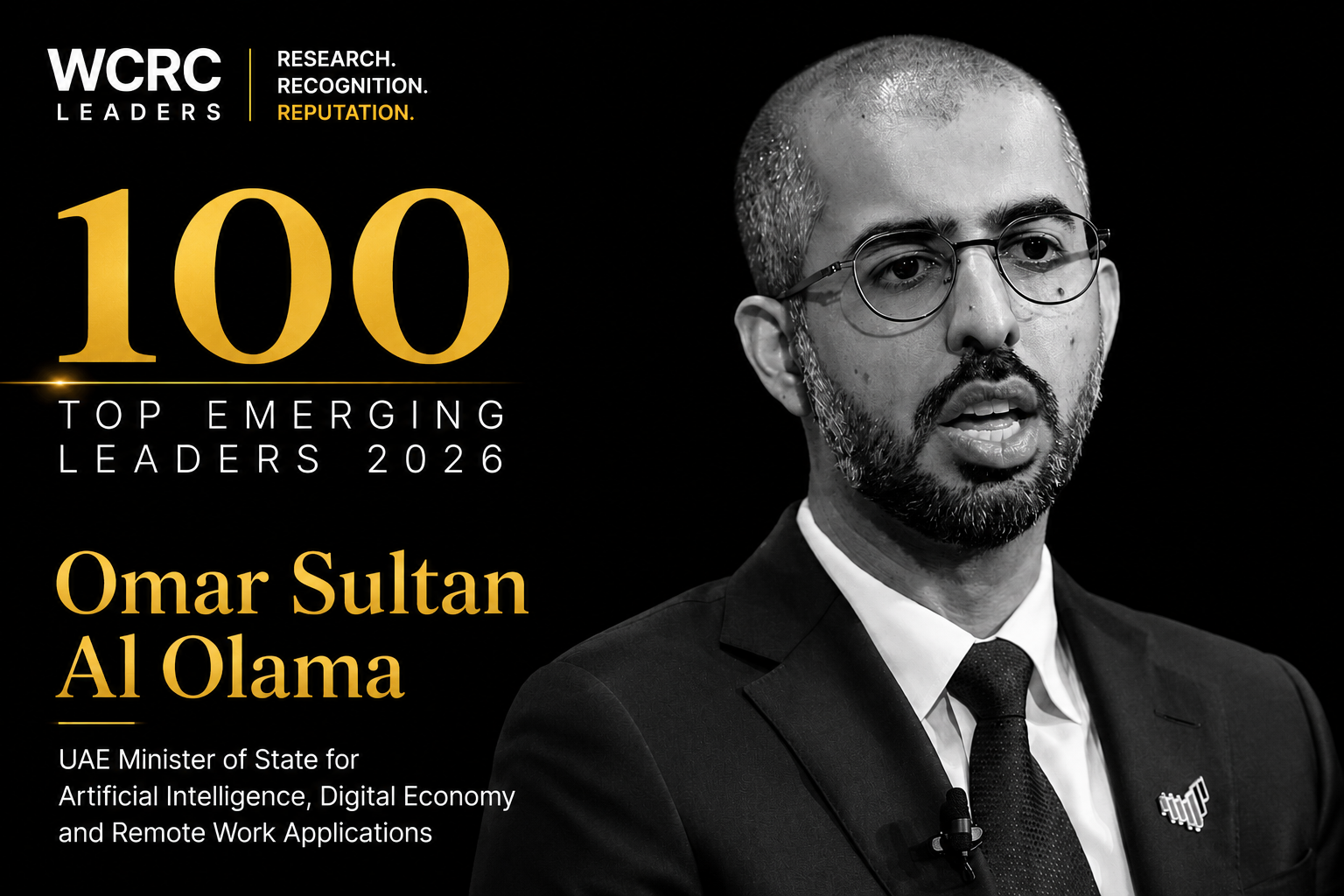
Leadership · Asia Top 100 Emerging Leaders 2026
Omar Sultan Al Olama: The 27-Year-Old Who Became the World's First AI Minister — and Why WCRC Ranks Him No. 2 in Asia
How the UAE's first AI minister spent nine years building the policy architecture that made the Gulf a reference point for applied AI governance.
651/700
Composite score
95
Vision Quotient
No. 2
Asia rank 2026
28
Gulf leaders ranked
Job titles rarely double as historical firsts. Omar Sultan Al Olama's did, twice over — first as the world's first Minister of State for Artificial Intelligence, then as one of the youngest cabinet appointees anywhere, at 27. Nine years later, WCRC's Asia Top 100 Emerging Leaders 2026 research has scored him 651 out of 700, second only to Wipro's Rishad Premji in a field of 847 qualified candidates across 18 nations — with a Vision Quotient of 95, the framework's measure of long-horizon strategic clarity, among the highest in the entire cohort.
A Cabinet Reshuffle That Made Global News
On October 19, 2017, UAE Vice President and Prime Minister Sheikh Mohammed bin Rashid Al Maktoum announced a cabinet reshuffle that included six new ministers, three of them women — part of what the government framed as a shift toward “future skills, future sciences and future technology.” Buried in that announcement was a title that had never existed anywhere in the world: Minister of State for Artificial Intelligence. The person given it was 27 years old.
Al Olama was born in Dubai on February 16, 1990. He wasn't a technologist by training — he holds a Bachelor of Business Administration from the American University in Dubai, earned in 2011, plus a project management diploma from the American University of Sharjah. His path into government ran through a series of policy and strategy roles rather than a computer science lab: corporate planning at the Prime Minister's Office in 2012, deputy head of the minister's office, deputy director of the Future Department, and — in one of the more unusual lines on his résumé — Secretary General of the World Organisation of Racing Drones, a role he held into the same month he became a minister. He'd also been serving as managing director of the World Government Summit since 2016, a platform that would later become central to his public profile.
None of that reads like the biography of an AI specialist. Which is, in part, the point: his mandate was never to write algorithms. It was to build the policy scaffolding — regulation, talent pipelines, government adoption — that would let a country move faster on AI than its bureaucracy would otherwise allow.
Building the Architecture Before the Hype Cycle
Al Olama's early work, well before generative AI became a mainstream obsession, focused on strategy documents that read as unusually prescient in hindsight. He was involved in drafting the UAE Centennial 2071 strategy, the UAE's Fourth Industrial Revolution Strategy, and — most directly in his lane — the UAE's national Artificial Intelligence Strategy, which the government describes as the first of its kind globally. These weren't symbolic gestures. They set out the institutional targets — talent development, sector-specific AI adoption, government service transformation — years before most governments had a formal AI policy of any kind.
In July 2020, his portfolio was formally expanded to include Digital Economy and Remote Work Applications, folding in oversight of one of the UAE's stated strategic priorities: doubling the non-oil economy's digital contribution within a decade. The expansion tracked a broader pattern in his career — each new title arriving after the groundwork for it had already been laid, not before.
By 2023, his responsibilities had grown further still. He was named Director General of the Prime Minister's Office at the Ministry of Cabinet Affairs and Director General of the Dubai Crown Prince's Office — appointments that moved him from a single-issue portfolio into the operational center of UAE federal governance. He also holds the chairmanship of the Dubai Chamber of Digital Economy, sits as a Board of Trustees member and Deputy Managing Director of the Dubai Future Foundation, and now serves as Vice Chair of the World Government Summit, the organization he ran day-to-day as managing director for the better part of seven years.
Institution-Building Over Announcement-Making
What distinguishes Al Olama's record from the announcement-heavy style common to fast-moving tech policy is the pattern of what he actually built. The UAE Council for Artificial Intelligence and Blockchain, a personal data protection law, and the National Program for Coders are the kind of unglamorous infrastructure — regulatory, educational, administrative — that determines whether a national AI strategy survives contact with reality or stays a slide deck. His stated focus areas — a “fertile AI ecosystem,” talent pipelines for AI-enabled jobs, and research collaboration with target industries — read as deliberately operational rather than aspirational.
That orientation toward governance has carried into his more recent international work. In 2023, the World Economic Forum selected him for the steering committee of its AI Governance Alliance, placing him alongside a small group of global figures shaping international AI governance norms. In December 2025, he became the first Middle East representative on Operation HOPE's AI Ethics Council board — a body co-chaired by OpenAI's Sam Altman — reinforcing a role that has increasingly extended past UAE borders into the global conversation about how AI should be regulated, not just adopted.
What WCRC's Data Adds
WCRC's Asia Top 100 Emerging Leaders framework scores candidates across seven parameters: Vision Quotient, Impact Index, Innovation Score, People Leadership, Stakeholder Trust, Resilience Factor and Global Mindset — applied through a five-stage process of nomination, eligibility screening, independent evaluator scoring, editorial panel review and final verification, built with academic input from INSEAD, the Indian School of Business and the Mohammed bin Rashid School of Government.
Al Olama's standout figure is a Vision Quotient of 95, among the highest recorded in the 2026 cohort. WCRC's own citation credits him with authoring the UAE's National AI Strategy 2031 and building the institutional scaffolding — MBZUAI, the Dubai Future Foundation's programming, and the national digital economy agenda — that made the UAE the Gulf's reference point for applied AI governance, describing his policy architecture as drafted a decade ahead of peer states.
That framing tracks closely with the record: a minister appointed before there was a template for the job, whose most consequential decisions were institutional rather than rhetorical — a data protection law here, a coders' program there, a governance council quietly assembled while the rest of the world was still debating whether AI needed a minister at all.
The Company He's Keeping
Al Olama sits within WCRC's Gulf Region cohort — 28 of the 100 ranked leaders this year, a group the research frames as bringing “sovereign scale and global ambition” to whatever domain its members enter. His immediate company in the rankings includes Sheikha Bodour Al Qasimi, who built Sharjah into a UNESCO World Book Capital (rank 3, 657/700), and Sara Al Madani, chairwoman of the Sharjah Chamber of Commerce (rank 6, 654/700) — leaders whose achievements, like his, are institutional rather than product-led.
That distinguishes the Gulf cohort from the founder-heavy Indian Subcontinent group topping the same list. Al Olama isn't running a company; he's running policy at national scale, in a domain — AI governance — that didn't have an established playbook when he started. WCRC's decision to rank that kind of work alongside, and in his case above, a wide field of company builders and founders says something about how the research defines leadership equity: institutional architecture, sustained over years, counts as much as a balance sheet.
The Long Game
Strip away the “world's first AI minister” headline and what's left is a fairly linear story: a policy operator who spent his twenties inside government strategy departments, was handed a portfolio that didn't exist yet at 27, and spent the following nine years building the regulatory and institutional infrastructure to make that portfolio mean something — before, during, and now well past the point where the rest of the world caught up to the idea that AI needed governing at all. A Vision Quotient of 95 is WCRC's way of saying the timing wasn't luck.