Leadership Studio · Asia Top 100 Emerging Leaders 2026
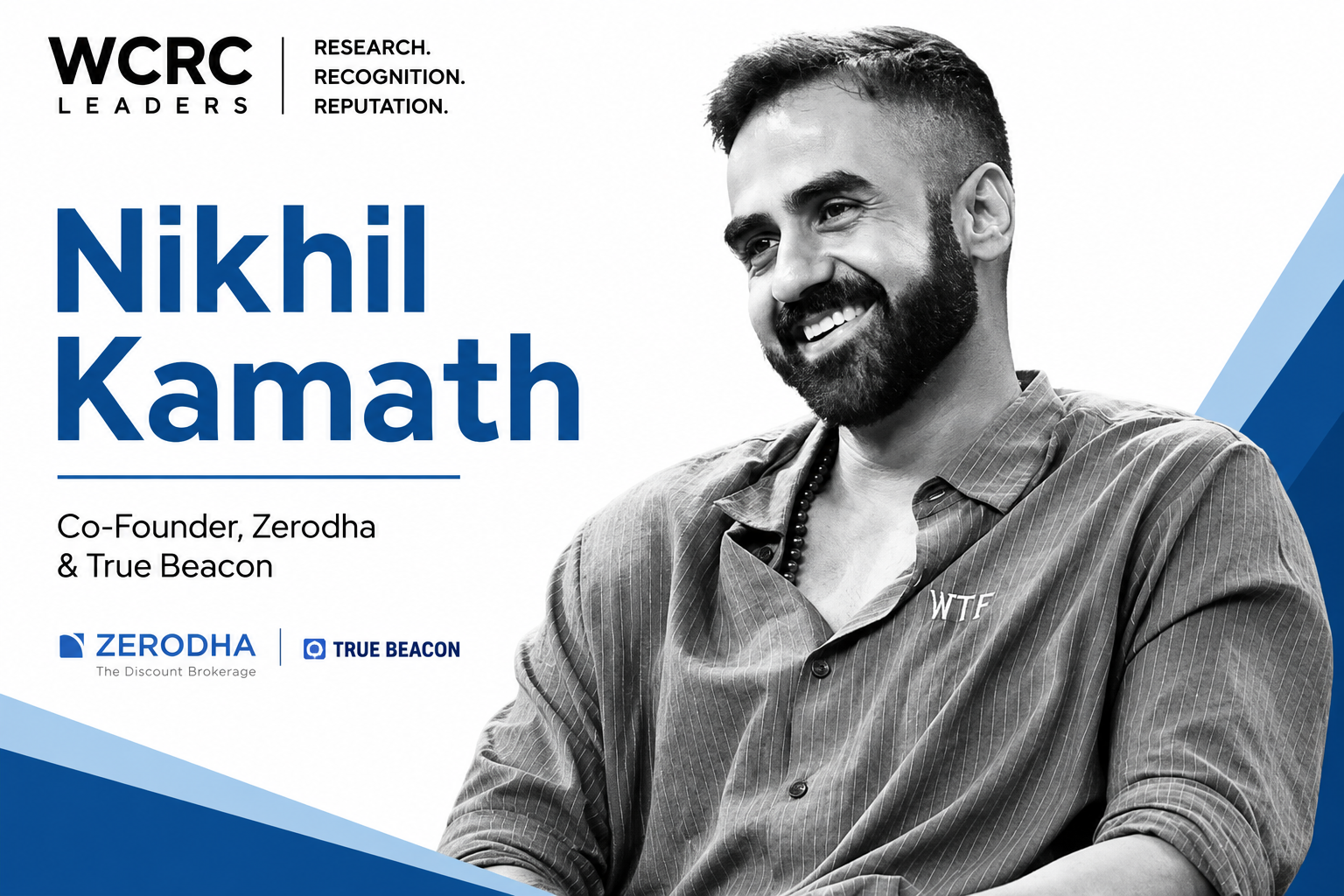
Nikhil Kamath: The Call-Center Dropout Who Bootstrapped India's Largest Brokerage — and Why WCRC Ranks Him No. 9 in Asia
No degree, no venture capital, no safety net — just a flat ₹20-per-trade fee that turned a call-center dropout into the founder of India's largest brokerage, serving 12 million clients. Behind a Resilience Factor of 92.
635/700
Composite score
92
Resilience Factor
No. 9
Asia rank 2026
$0
Outside capital raised
Most billionaire founders eventually acquire a credential story to go with the wealth — an honorary degree, a business school guest lecture, something to round out the résumé. Nikhil Kamath has mostly skipped that step. He dropped out of school at fourteen, holds no college degree, and built India's largest retail stockbroker anyway, without ever raising outside capital. WCRC's Asia Top 100 Emerging Leaders 2026 research has scored him 635 out of 700, ninth overall in a field of 847 qualified candidates across 18 nations, with a Resilience Factor of 92 — one of the highest in the entire cohort.
Trading Instead of Studying
Kamath was born on September 5, 1986, in Shimoga, Karnataka, and raised in Bengaluru, the younger of two sons; his father worked at Canara Bank, and his mother ran a small business in event management and landscaping. He left formal education after the tenth grade, drawn instead to chess and the stock market, and took a job at a call center as a teenager while teaching himself to trade equities on the side. By 2006, he and his older brother Nithin had turned that early trading knowledge into Kamath & Associates, a sub-brokerage firm managing investments for high-net-worth clients — a modest, unglamorous starting point for what would become one of India's defining fintech companies.
Zerodha, Built Without a Single Outside Rupee
In 2010, the brothers founded Zerodha, introducing a flat ₹20-per-trade brokerage fee into a market where commissions had historically eaten heavily into retail investor returns. The pitch was simple and the timing was right: India's retail trading population was about to grow dramatically, and a low-cost, technology-first brokerage was positioned to capture that growth better than the legacy full-service firms it was undercutting. Zerodha scaled to become India's largest stockbroker by trading volume, now serving more than 12 million clients — and did it entirely on internally generated profit. The company never took a funding round, an unusual discipline in an Indian startup ecosystem where venture capital became almost a prerequisite credential for legitimacy through the 2010s and early 2020s. WCRC's own citation attributes Kamath's Resilience Factor score directly to that discipline: a company that stayed profitable from day one without ever needing outside money to survive a hard quarter.
Alongside Zerodha, the brothers built Rainmatter, a venture fund and incubator investing in fintech and financial-inclusion-focused startups — extending the company's original mission of lowering barriers to market participation into a broader ecosystem play rather than keeping the value entirely inside Zerodha itself.
Expanding Past Brokerage
Kamath's ventures after Zerodha have moved outward in a pattern that tracks his original thesis — reducing friction for underserved segments of India's financial system — applied to progressively higher-net-worth and more specialized markets. In 2020, he co-founded True Beacon, a zero-fee asset management firm built for ultra-high-net-worth individuals, offering access to privately pooled investment vehicles that had traditionally been difficult for even wealthy Indian investors to access efficiently. In 2021, he co-founded Gruhas with Abhijeet Pai, an investment firm backing early and growth-stage startups across climate tech, consumer brands, senior care, sustainability and proptech — now with stakes in more than 50 companies. Gruhas has since expanded into two dedicated vehicles, the Gruhas Collective Consumer Fund and the Earth Fund, the latter a partnership with Brigade Group targeting sustainability and proptech, with recent moves into emerging areas like hydrogen energy and brain-computer interface technology.
In 2023, Kamath became the youngest Indian signatory of the Giving Pledge, committing the majority of his wealth to philanthropic causes — a commitment that sits somewhat unusually alongside a net worth Forbes places at roughly $3.3 billion as of late 2025, most of it still tied to his Zerodha stake.
Turning Into a Media and Talent Platform
Since March 2024, Kamath has hosted “WTF is”, a long-form podcast interviewing entrepreneurs, investors and public figures on business, technology, psychology and current affairs — a format that by December 2025 had drawn guests including India's Prime Minister, and by early 2026 had featured figures like Omar Sultan Al Olama, the UAE's Minister of State for Artificial Intelligence, in a wide-ranging conversation on youth in politics. The podcast has become a platform in its own right rather than a side project, functioning as much as a networking and visibility engine for Kamath's other ventures as a media property.
That platform also feeds directly into WTFund, a non-dilutive grant program offering young founders ₹20 lakh with no equity taken in return — a structure explicitly designed to remove the funding barrier for very early-stage entrepreneurs, the same underlying instinct that shaped Zerodha's flat-fee model fifteen years earlier. The program's third cohort, announced in January 2026, selected eight startups from more than 3,000 applications, spanning AI-led transaction processing, preventive cancer screening diagnostics, and voice-first computing — evidence the fund is being run as a genuine early-stage sourcing pipeline rather than a branding exercise.
What WCRC's Data Adds
WCRC's Asia Top 100 Emerging Leaders framework scores candidates across seven parameters — Vision Quotient, Impact Index, Innovation Score, People Leadership, Stakeholder Trust, Resilience Factor and Global Mindset — applied through a five-stage process of nomination, eligibility screening, independent evaluator scoring, editorial panel review and final verification.
Kamath's standout figure is a Resilience Factor of 92. WCRC's own citation credits him with democratizing stock market participation for 13 million Indians through Zerodha's zero-commission model, while simultaneously building the country's most credible alternative investment platform in True Beacon — and attributes the score specifically to a bootstrapped journey that stayed profitable from day one without external capital. That's a fairly rare achievement to score highly at India's current fintech scale: most of the country's largest consumer financial platforms, including several elsewhere in this same WCRC ranking, were built on substantial venture funding. Zerodha's route — a call-center employee and a sub-broker, scaling to India's largest brokerage purely on trading revenue — represents a structurally different kind of resilience than weathering a difficult funding market, since there was never a funding cushion to weather adversity with in the first place.
The Company He's Keeping
Kamath sits within WCRC's Indian Subcontinent cohort — 46 of the 100 ranked leaders this year, the largest of the three sub-regions, and heavily populated by fintech founders. His immediate company includes CRED's Kunal Shah (rank 7, 636/700) and Razorpay's Harshil Mathur (rank 4, 641/700) — both venture-backed companies operating in adjacent categories, competing for a similar generation of financially engaged Indian consumers and small businesses.
What separates Kamath within that group is the financing structure underneath the achievement. Shah built CRED on roughly $1 billion in venture capital across successive rounds; Mathur built Razorpay through Y Combinator and multiple funding rounds en route to its pending IPO. Kamath's Zerodha took none. That's not simply a point of founder pride — it changes the operating discipline required at every stage, since profitability wasn't a milestone to reach eventually but a constraint the business had to satisfy continuously from its earliest days.
The Throughline
Strip away the podcast visibility and the Giving Pledge headlines and what's left is a fairly specific method, applied consistently since 2006: identify a segment of India's financial system where friction — cost, access, complexity — is keeping people out, and build a business that removes that friction without requiring outside capital to do it. A flat-fee brokerage for retail traders. A zero-fee asset manager for ultra-high-net-worth investors who'd been overpaying for access. A non-dilutive grant fund for founders too early for venture money. WCRC's 635-point score and its 92 in Resilience aren't measuring a single company's growth curve. They're measuring what happens when a founder with no formal credentials and no outside funding keeps applying the same fix to progressively different corners of the same underlying problem.