Leadership Studio · Asia Top 100 Emerging Leaders 2026
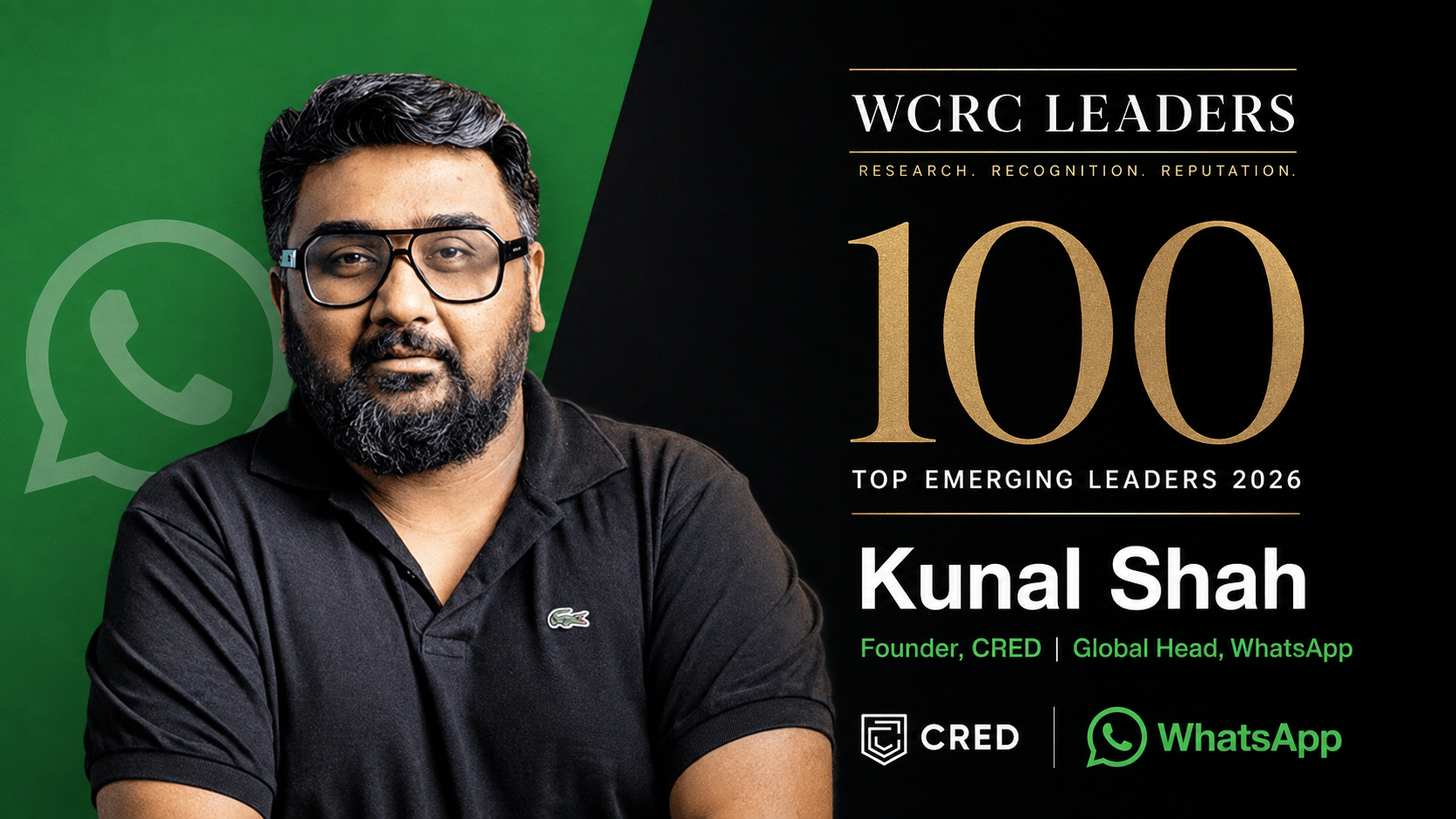
Kunal Shah: The Philosophy Graduate Who Built Trust Into a Business Model — and Why WCRC Ranks Him No. 7 in Asia
A philosophy graduate from Wilson College, a ₹2,800-crore FreeCharge exit, CRED's contrarian trust thesis held through a brutal valuation correction — and now the global helm of WhatsApp. Behind an Innovation Score of 96.
636/700
Composite score
96
Innovation Score
No. 7
Asia rank 2026
250+
Angel investments
Editor's note: WCRC's Asia Top 100 Emerging Leaders 2026 research, published in August 2026, lists Kunal Shah as “Founder & CEO, CRED.” On June 22, 2026, Meta announced Shah would step down as CRED's CEO to become the global head of WhatsApp, succeeding Will Cathcart, alongside a $900 million Meta investment in CRED. This piece reflects that more recent development.
Most fintech founders in India's startup canon come from IIT or IIM. Kunal Shah's degree is in philosophy, from Wilson College in Mumbai — and if there's a throughline across his three-decade career, it's that he's treated business as applied philosophy about what people actually value, more consistently than most founders treat it as engineering. WCRC's Asia Top 100 Emerging Leaders 2026 research has scored him 636 out of 700, seventh overall in a field of 847 qualified candidates across 18 nations, with an Innovation Score of 96.
Working at Fifteen, Building by Instinct
Shah was born in Mumbai on May 30, 1979, to a family running a small wholesale pharmaceutical distribution business in South Bombay — a detail that separates his origin story from the more privileged backgrounds common among India's startup founders. He began working at fifteen to help his family through a financial crisis, continuing through his undergraduate years with freelance design and programming gigs. He studied philosophy at Wilson College, later enrolling in a part-time MBA at Mumbai's Narsee Monjee Institute of Management Studies, which he dropped out of before finishing.
His first venture, PaisaBack, launched in 2009 as a cashback and promotional discount platform for retailers. It didn't stay a standalone business for long — the concept evolved directly into FreeCharge, which Shah co-founded with Sandeep Tandon in 2010, offering mobile recharge with discount coupons attached. FreeCharge became one of the defining products of India's first digital payments wave, eventually acquired by Snapdeal in April 2015 in a deal reported around ₹2,800 crore — one of the marquee startup exits of that era. Shah stayed on running FreeCharge under Snapdeal's ownership before exiting in October 2016; Axis Bank later acquired the business outright in 2017.
A Contrarian Bet: Build for the Top, Not the Masses
After FreeCharge, Shah spent roughly two years as an active angel investor — a role he'd continue at scale for the rest of his career, eventually backing more than 250 startups including Razorpay, BharatPe, and Unacademy — before founding CRED in 2018. The premise ran directly against the dominant logic of Indian fintech at the time, which was chasing financial inclusion for underbanked, first-time digital users. CRED did the opposite: an invite-only platform for India's highest-credit-score population, rewarding them for paying credit card bills on time, in a market where nearly every competitor was fighting for volume among users with far less spending power.
It was, by Shah's own account and by that of early investors, a difficult thesis to underwrite. The product had no clear near-term path to profitability, and the customer base — people who already had good credit and paid their bills anyway — seemed to some observers like a solution without a problem. Sequoia, Ribbit Capital and GIC backed it early regardless, largely on the strength of Shah's FreeCharge track record and his broader thesis that trust, not access, was India's scarcest resource in financial services. CRED reached unicorn status in April 2021, less than three years after founding, and became known as much for high-profile, culturally-tuned advertising — including a run as IPL title sponsor — as for its underlying product.
The Long Road to Profitability
CRED's financial story through the mid-2020s tracked the arc familiar to a lot of consumer fintech from that era: rapid valuation growth followed by a hard correction. The company peaked at a $6.4 billion valuation in a 2022 funding round, before adjusting down to $3.5 billion by May 2025 and, by some internal marks, as low as $1.2 billion in December 2025. Revenue kept growing through that stretch regardless — FY2024 revenue rose 66% year-on-year to roughly ₹2,473 crore, and FY2025 consolidated operating revenue reached approximately ₹2,735 crore, a 16% increase, with operating losses cut by 51% to around ₹298 crore. By early 2026, CRED reported its first profitable quarter, covering January through March — a real milestone for a company that had spent years being characterized, not entirely unfairly, as a high-burn brand play rather than a sustainable business.
Shah's own public response to the valuation swings was notably unbothered in tone. Speaking to Forbes India in mid-2025, as CRED's valuation was being marked down, he argued that valuation is “a point-in-time view” and that the more durable measures are revenue, profit and growth — a framing that reads less like founder spin and more like the same philosophy-first instinct that shaped CRED's original contrarian bet: optimize for what's actually true over time, not for what looks good in a single funding round.
The WhatsApp Move
In June 2026, that steadiness got tested at a different scale entirely. Meta announced that Shah would succeed Will Cathcart as global head of WhatsApp — the messaging platform serving more than 3 billion users worldwide, including over 500 million in India, WhatsApp's largest single market. The appointment came bundled with a $900 million Meta investment in CRED, structured through primary and secondary share purchases, valuing the company at $4.5 billion post-money — a meaningful recovery from its late-2025 lows. Mark Zuckerberg framed the pick directly: Shah had built CRED into “one of India's most important technology companies” and brought the “builder mentality and global perspective” Meta wanted for WhatsApp's next phase, particularly around payments, commerce, and business messaging — three areas where Shah's fintech background maps directly onto what Meta is trying to build.
Shah stepped down as CRED's CEO, promoter, and board member as part of the transition, filings with India's Ministry of Corporate Affairs confirmed, while retaining his personal shareholding in the company — one of the more significant governance handoffs in Indian fintech's recent history, and a rare case of an Indian founder moving directly into a top global operating role at a Big Tech company rather than the more familiar reverse pattern of Big Tech executives moving into Indian startups.
What WCRC's Data Adds
WCRC's Asia Top 100 Emerging Leaders framework scores candidates across seven parameters — Vision Quotient, Impact Index, Innovation Score, People Leadership, Stakeholder Trust, Resilience Factor and Global Mindset — applied through a five-stage process of nomination, eligibility screening, independent evaluator scoring, editorial panel review and final verification.
Shah's standout figure is an Innovation Score of 96. WCRC's own citation credits him with redefining trust-based commerce in India, building a platform whose brand equity exceeded its transaction volumes — a description WCRC attributes to a philosophical approach to product-market fit and what it calls contrarian thinking. That framing holds up well against the record: a founder who built a company premised on rewarding people for a behavior — timely bill payment — they were mostly already going to do, on the theory that trust itself could be the product, and stuck with that thesis through a punishing valuation correction until the underlying business proved it out.
The Company He's Keeping
Shah sits within WCRC's Indian Subcontinent cohort — 46 of the 100 ranked leaders this year, the largest of the three sub-regions, dominated by founder-led fintech and consumer stories. His immediate company includes Razorpay's Harshil Mathur (rank 4, 641/700) and Zerodha's Nikhil Kamath (rank 9, 635/700) — both companies Shah has personally invested in as an angel, placing him in the unusual position of appearing in the same ranking as founders he's also backed financially.
What separates his entry in the cohort, as of mid-2026, is that his listed company is no longer the platform he's actively running day to day. Most founders in this ranking are scored on decisions they're still making. Shah's WCRC score reflects a body of work — FreeCharge, then CRED's contrarian thesis and its slow, hard-won turn to profitability — that was largely complete by the time the ranking published, with his attention already redirected toward a messaging platform two orders of magnitude larger than anything he'd built before.
The Throughline
Strip away the philosophy-graduate framing and what's left is a career built on a consistent, slightly perverse instinct: build for the segment everyone else is ignoring, on a thesis about human behavior rather than a spreadsheet, and hold that thesis through periods when the market actively disagreed with it — a mobile recharge platform that became a payments company, a credit rewards app built for people who didn't obviously need rewarding, sustained through a 2025 valuation correction that would have spooked a lot of founders into pivoting. WCRC's 636-point score and its 96 in Innovation are measuring that pattern up through CRED's turn to profitability. What comes next is a different scale of bet entirely — one Meta is now underwriting directly.