Leadership · Asia Top 100 Emerging Leaders 2026
The Publisher Who Turned a Reading Habit Into a Free Trade Zone — and Why WCRC Ranks Her No. 3 in Asia
From a children's publishing house in Sharjah to the world's first publishing free trade zone — how Sheikha Bodour Al Qasimi built an interlocking set of institutions.
657/700
Composite score
98
Global Mindset (cohort high)
No. 3
Asia rank 2026
28
Gulf leaders ranked
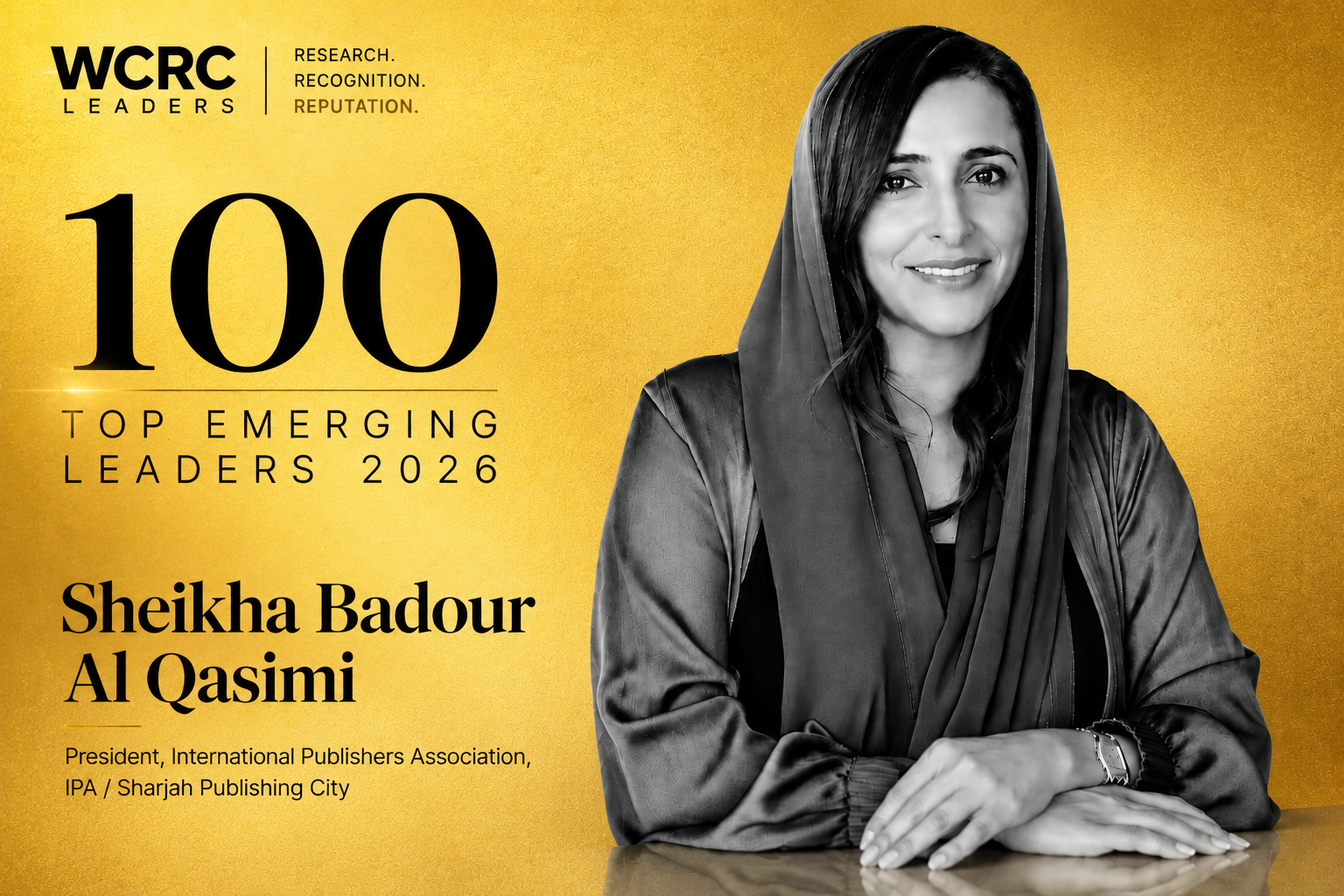
Most people who love books end up with a well-stocked shelf. Sheikha Bodour Al Qasimi ended up with a free trade zone. WCRC's Asia Top 100 Emerging Leaders 2026 research has scored her 657 out of 700 — third overall in a field of 847 qualified candidates across 18 nations, and the highest Global Mindset score in the entire cohort, at 98. The number is a fair proxy for what she's actually built: not a single institution, but an interlocking set of them, each one designed to make Sharjah's cultural ambitions durable rather than ceremonial.
Starting With a Children's Publishing House
Al Qasimi was born in Sharjah in 1978, into the emirate's ruling family — her father is Sheikh Sultan bin Muhammad Al Qasimi, the Ruler of Sharjah, whose own decades-long cultural project has shaped much of the emirate's identity. But her career didn't begin with an inherited title. It began in 2007, when she founded Kalimat Group, the UAE's first publishing house dedicated solely to Arabic-language children's books.
That starting point matters more than it might first appear. Arabic children's publishing in the Gulf at the time was a thin market — dominated by translated or imported content, without much infrastructure for original Arabic-language storytelling aimed at young readers. Kalimat didn't just fill a gap; it built toward one, eventually expanding through the Kalimat Foundation into inclusive-reading initiatives across more than 30 countries, including accessible publishing for children with visual impairments and outreach programs in refugee and crisis-affected communities. That combination — a commercial publishing house paired with a foundation doing harder, less profitable outreach work — became a template she'd repeat at larger and larger scales.
In 2009, she founded the Emirates Publishers Association, which gained full membership in the International Publishers Association in 2012. It was a deliberate piece of institution-building: an industry body that gave UAE publishers formal standing in the global conversation, rather than leaving them to operate individually and invisibly.
First Arab Woman to Lead a 125-Year-Old Institution
That groundwork paid off in November 2020, when Al Qasimi was appointed President of the International Publishers Association — becoming the first woman from the Arab world, and only the second woman in the organization's history, to hold the position since its founding in Paris in 1896. She'd served as IPA Vice President since 2018, elected to the role two years before taking the top job, which meant the presidency arrived as a continuation of work already underway rather than a surprise elevation.
Her term, running from January 2021 through late 2022, landed squarely in the publishing industry's pandemic-era reckoning. She used the position to focus on recovery and resilience in a sector that had been hit hard by closures and supply chain disruption, and launched InSPIRe, a global industry dialogue platform intended to keep publishers talking to each other across borders during a period when in-person industry gatherings had largely stopped. It was, in a sense, the same instinct that built Kalimat and the Emirates Publishers Association — treating a market weakness as an infrastructure problem to be solved, not just weathered.
Her IPA tenure also arrived after years spent positioning Sharjah itself on the global publishing map. She chaired the advisory committee that helped secure Sharjah's selection as UNESCO World Book Capital 2019, a designation that doesn't get awarded on cultural sentiment alone — it requires a demonstrated infrastructure of festivals, literacy programs, and institutional commitment, the kind of groundwork she'd already been laying for a decade.
From Publishing House to Free Trade Zone
Where Al Qasimi's record moves from notable to genuinely unusual is what happened after the IPA presidency ended. In January 2023, she was appointed Chairperson of the Board of Trustees and President of the American University of Sharjah, putting a publisher and cultural executive in charge of a research university — a mandate to strengthen the institution's regional and global research standing and its focus on gender equality, including establishing the Sheikha Jawaher bint Mohammad Al Qasimi Endowed Chair in Women's Leadership in 2024, the first of its kind in the UAE.
Then, in May 2023, she was appointed Chairperson of the Sharjah Book Authority, the body that runs the Sharjah International Book Fair — now the world's largest book fair by attendance, drawing over 1.4 million visitors from 206 countries in its 44th edition — and operates Sharjah Publishing City, the world's first free trade zone built specifically for the publishing industry. That's the detail that separates her from most cultural executives: a free trade zone is a piece of economic infrastructure, with tax and regulatory design behind it, not a festival or a prize. It reframes publishing as an industry to be built rather than a cultural activity to be subsidized.
She holds a comparable set of roles across Sharjah's economic institutions: Chairperson of the Sharjah Research, Technology and Innovation Park, overseeing a $150 million push into emerging technology fields; Chairperson of the Sharjah Investment and Development Authority, where her work has been credited with mobilizing more than $4 billion in foreign direct investment and creating over 20,000 jobs; and Chairperson of the Sharjah Entrepreneurship Center, which has supported 150 startups that have collectively raised $128 million. In 2025, UNESCO named her a Goodwill Ambassador for Education and Book Culture, extending her institutional reach from Sharjah's own economy into global cultural diplomacy.
What WCRC's Data Adds
WCRC's Asia Top 100 Emerging Leaders framework scores candidates across seven parameters — Vision Quotient, Impact Index, Innovation Score, People Leadership, Stakeholder Trust, Resilience Factor and Global Mindset — applied through a five-stage process of nomination, eligibility screening, independent evaluator scoring, editorial panel review and final verification.
Al Qasimi's standout figure is a Global Mindset score of 98, the highest recorded anywhere in the 2026 cohort. WCRC's own citation frames her achievement as transforming Sharjah into a UNESCO World Book Capital and positioning the emirate as the Arab world's intellectual publishing hub — describing it as a feat requiring diplomatic, cultural, and commercial leadership simultaneously. That's a fair summary of a career that moves fluidly between a children's book imprint, a 125-year-old international trade body, a research university, a free trade zone, and a UNESCO ambassadorship, without any of those roles reading as a departure from the others. They're the same project, worked at different scales.
The Company She's Keeping
Al Qasimi sits within WCRC's Gulf Region cohort — 28 of the 100 ranked leaders this year, a group the research frames as bringing sovereign scale and global ambition to whatever domain its members enter. Her nearest company includes Omar Sultan Al Olama, the UAE's Minister of State for Artificial Intelligence (rank 2, 651/700), and Sara Al Madani, chairwoman of the Sharjah Chamber of Commerce (rank 6, 654/700) — a cluster of leaders whose common thread is institution-building at government or quasi-government scale, rather than product launches or funding rounds.
What distinguishes her within even that group is the range of institution types involved. Most leaders in the Gulf cohort operate within a single domain — a ministry, a sovereign fund, a bank. Al Qasimi's portfolio spans publishing, higher education, technology innovation, investment promotion, and entrepreneurship support, unified only by the fact that all of it runs through Sharjah and all of it traces back to the same instinct that founded Kalimat in 2007: that a cultural gap is also an infrastructure gap, and infrastructure gaps get closed by building institutions, not by hoping the market notices on its own.
The Throughline
Strip away the “first Arab woman” headlines — genuine and significant as they are — and what's left is a career built on a consistent method: identify an underbuilt niche, found or lead the institution that fixes it, and then use the credibility from doing that well to take on the next, larger one. A children's publisher becomes an industry association; the association becomes an IPA vice presidency, then a presidency; the presidency's cultural capital becomes a university chairmanship, a book authority, a free trade zone, an investment agency, an entrepreneurship center. WCRC's 657-point score and its record 98 in Global Mindset aren't measuring one achievement. They're measuring the accumulated weight of roughly two decades spent turning the same instinct into an increasingly large set of institutions.