Leadership · Asia Top 100 Emerging Leaders 2026
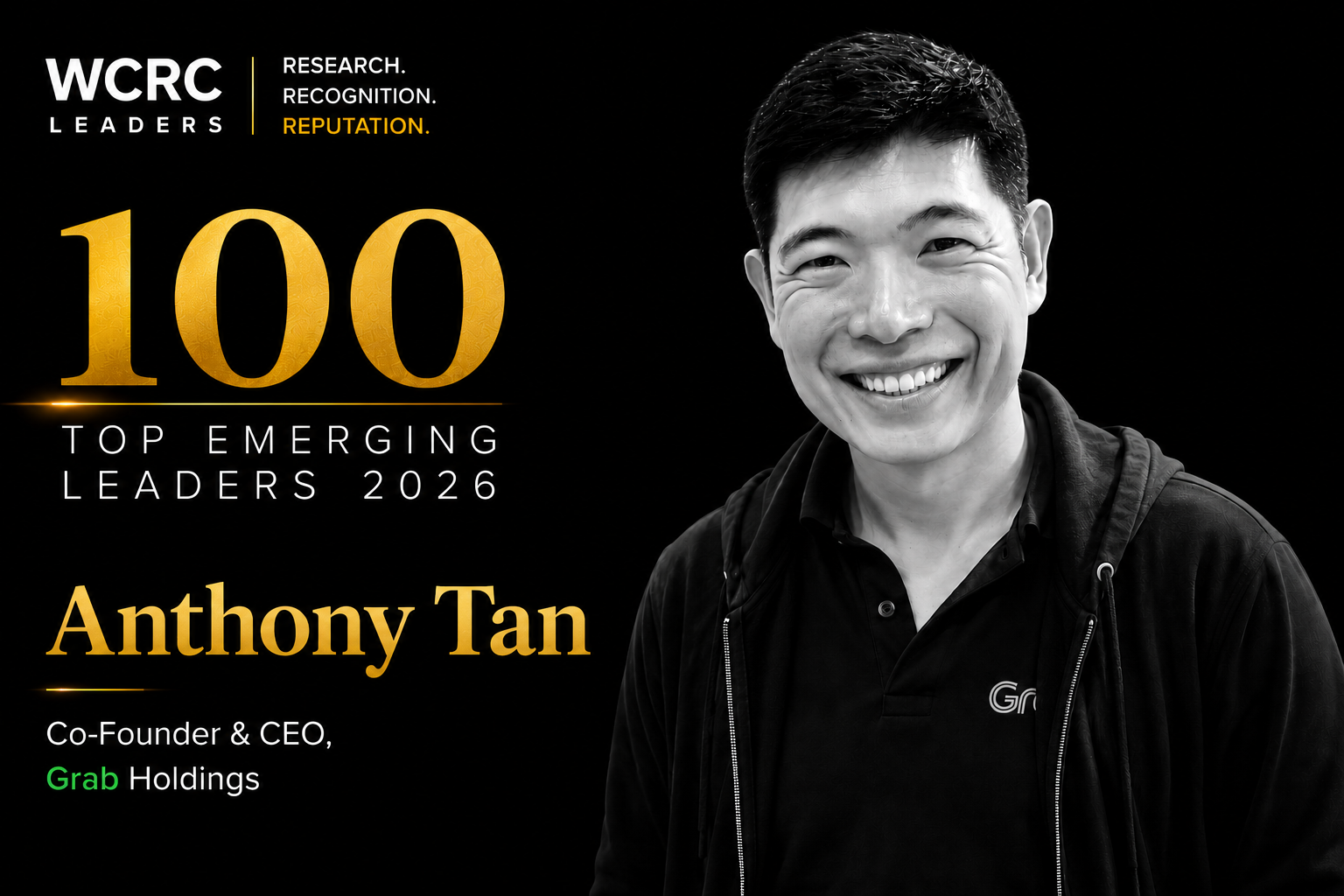
Anthony Tan: The Taxi App That Became Southeast Asia's Financial Rail — and Why WCRC Ranks Him No. 5 in Asia
A Harvard class project on Malaysia's taxi industry became a super-app spanning eight countries — and a 97 Global Mindset score, among the highest in the cohort.
655/700
Composite score
97
Global Mindset
No. 5
Asia rank 2026
8
Countries served
Most super-app founders in Southeast Asia have a version of the “started with one problem” story. Anthony Tan's is unusually literal: a business school case study on Malaysia's badly run taxi industry, written for a class assignment, that he decided to actually go and fix. WCRC's Asia Top 100 Emerging Leaders 2026 research has scored him 655 out of 700, fifth overall in a field of 847 qualified candidates across 18 nations — with a Global Mindset score of 97, among the highest in the entire cohort, credited to fluency across the region's regulatory and cultural diversity.
An Automotive Family, an Economics Degree, and a Class Project
Tan was born in Kuala Lumpur in 1982, the youngest of three brothers, to Tan Heng Chew, president of the automotive conglomerate Tan Chong Motor Holdings, and Rosie Tan. He studied Economics and Public Policy at the University of Chicago, graduating in 2004, and worked in his family's business afterward as Head of Supply Chain and Marketing at Tan Chong Group — a role focused on logistics and brand-building for the group's automotive lines, not technology.
It was during his MBA at Harvard Business School, between 2009 and 2011, that the idea for what would become Grab took shape — reportedly as a class project examining the dysfunction of Malaysia's taxi industry: unsafe rides, unreliable bookings, drivers with no efficient way to find fares. Tan co-founded the company with Tan Hooi Ling, a fellow Harvard MBA student who'd previously worked as a business analyst at McKinsey. In June 2012, the two launched MyTeksi in Kuala Lumpur — a straightforward taxi-booking app aimed at fixing exactly the problem the class project had identified.
From MyTeksi to a Regional Platform
The company renamed itself GrabTaxi in 2013 and then simply Grab in 2016, relocating its headquarters to Singapore as it expanded beyond Malaysia. What followed was a decade of steady geographic and product expansion: ride-hailing first, then GrabFood and grocery delivery, then GrabPay and a broader digital financial services arm now spanning lending and insurance. By the mid-2020s, Grab was operating across eight Southeast Asian countries — Singapore, Malaysia, Indonesia, Thailand, Vietnam, the Philippines, Cambodia, and Myanmar — serving more than 900 cities and over 50 million monthly transacting users through a single app.
The company went public on Nasdaq in December 2021 via a SPAC merger with Altimeter Growth Corp, at a roughly $40 billion valuation — Southeast Asia's largest-ever public listing at the time, and the culmination of Grab's status as the region's first unicorn. The debut wasn't smooth: shares fell more than 70% in the four months following the listing, hit by a 44% quarterly revenue decline and a $1.1 billion quarterly loss reported that March. It's the kind of stretch that ends a lot of founder tenures. Tan stayed, and the company's more recent numbers tell a different story than that early period suggested: in 2025, Grab posted its first full-year net profit, $200 million on $3.37 billion in revenue, up 20% year-over-year, alongside a $500 million share buyback program and management guidance of $700–720 million in adjusted EBITDA for 2026.
Expanding the Playbook Past Southeast Asia
In March 2026, Grab announced a $600 million deal to acquire Foodpanda's Taiwan operations — its first expansion outside Southeast Asia, set to complete in the second half of 2026 with a full platform migration by early 2027. Tan framed it as exporting a playbook rather than entering unfamiliar territory: “our experience in Southeast Asia is a direct fit for this market... our longstanding expertise in managing complex delivery logistics for dense and high-traffic cities is well-suited for Taiwan.” Analysts described it as a natural next step for a company that had spent close to a decade dominating ride-hailing and delivery competition against both domestic rivals and global entrants like Uber, holding a 55% regional market share by the mid-2020s.
The bigger structural story running through 2025 and 2026, though, has been the long-rumored merger between Grab and Indonesia's GoTo Group — a deal that would combine the two dominant Southeast Asian super-apps and, by some estimates, create a company controlling over 90% of Indonesia's ride-hailing and delivery market. Talks have moved in fits and starts for years, complicated by Indonesian government resistance to majority foreign ownership of a domestic strategic asset. By late 2025, that resistance had reportedly softened, with reports that Indonesia's sovereign wealth fund Danantara was in discussions to take a “golden share” in a combined entity — a structure that would preserve Indonesian government influence over the merged company's local operations while allowing the deal to proceed. Tan reportedly met directly with Indonesian President Prabowo Subianto to lobby for the transaction, and GoTo's own leadership changed hands in the run-up to a shareholder meeting widely read as merger-related preparation. As of mid-2026, the deal remained unresolved but live — the kind of protracted, government-entangled negotiation that rarely features in a typical startup growth narrative, and one Tan has stayed personally engaged in rather than delegating to deal teams.
What WCRC's Data Adds
WCRC's Asia Top 100 Emerging Leaders framework scores candidates across seven parameters — Vision Quotient, Impact Index, Innovation Score, People Leadership, Stakeholder Trust, Resilience Factor and Global Mindset — applied through a five-stage process of nomination, eligibility screening, independent evaluator scoring, editorial panel review and final verification.
Tan's standout figure is a Global Mindset score of 97. WCRC's own citation credits him with building Southeast Asia's most consequential technology company — a super-app spanning ride-hailing, food delivery, payments, and healthcare across eight countries — and attributes the score specifically to fluency across the region's extraordinary cultural and regulatory diversity. That's a fitting description of what the GoTo negotiations alone have required: operating simultaneously as a Nasdaq-listed public company answerable to US securities regulators and as a negotiating partner navigating Indonesian sovereign-fund politics, driver-welfare regulation, and presidential-level lobbying — sometimes in the same news cycle.
It also captures something about the shape of Grab's growth generally. Unlike single-market or single-product founders, Tan has had to build one platform that works across eight countries with different regulatory regimes, currencies, and driver-economy structures, then extend that same operating model into a ninth market, Taiwan, that shares none of the same regulatory scaffolding. Doing that without the platform fragmenting into eight local variants is, in itself, a governance and design achievement as much as a growth one.
The Company He's Keeping
Tan sits within WCRC's Southeast Asia cohort — 26 of the 100 ranked leaders this year, a region the research frames as forging “a new model of connected, platform-native leadership” where super-apps, sovereign funds, and social enterprise converge. His nearest company includes Gojek co-founder Kevin Aluwi (rank 10, 647/700) — notably, the executive who led Grab's principal domestic rival through its own merger into GoTo — and Sea Limited's Forrest Li (rank 14, 649/700), builder of the region's other major three-in-one platform spanning gaming, e-commerce, and digital finance.
That places Tan directly alongside the leaders of the ecosystem's other dominant platforms, in a region where the biggest strategic moves of the mid-2020s have been about consolidation as much as expansion — Grab-GoTo the most consequential pending example. WCRC's framework rewarding Global Mindset above other parameters for Tan specifically suggests the research reads that consolidation-era complexity, not just Grab's original growth story, as the leadership challenge actually being tested right now.
The Throughline
Strip away the “Southeast Asia's first unicorn” framing and what's left is a fairly specific story: an economics graduate from an automotive family who turned a business school case study into a functioning fix for a real regional problem, weathered a punishing post-IPO stock collapse without stepping back, got the company to its first full year of profit fourteen years after founding it, and spent the years since managing an international expansion and a politically fraught regional consolidation simultaneously. WCRC's 655-point score and its 97 in Global Mindset aren't measuring the founding story. They're measuring what it's taken to keep one platform coherent across eight countries, a ninth in progress, and a merger that's spent a year moving through the office of Indonesia's president.