


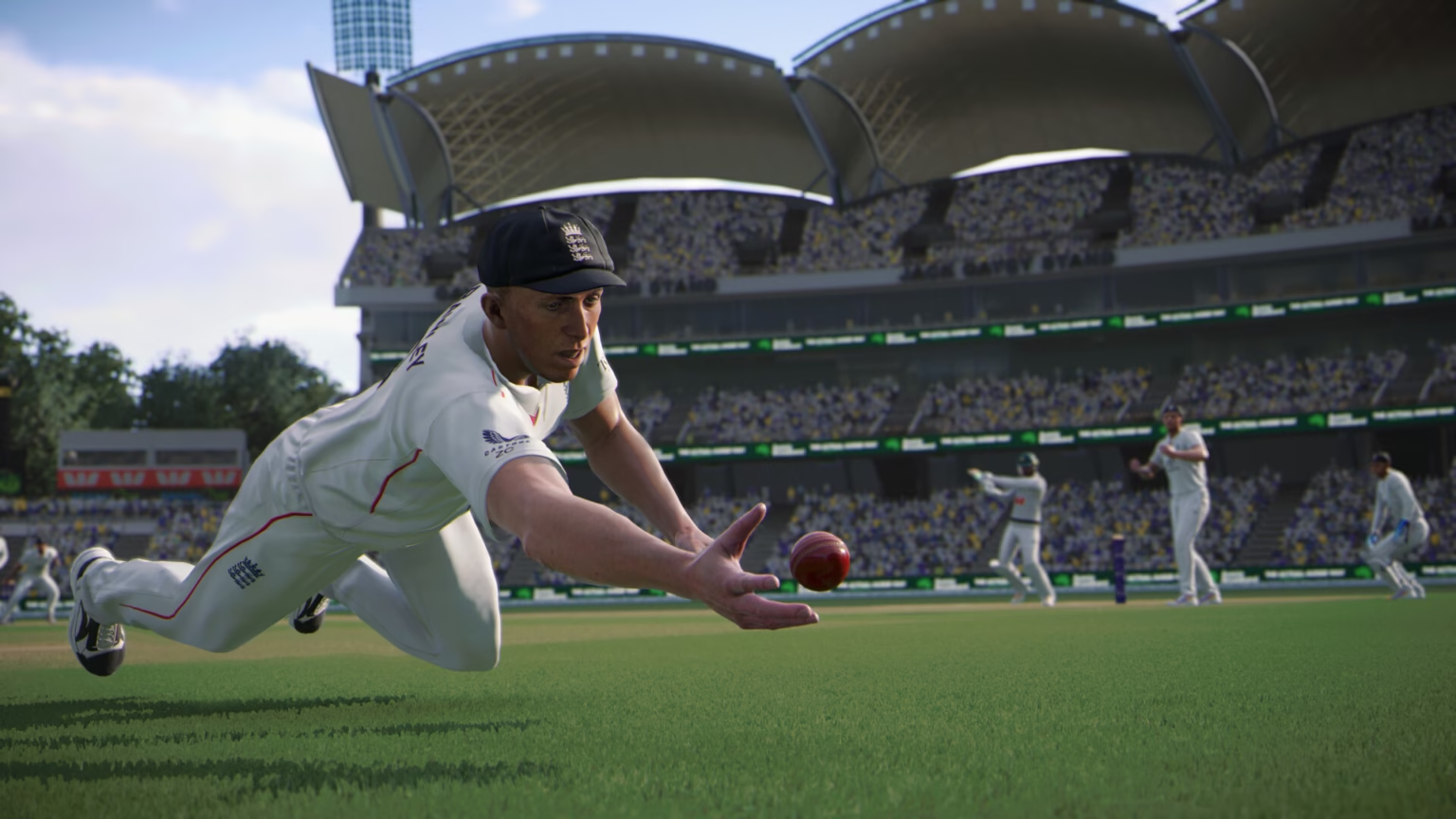

How Big Ant Studios Took One Step Forward and Three Steps Back
Based on direct feedback from over 50 dedicated online gamers who have lived through every patch, every broken promise, and every fleeting moment of hope, we present the unvarnished truth about Cricket 26 after Patches 84 and 85. The verdict is neither simple nor kind.
- How Big Ant Studios Took One Step Forward and Three Steps Back
- The Good News: Progress Has Been Made
- The Bad News: Fielding Has Become a Nightmare
- Slow Boundary Fielders: Free Runs for Everyone
- Infielders Who Cannot Hit the Target
- Semi-Assist Fielding: No Power, All Frustration
- The Wicketkeeper: A Total Dummy
- The Exception That Proves the Rule
- A Game Away from Reality
- What Gamers Actually Want
- The Casual and Competitive Divide
- The Loyalty Question
- The Clock Is Ticking
- Voices from the Community
- The Bottom Line
The Good News: Progress Has Been Made
Let us acknowledge what has genuinely improved. After months of community outcry, Big Ant Studios has finally addressed some of the most glaring issues:
Shot power is now more balanced. Batters can generate appropriate force based on timing and footwork. The days of backfoot defensive strokes sailing for six are largely behind us.
Ball spotting has improved tremendously. Players can actually read deliveries with some consistency. The premeditation prison that defined earlier patches has been partially dismantled.
Wide line dynamics have been adjusted. While not perfect, the endless spamming of unplayable outswingers has been somewhat curtailed.
These improvements matter. They represent progress. The game is closer to being functional than it was during the disaster of Patch 80. But here’s the cruel truth: fixing some problems has only highlighted how broken others remain.
The Bad News: Fielding Has Become a Nightmare
If shot power and ball spotting have improved, the fielding mechanics have descended into absolute farce. What we have now is not cricket—it’s a slow-motion comedy of errors that makes a mockery of the sport.
Slow Boundary Fielders: Free Runs for Everyone
In fully assisted fielding, boundary fielders throw with the urgency of pensioners tossing a beach ball. The ball travels so slowly that any batter with working eyes knows they can easily take two, sometimes three runs. There is no risk. There is no tension. There is only the knowledge that the fielder will lob the ball back with all the velocity of a dying star.
One player described it perfectly: “I take extra runs now not because I’m brave, but because I’m bored. The fielder might as well be mailing the ball back.”
Infielders Who Cannot Hit the Target
Infielders in fully assisted mode miss their targets with alarming regularity. Simple throws to the keeper or bowler end up anywhere but the intended destination. This isn’t challenging; it’s just broken. Batters steal cheap singles knowing that the throw will likely miss, and even if it hits, the keeper or fielder will be too slow to do anything about it.
Semi-Assist Fielding: No Power, All Frustration
Switch to semi-assist fielding, hoping for more control, and you’re greeted with a different flavor of broken. Fielders have no power behind their throws. The ball trickles in while batsmen run freely. Most infuriating is when a fielder fields the ball cleanly, stops, and simply… stands there. No throw. No urgency. Just a pause that says “I’ve done my part” while the batsmen collect easy runs.
“The entire engine feels like a joke,” one league veteran told us. “I’ve played cricket games for twenty years. I’ve never seen fielding this bad. Never.”
The Wicketkeeper: A Total Dummy
Perhaps the most egregious failure is the wicketkeeper. In a sport where the keeper is arguably the most active fielder, Cricket 26 has reduced this position to a decorative placeholder.
Edges fly past slips and gully with impunity. The keeper doesn’t react. Doesn’t dive. Doesn’t even seem to register that the ball has been hit. Edges that should be chances become boundaries. Bowlers who have beaten the bat are rewarded with runs rather than wickets.
Stumping opportunities are non-existent. The keeper is so slow to react to missed shots that batsmen can stumble out of their crease, reconsider, and wander back before the keeper even thinks about collecting the ball.
Run-out chances are routinely botched. Throws come in, and the keeper is either late to the stumps or positioned incorrectly. The result is a bowling experience that feels utterly rewardless.
“I’ve stopped caring about beating the bat,” one bowler told us. “What’s the point? Even if I get an edge, it’s going to the boundary. Might as well bowl straight and hope for LBW.”
The Exception That Proves the Rule
The only situation where edges occasionally carry is on extreme wide line bowling—the very tactic the community has been begging to be nerfed. This creates a perverse incentive: if you want your bowling to have any chance of producing wickets, you must exploit the same broken mechanics that make the game unrealistic.
This is not design. This is dysfunction.
A Game Away from Reality
Big Ant Studios set out to create a realistic cricket simulation. What they have delivered, after 85 patches, is a game that increasingly resembles cricket in name only.
Real cricket has:
- Fielders who throw with urgency and accuracy
- Wicketkeepers who react to edges
- Tension between bat and ball where both sides have chances
- Rewards for good bowling and good batting
Cricket 26 has:
- Slow motion throws that gift extra runs
- A keeper who might as well be sitting in the stands
- Bowling that feels pointless because edges don’t carry
- A system where the only reliable wicket-taking method is exploiting wide lines
This is not simulation. This is torture.
What Gamers Actually Want
The feedback from over 50 online gamers is consistent and clear: a game needs to be tough yet balanced and rewarding. Nobody wants a cakewalk. Nobody wants guaranteed wickets or guaranteed runs. What players want is a contest where skill matters, where good play is rewarded, and where broken mechanics don’t decide the outcome.
Cricket 26 with every patch has gotten more ridiculous. The improvements to shot power and ball spotting are genuine achievements, but they have been undermined by fielding so broken that it renders the entire experience frustrating.
The Casual and Competitive Divide
Whether you’re a casual player facing AI or a competitive warrior in online leagues, the experience is the same: nobody likes these kinds of errors in a fast-paced world of cricket.
Casual players want immersion and fun. Watching a fielder slowly lob the ball while batsmen run three breaks immersion. Competitive players want fairness and consistency. Watching a wicketkeeper ignore an edge breaks competitive integrity.
Big Ant has managed to disappoint both audiences simultaneously—a remarkable achievement in failure.
The Loyalty Question
Cricket 26 from Big Ant Studios will remain the most disappointing game from this franchise. That is not hyperbole; it is the consensus of the community that has supported this studio through thick and thin.
The players who stuck around through Patch 80, who celebrated Patch 79, who hoped against hope that Patches 84 and 85 would finally deliver—these players are now exhausted. They are not angry in the way that temporary frustration produces anger. They are disappointed in the way that long-term betrayal produces disappointment.
And disappointment, unlike anger, does not fade. It accumulates. It transforms loyalty into memory.
The Clock Is Ticking
It is only a matter of time before Big Ant Studios loses these gamers entirely. Not temporarily. Not until the next patch. Permanently.
When players who have been here since Cricket 16 start talking about quitting, when league organizers stop organizing, when content creators stop creating—that’s not a dip. That’s a death spiral.
The loyalty that took years to build can be destroyed in months. Big Ant is learning this lesson in real-time.
Voices from the Community
“I’ve played every cricket game since 2005. I’ve never seen fielding this bad. Never. The keeper is a statue. The fielders throw like they’re underwater. It’s torture.” — Raj, Mumbai, player since Cricket 07
“Shot power is better now. Ball spotting is better. I should be happy. But I’m not, because every time I beat the bat, the ball flies to the boundary while my keeper watches. What’s the point?” — Hassan, Lahore, league player for 8 years
“I took three runs today because the boundary fielder threw the ball so slowly my grandmother could have run them. She’s been dead for a decade. That’s the state of this game.” — Mitchell, Sydney, tournament organizer
“The game is torture. Genuine torture. I want to love it. I want to play it. But every session ends in frustration because of things that have nothing to do with my skill.” — James, London, content creator
“Big Ant had a chance. They improved the right things. But they broke fielding so badly that none of it matters. This game will be remembered as the one that killed the franchise.” — Arjun, Delhi, competitive player
The Bottom Line
Cricket 26 after Patches 84 and 85 is a study in contradiction. Parts of it work better than ever. Shot timing. Ball spotting. These are genuine improvements worthy of praise.
But fielding—the thing that happens on every single ball, the thing that determines whether bowling feels rewarding, the thing that creates tension in every run chase—fielding is worse than it has ever been.
A game with good batting and broken fielding is not a good game. It is a frustrating game. It is a torture game.
Big Ant Studios: you are so close to fixing this. The shot power work proves you can do it. The ball spotting improvements prove you can listen. Now apply that same focus to fielding. Fix the keeper. Fix the throws. Fix the reactions.
Until then, Cricket 26 will remain what it has always been: the most disappointing game in this franchise’s history, played by increasingly unhappy loyal gamers who remember when cricket games were actually fun.